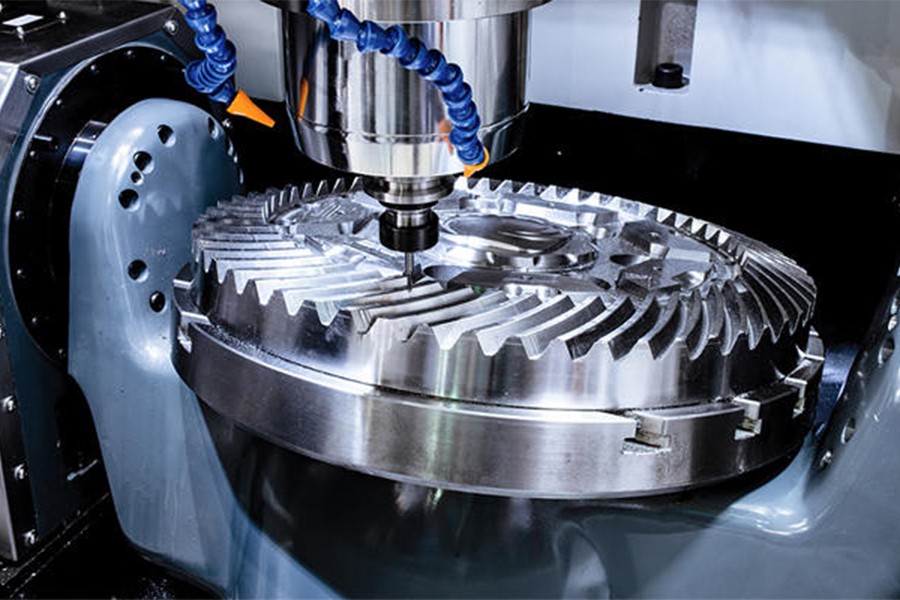
A CNC milling machine is a machine tool in which the cutting tool rotates at high speed while the workpiece is clamped to the table and machined under computer control. It operates on the exact opposite principle of a lathe: in a lathe, the workpiece rotates, while in a milling machine, the cutter rotates. It is the primary machine used for producing flat surfaces, grooves, pockets, and complex three-dimensional shapes.
When you see a bracket, a body part, a mold, or an angular fastener, it has most likely been machined on a CNC milling machine. In this article, we explain how a CNC milling machine works, its main components, the difference between vertical and horizontal machining centers, and the types of operations it performs.
How does a CNC milling machine work?
The workpiece is first secured to the table; a vise or special clamping devices are used for this purpose. The cutting tool is mounted on the spindle and rotates at high speed. The machine moves along three basic axes to position the tool at the desired points on the workpiece: the two directions of the table’s horizontal plane (X and Y) and the tool’s vertical movement (Z).
The process proceeds as follows. The part’s 3D model is converted into toolpaths in CAD/CAM software, and a G-code program is generated. The operator secures the raw material to the table, loads the required tools into the tool magazine, and loads the program. When the machine starts running, the rotating tool penetrates the material in a controlled manner, machining surfaces, channels, and forms with micron-level precision. When multiple tools are required, the machine automatically changes them, allowing the machining process to continue uninterrupted.
The main components of a CNC milling machine
- Spindle: It is the main shaft that holds the cutting tool and rotates it at high speed.
- Table: It is the surface to which the workpiece is clamped; it moves in the X and Y directions.
- Tool magazine and automatic tool changer (ATC): It automatically switches teams based on the program's needs.
- Vise and clamping devices: It keeps the workpiece stable and vibration-free throughout the process.
- Control unit: It is the control unit that reads the G-code and controls all axes.
The difference between vertical and horizontal machining centers
CNC milling machines are generally divided into two main categories. Both perform the same function but excel in different applications.
Vertical machining center (VMC)
This is the type where the spindle is in a vertical position, meaning the tool moves down onto the workpiece from above. It is the most common type of CNC milling machine. It is easy to set up, suitable for a wide range of workpieces, and practical for machining single surfaces. Most prototyping, tooling, and general-purpose manufacturing is performed on vertical machining centers.
Horizontal machining center (HMC)
This is a type of machine where the spindle is in a horizontal position; the tool approaches the workpiece from the side. It is typically used in conjunction with a pallet system and a multi-face clamping fixture known as a “tombstone,” allowing the workpiece to be machined from multiple surfaces in a single setup. Thanks to the easy removal of chips by gravity, it is efficient for heavy chip removal and long-term mass production. It offers higher productivity than a vertical machining center for high-volume jobs.
In short: vertical machining centers are ideal for flexibility and single-part jobs, while horizontal machining centers are best suited for high-volume production runs and multi-sided parts.
What does the number of axes affect?
In milling machines, the number of axes determines the complexity of the geometry that can be machined. Three-axis machines are sufficient for flat surfaces and standard shapes. When the fourth and fifth axes are added, the part can be machined from different angles in a single setup; this opens the door to inclined surfaces, complex forms like turbine blades, and multi-faceted parts. We’ve covered this topic in detail in a separate article: The Difference Between 3-, 4-, and 5-Axis CNC Machines.
What operations are performed on a CNC milling machine?
A milling machine is a versatile machine tool; many operations can be completed in a single setup:
- Surface milling: Large flat surfaces are leveled and brought to size.
- Channel and pocket cutting: Holes, channels, and hollowed-out pockets are machined.
- Drilling, reaming, and tapping: Holes are drilled, the area is numbed, and the tooth is extracted.
- Profile and contour machining: The outer contours and specific shapes of the part are defined.
- Complex forms: Mold surfaces, cam profiles, and free-form geometries are machined.
- Socket and stud: Screw holes and center holes are drilled.
Which parts and materials are processed?
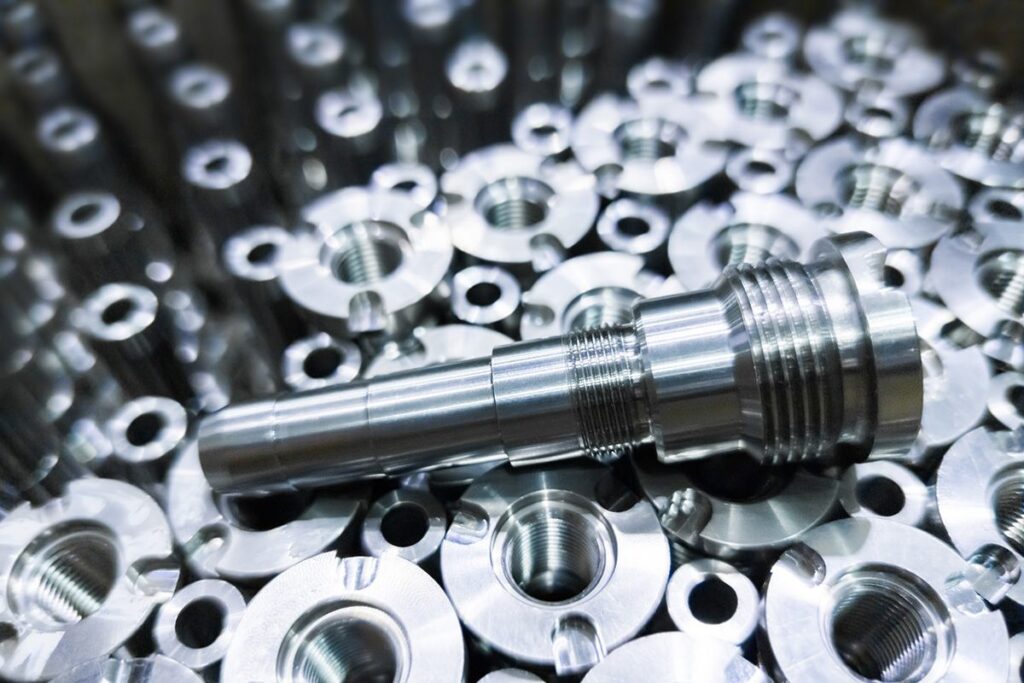
CNC milling is used primarily for prismatic and angular parts: brackets, body and housing components, plates, manifolds, molds, fixtures, and complex fasteners. In terms of materials, aluminum, steel, stainless steel, titanium, brass, copper, and engineering plastics can be easily machined. Cutting speed, tool selection, and cooling are determined separately for each material. We have covered the material side in a separate guide: Which Metals Can Be Machined Using CNC?.
The difference between a CNC milling machine and a lathe
Both machines remove material by cutting, but they are designed for different types of workpieces. On a lathe, the workpiece rotates and the tool moves along a fixed axis; therefore, it is suitable for cylindrical and conical parts (shafts, bushings, couplings). On a milling machine, however, the tool rotates while the workpiece remains stationary; it is used for flat surfaces, grooves, and complex shapes. The two machines often complement each other: the rotating part of a workpiece is machined on the lathe, while the angular part is machined on the milling machine. For a detailed comparison, What Is a CNC Lathe? and The Difference Between a CNC Lathe and a CNC Milling Machine You can check out our articles.
Frequently Asked Questions
What is a CNC milling machine used for? A CNC milling machine is used to produce flat surfaces, grooves, pockets, and complex three-dimensional shapes with high precision and repeatability. The production of prismatic parts such as brackets, housings, plates, and molds relies heavily on this machine.
What is the difference between a vertical and a horizontal machining center? In a vertical machining center, the tool moves from top to bottom; it is easy to set up and suitable for flexible operations. In a horizontal machining center, the tool approaches from the side; it is more efficient for multi-sided parts and high-volume production runs.
What tolerance does a CNC milling machine operate within? On a high-quality CNC milling machine, a tolerance of ±0.01 mm is standard. With additional precision machining and grinding, this can be reduced to the micron level—that is, ±0.005 mm or less.
What is the difference between a milling machine and a lathe? In milling, the tool rotates and the workpiece remains stationary; it is suitable for angular, flat, and complex shapes. In turning, the workpiece rotates; it is used for cylindrical parts. Both methods are often used together on the same workpiece.
What should I send for production? A technical drawing of the part (including dimensions and tolerances) or a 3D model (STEP/IGES) is sufficient. If you do not have a drawing, production can also be carried out using a sample part.
Would you like to have your prismatic and complex parts manufactured to tight tolerances? Send us your technical drawing; with our fleet of CNC milling machines and machining centers, we’ll provide a solution tailored to your needs, from prototyping to mass production. Get a Quote →