A CNC lathe is a machine tool in which the workpiece rotates at high speed while a cutting tool moves under computer control to remove material. “CNC” stands for Computer Numerical Control; in other words, all movements are controlled not by the operator but by a pre-programmed sequence. It is the primary machine for producing cylindrical and conical parts.
The next time you pick up a spindle, a bearing, or a coupling, it has most likely been machined on a CNC lathe. In this article, we explain how a CNC lathe works, its main components, the operations it performs, and how it differs from a conventional lathe.
How does a CNC lathe work?
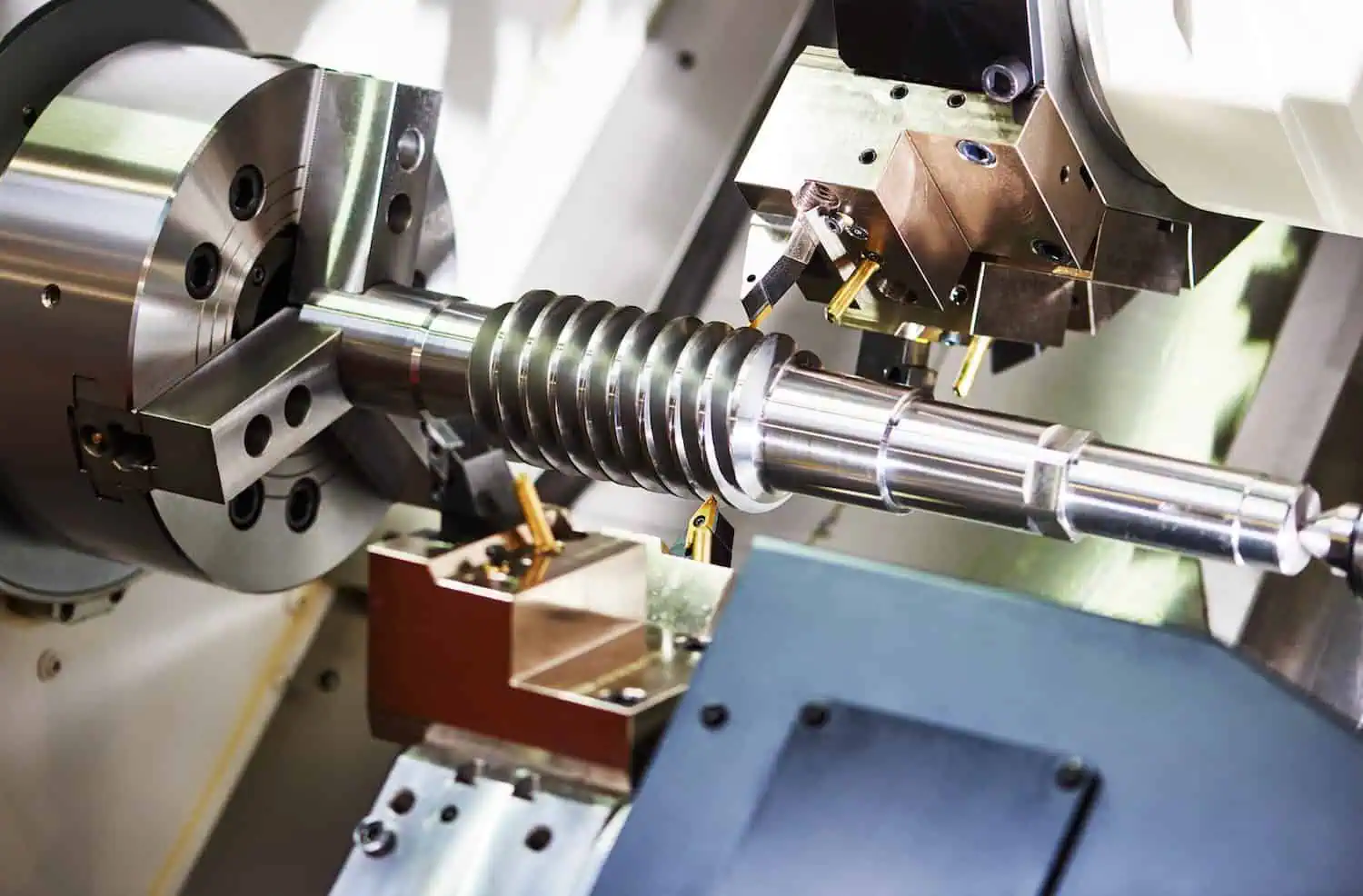
The operating principle is based on rotation. The workpiece is clamped into a holding device called a “chuck” and rotated at high speed by the spindle. The cutting tool is mounted on the turret and moves along two primary axes: along the workpiece axis (Z-axis) and perpendicular to the workpiece, i.e., in the direction that determines the diameter (X-axis).
The process works as follows, step by step. The part’s technical drawing is converted into toolpaths using CAD/CAM software, and a G-code program is generated. The operator secures the raw material to the chuck, loads the tools into the tool turret, and loads the program. When the machine starts running, the tool engages the rotating part in a controlled manner, machining the desired diameter and shape with micron-level precision. Once the program is complete, the part is ready to specification and with repeatable results.
Main components of a CNC lathe
Understanding a CNC lathe makes it easier to understand how it works:
- Spindle: It is the main spindle that rotates the workpiece. The rotational speed is adjusted according to the material being machined.
- Chuck: A clamping mechanism that holds the workpiece securely in place.
- Turret: It holds multiple cutting tools; it automatically changes tools as the program requires.
- Tailstock: It prevents vibration by supporting the free end of long pieces.
- Control unit: The brain reads the G-code and controls the axes.
On more advanced machines, these are supplemented with powered tools, a Y-axis, a C-axis, and a sub-spindle; this allows the workpiece to be both turned and milled in a single setup.
What operations are performed on a CNC lathe?
Turning isn't limited to just turning operations. Many operations can be completed in a single setup:
- External and internal turning: The outer surface and the interior of the hole are machined.
- Face turning: The surface of the piece is smoothed, and the length is adjusted.
- Channel creation: Holes such as the piston ring groove and the O-ring groove are drilled.
- Screw and tooth extraction: The internal and external threads are precision-machined.
- Drilling and reaming: Center holes are drilled and reamed.
- Conical and profile machining: Open surfaces and special shapes are created.
Types of CNC lathes
Different types of lathes are used depending on the need:
- Universal CNC lathe: The most common type; suitable for a wide range of parts.
- Vertical lathe: For large-diameter and heavy parts, the spindle is in a vertical position.
- Sliding vending machine (Swiss-style): It ensures high precision in the mass production of thin and long parts.
- Mill-turn center: It combines turning and milling in a single machine; it reduces the number of setups for complex parts.
The difference between a CNC lathe and a conventional lathe
On a conventional lathe, the operator performs every movement by hand; the dimensions depend on the operator’s skill. It is suitable for single-piece or simple jobs, but it is difficult to ensure that every part in a series comes out the same.
On a CNC lathe, movements are controlled by a program. The results are clear: hundreds of parts are produced to the same dimensions, tight tolerances of ±0.01 mm are easily achieved, complex profiles are produced using a single program, and production speed increases. For precision and high-volume work, the CNC lathe is far ahead of the competition.
For milling, which is the other half of the process, and the differences between the two What Is a CNC Milling Machine? and The Difference Between a CNC Lathe and a CNC Milling Machine You can check out our articles.
Which parts and materials are processed?
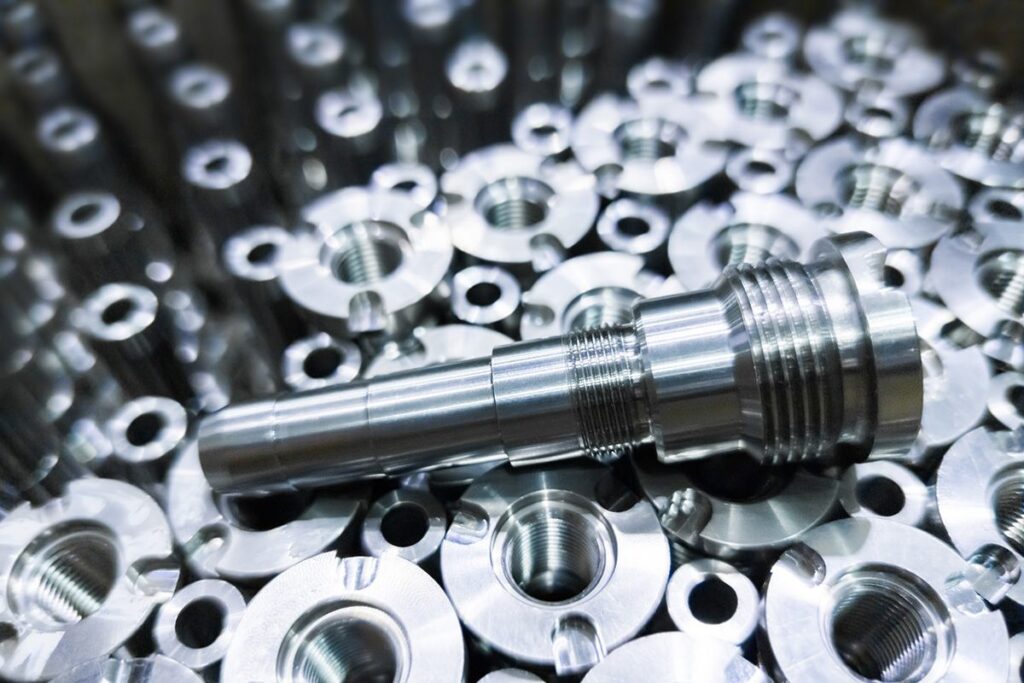
CNC lathes are used for virtually any part with rotational symmetry: shafts, bushings, pins, couplings, flanges, fasteners, and hydraulic and pneumatic components. In terms of materials, aluminum, steel, stainless steel, titanium, brass, copper, and engineering plastics can be easily machined. The cutting speed, tool, and coolant are determined separately for each material.
Frequently Asked Questions
What is a CNC lathe used for? CNC lathes are used to produce cylindrical and tapered parts with high precision and repeatability. The mass production of rotating parts such as shafts, bushings, and couplings relies heavily on this machine.
What is the difference between a CNC lathe and a CNC milling machine? In a lathe, the workpiece rotates while the tool moves along a fixed axis; this makes it suitable for turning parts. In a milling machine, the tool rotates while the workpiece remains stationary; it is used for flat surfaces and complex shapes. The two methods often complement each other.
What tolerance range does a CNC lathe operate within? On a high-quality CNC lathe, a tolerance of ±0.01 mm is standard. With additional grinding and precision machining, tolerances can be reduced to the micron level—that is, ±0.005 mm or less.
What should I send for CNC lathe production? A technical drawing of the part (including dimensions and tolerances) or a 3D model (STEP/IGES) is sufficient. If you do not have a drawing, production can also be carried out using a sample part.
Would you like to have your turned parts manufactured to tight tolerances? Send us your technical drawing; with our CNC turning facilities, we’ll provide a solution tailored to your needs, from prototyping to mass production. Get a Quote →