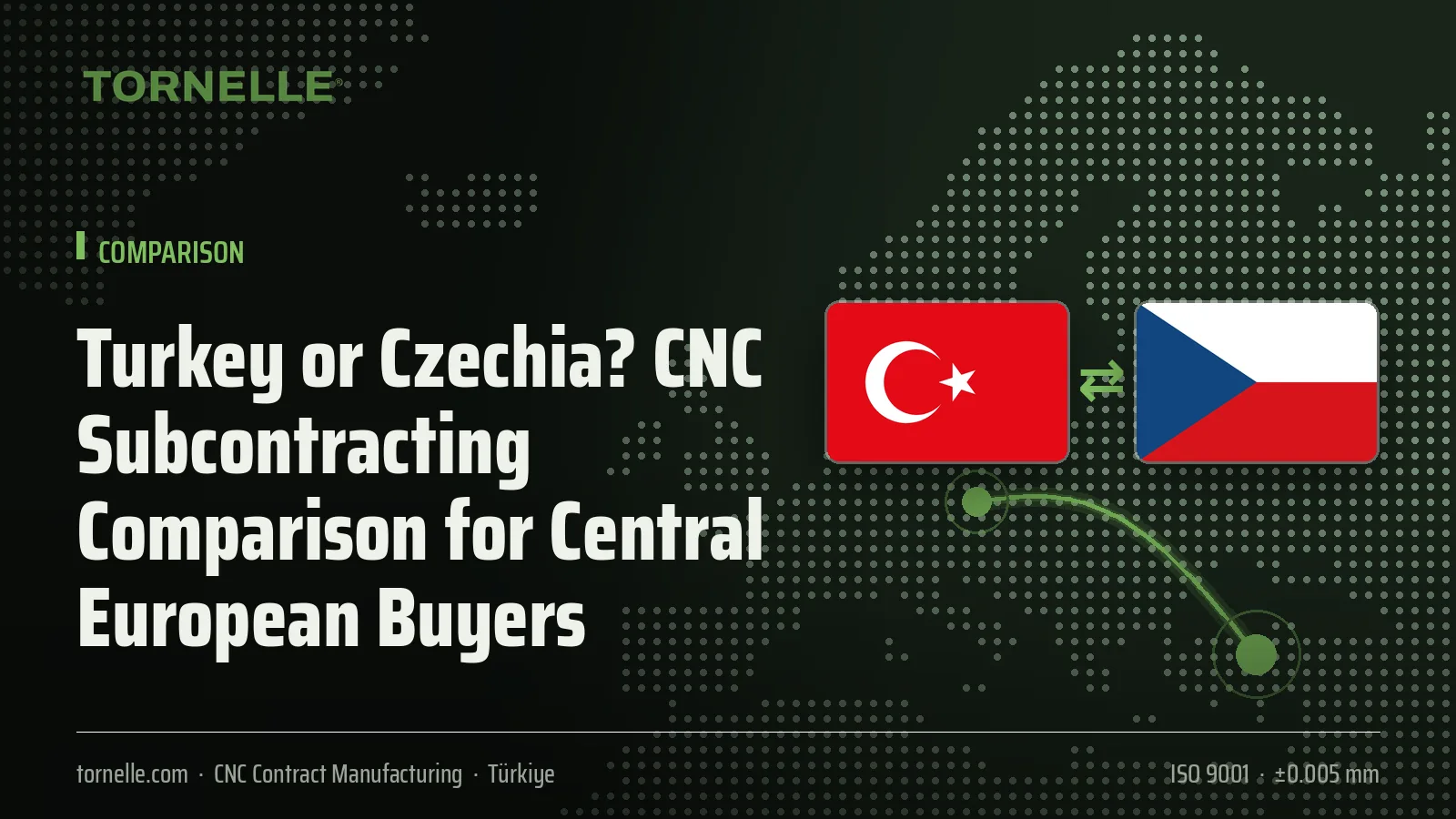
Czechia and Slovakia have become the natural extension of German industry since the 1990s; but in the last decade Czech wages have risen rapidly, capacity has filled up and the cost advantage has narrowed. In this gap Turkey stands out as the more distant but larger and cheaper alternative. As the Czech version of our Poland comparison, this article puts the two countries side by side for the German and Austrian buyer with measurable criteria.
Comparison Table
| Criterion | Czechia | Turkey |
|---|---|---|
| CNC hourly rate (3-axis, typical) | €35–50 | €22–35 |
| Swiss-type hourly rate | €45–60 | €28–40 |
| Industrial labour cost (hour, gross + overheads) | ~€18–22 | ~€7–10 |
| Number of machining SMEs (approx.) | A few thousand | Tens of thousands |
| Capacity situation | High utilisation, labour shortage | Ample free capacity, young workforce |
| Customs | Intra-EU, no customs | 0% duty with A.TR |
| VAT | Intra-EU supply, reverse charge | Import VAT, reclaimable |
| Road to Munich | 1 day | 4–6 days |
| Currency | CZK (fluctuates against the euro) | Prices in euro; internal costs in TRY |
| Language | German widespread | English standard, German limited |
| Quality certificate density | ISO 9001 and IATF widespread | ISO 9001 widespread, IATF in automotive |
Cost
Industrial labour cost in Czechia has nearly doubled in the last decade and reached 55–65% of Western Europe; in Turkey the euro-based labour cost fluctuates but is about half of Czechia's. Reflection in the part price: on turned and milled parts Turkey is 15–30% cheaper than Czechia; on labour-intensive parts (long cycle, many operations) the gap widens, on material-dominated parts it narrows. When logistics and financing costs are added, the net difference falls to 10–25%. Calculation details are in our Germany–Turkey cost article.
Capacity and Flexibility
Czechia's biggest problem is capacity: unemployment is among the lowest in the EU, qualified CNC operators are hard to find, shops are full and selective in accepting new customers. Lead times can stretch to 8–14 weeks. In Turkey the sector is much larger, young shops seeking capacity are widespread; 3–6 week delivery and adapting to sudden volume increases are easier. Although Czechia's geographical proximity is an advantage for urgent jobs, proximity is useless if there is no capacity.
Quality
The Czech engineering tradition is strong; familiarity with German standards, German-language communication and ISO/IATF certificate density are high. In Turkey the quality level at export shops is comparable to Czechia; the difference is that variability from shop to shop is larger in Turkey. For this reason supplier selection is more critical and more decisive in Turkey. Certified suppliers at aerospace quality exist in both countries; in automotive Czechia's IATF density and Turkey's Bursa cluster stand out. The standard set to expect from a Turkish supplier is described in our quality assurance article.
Logistics and Customs
A truck from Czechia reaches Munich or Vienna in one day, consolidation and daily delivery are possible; from Turkey it takes 4–6 days, a weekly groupage flow and higher safety stock are required. In customs the difference is small: Czechia is an intra-EU supply (Intrastat declaration and reverse-charge VAT), Turkey is 0% duty with A.TR and reclaimable import VAT (deferral is possible for large importers in Germany). Extra work on the Turkish side: customs declaration (the forwarder does it, €30–60/shipment) and EORI. Our A.TR article gives details. Groupage transport per pallet Czechia–Germany €40–80, Turkey–Germany €120–220; this difference is usually 1–3% per part.
Currency and Inflation Risk
The Czech koruna fluctuates against the euro; Czech suppliers usually quote in euro, but wage increases and exchange rates feed into annual price revisions. In Turkey prices are euro-based; high domestic inflation raises TRY costs while the exchange rate adjustment partly balances this, so the net euro cost fluctuates periodically. The practical solution is the same for both countries: 6–12 months price validity, material price indexation and an annual revision meeting. The factors affecting price are explained in our price factors article.
Communication and Culture
In Czechia German-speaking engineers and sales teams are widespread; meetings, visits and audits are done as day trips. In Turkey English is standard, German is limited (second-generation Turks returned from Germany are an advantage in some companies); a visit requires one overnight stay, but 3-hour direct flights from Germany to Istanbul operate with dozens of daily departures. In business culture Turkish suppliers tend to be more flexible and quick to respond, Czech suppliers more formal and planned; both are familiar with German business discipline.
Which Country for Which Part?
| Part / situation | Recommendation |
|---|---|
| Parts requiring daily/weekly JIT delivery | Czechia (proximity) |
| High-volume turned and Swiss-type parts | Turkey (cost and capacity) |
| Heavy and large parts (high transport cost) | Czechia |
| Small-volume, high-value parts | Turkey (low logistics share) |
| German-language communication mandatory | Czechia |
| Capacity constraint, fast scaling | Turkey |
| Capacity/price problem with existing Czech supplier | Second source with Turkey |
Dual-Sourcing Strategy
Many German and Austrian SMEs use Czechia and Turkey not as rivals but as complements: the Czech supplier produces urgent and JIT parts, the Turkish supplier high-volume and cost-driven parts. This model spreads capacity risk, keeps price competition alive and provides a balance against currency/wage fluctuations. The steps of working with a Turkish supplier are described in our Germany guide.
Numerical Example
A Bavarian machine builder's comparison for a 42CrMo4 turned-and-milled shaft (0.6 kg, 3 operations), 20,000 pieces per year: Czech quote €9.80/piece, Turkish quote €7.40/piece. Logistics: Czechia €0.12/piece, Turkey €0.35/piece; customs declaration and additional stock financing €0.15/piece for Turkey. Net: Czechia €9.92, Turkey €7.90 — a 20% difference, about €40,000 savings per year. The Turkish supplier's 5-week lead time against the Czech supplier's 12 weeks also influenced the decision; the buyer left two small parts requiring JIT in Czechia.
Frequently Asked Questions
How much cheaper is Turkey than Czechia?
15–30% in part price; 10–25% net including logistics and stock costs. The gap is larger on labour-intensive parts.
Czechia is an EU member, is there a customs advantage?
In practice the difference is small: Turkey has 0% duty with A.TR; additionally a customs declaration and import VAT (reclaimable) are required.
My Czech supplier cannot provide capacity, what should I do?
Moving high-volume, non-time-critical parts to Turkey and reserving Czech capacity for urgent jobs is the common solution.
Is 1-week delivery from Turkey possible?
Road is 4–6 days; yes with shipment from stock or air freight (2–3 days). Production time is planned separately.
Conclusion
Czechia stands out with proximity, German and JIT flexibility; Turkey with cost, capacity and scalability. For the Central European buyer the right answer is most often to use both together. If you want to obtain a Turkish quote for your high-volume turned, Swiss-type and milled parts and compare it with your current Czech prices, send your drawings via our quote form; a DAP Germany/Austria price arrives within 24 hours.