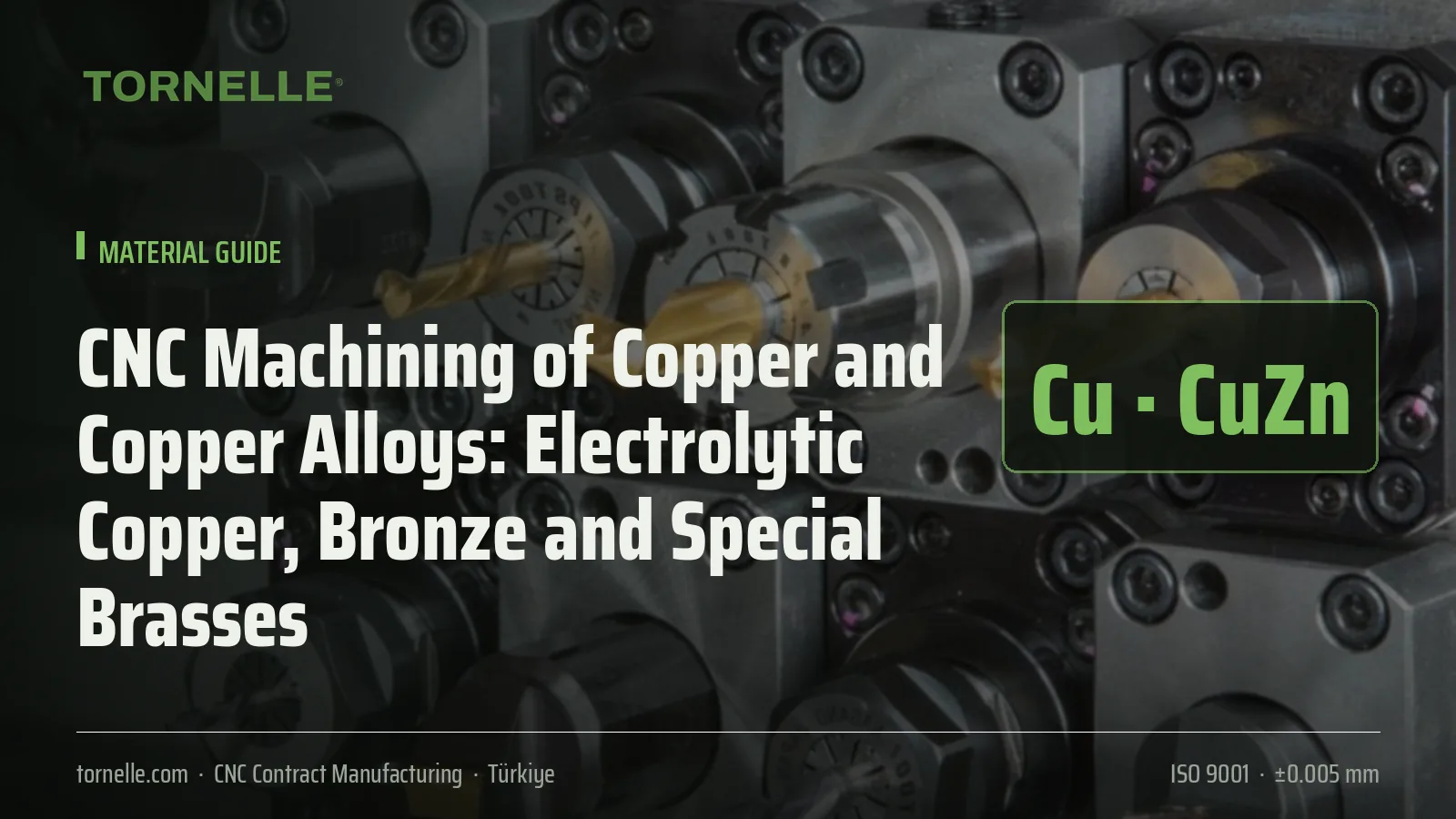
Our brass article described the most common copper alloy (CuZn39Pb3); the copper family is much wider than that. Conductor busbars for switchgear, CuCrZr for welding electrodes, tin bronze for gears and bearings, aluminium bronze for seawater pumps and lead-free brass for drinking water fittings: each has different machining behaviour and supply dynamics. This guide summarises copper alloys from a CNC perspective for buyers and designers.
Overview of the Copper Family
| Group | Typical grades (EN) | Key property | Machinability (CuZn39Pb3 = 100) | Typical application |
|---|---|---|---|---|
| Pure copper | Cu-ETP (CW004A), Cu-OF (CW008A) | Electrical/thermal conductivity (100% IACS) | ~20 | Busbars, contacts, heat exchanger parts |
| High-strength copper | CuCrZr (CW106C), CuBe2 (CW101C), CuNi2Si | Conductivity + strength + softening resistance | ~40–60 | Welding electrodes, mould cooling, spring contacts |
| Tin bronze | CuSn8 (CW453K), CuSn12 (CC483K cast) | Bearing, wear, corrosion | ~40–50 | Bushings, worm wheels, slideways |
| Leaded bronze | CuSn7Pb15, CuSn10Pb10 (CC495K/CC496K) | Dry-running bearing property | ~70–80 | Bearing bushings, hydraulic pump plates |
| Aluminium bronze | CuAl10Ni5Fe4 (CW307G), CuAl10Fe3Mn2 | High strength, seawater, cavitation resistance | ~20–30 | Propellers, pumps, valves, marine fittings |
| Lead-free brass | CuZn21Si3P (CW724R), CuZn42 (CW510L) | Drinking water compliance, RoHS without exemption | ~70–90 | Fittings, water meters, connectors |
| Special brass | CuZn40Mn1Pb1 (CW720R), CuZn35Ni3Mn2AlPb | Wear, strength | ~60–70 | Synchroniser rings, bearing cages |
| Nickel silver / Cupronickel | CuNi18Zn20, CuNi10Fe1Mn | Appearance, seawater corrosion | ~40–50 | Instrument parts, marine pipe fittings |
Pure Copper: Managing Gummy Chips
Electrolytic copper is indispensable for conductivity but difficult to machine: it is soft, ductile and gummy; chips are long and stringy, the surface scratches easily, holding size is difficult, and built-up edge forms on the tool tip. Solutions: very sharp, polished carbide tools (uncoated or diamond-like coated); high cutting speed (300–600 m/min); positive geometry and large rake angle; generous coolant; chip direction by high-pressure coolant instead of chip breakers; thread milling instead of tapping (tap breakage is common). Hard (H) temper bar machines better than annealed material; conductivity remains the same. Ra 0.8 routine; Ra 0.4 possible with diamond tooling. Tolerance: thermal expansion is high (17 µm/m·K), the measuring temperature must be controlled.
CuCrZr and High-Strength Coppers
CuCrZr offers 400+ MPa strength and softening resistance up to 500 °C with about 80% of the conductivity of pure copper; it is used in resistance welding electrodes, injection mould cooling pins and electric motor parts. Its machinability is much better than pure copper; it is machined with standard carbide tools at medium speeds. CuBe2 (beryllium copper) is used in spring contacts; its dust and chips carry a health risk, special ventilation is required during machining and many shops do not accept it; as an alternative CuNi2Si or CuNi3Si1Mg is increasingly preferred.
Bronzes: Bearings and Wear
Tin bronzes (CuSn8 wrought, CuSn12 cast) provide low friction and high load capacity against a steel counterface in worm gears, bushings and slideways. Machinability medium; because the chip is short and brittle, turning is comfortable. Leaded bronzes (CuSn7Pb15) provide self-lubrication in dry or boundary-lubricated bearings and machine very easily; if within RoHS scope, care is needed because they exceed the 4% lead exemption limit. Cast bronzes come as continuously cast bar or chill-cast blanks; because of porosity risk, wrought (CuSn8) is preferred for parts requiring leak-tightness. Pump plate applications are mentioned in our hydraulics article.
Aluminium Bronze: Hard and Durable
CuAl10Ni5Fe4 is used in propellers, pump impellers, marine valves and highly loaded bearings with 600+ MPa strength and seawater and cavitation resistance. Machining resembles steel: medium cutting speed (80–150 m/min), coated carbide, rigid clamping; it is abrasive and tool life is short compared with tin bronze. Chips are short. It can be welded and heat treated. Its price is high among the bronzes. A separate sector article on marine applications is planned.
Lead-Free and Special Brasses
Drinking water legislation (EU Drinking Water Directive, 4MS list) and demand for RoHS compliance without exemption have increased the use of lead-free brass. CuZn21Si3P (trade names ECOBRASS/Eco Brass) gains machinability from silicon; it runs at cutting speeds close to CuZn39Pb3 but tool wear and chip control are slightly more difficult; the material price is 15–25% higher. CuZn42 is cheaper but has lower machinability. Special brasses (with manganese, nickel, aluminium additions) are used in wear parts and are of medium machining difficulty. The lead declaration is explained in our RoHS/REACH article.
Tolerance, Surface and Measurement
- In copper alloys ±0.01 mm is achievable on the lathe; in pure copper ±0.02 is more realistic because of flexibility and expansion.
- Surface: Ra 0.4–0.8 routine in brass and bronze; in pure copper protective packaging is essential because of scratch risk.
- Measurement: 20 °C reference; copper's expansion is 1.5 times that of steel, a 5 °C difference between shop floor and measuring room creates 8 µm deviation over 100 mm.
- Edges: in copper and lead-free brass burrs can be gummy; the deburring method (brush, vibratory, thermal) should be specified.
Material Supply and Price
Turkey has brass and copper bar production (Sarkuysan, Sarbak and others); CuZn39Pb3, Cu-ETP and some bronzes are available from stock. CuCrZr, aluminium bronze, lead-free brass and special alloys are imported or made to order (2–8 weeks). Prices are indexed to the LME copper price and are volatile; a metal indexation clause is standard in long-term contracts. Approximate levels: CuZn39Pb3 6–8 times the steel price, Cu-ETP 8–10 times, CuSn8 10–14 times, CuAl10Ni 12–16 times, CuCrZr 15–20 times. Copper chips are valuable; serious suppliers reflect the chip buy-back value in the price (especially in Swiss-type turning, where the chip ratio can exceed 50%). Certificate: the 3.1 certificate includes chemical analysis and conductivity (if required).
Designer Notes
- If conductivity is needed, Cu-ETP; if conductivity + strength, CuCrZr or CuNi2Si; avoid beryllium copper.
- For bearings, tin bronze or leaded bronze depending on the counterface hardness; if within RoHS scope, evaluate a lead-free bronze alternative.
- For seawater, aluminium bronze or cupronickel; brass is prone to dezincification (except DZR brass).
- For drinking water contact, specify lead-free brasses on the 4MS list.
- Reduce the chip ratio: copper material has high scrap value, but the loss is still reflected in the price.
Frequently Asked Questions
Why is a pure copper part more expensive to machine than brass?
Gummy chips, low machinability (a fifth of brass), special tooling and surface protection requirements increase machining time 2–3 times; the material is also more expensive.
Can lead-free brass be machined on Swiss-type lathes?
Yes; CuZn21Si3P is routinely machined on Swiss-type lathes, cutting speed is slightly lower and tool life shorter; the part price is 15–30% higher than leaded brass.
Cast or wrought for a bronze bushing?
If leak-tightness or high load is required, wrought CuSn8; for a standard bearing, continuously cast CuSn12 is economical.
Do you machine beryllium copper?
Like many shops, we prefer not to because of the health risk; we recommend the CuNi2Si or CuCrZr alternative.
Conclusion
The copper family covers a wide range of needs from conductivity to bearing properties, from seawater resistance to drinking water compliance; the right alloy choice and machining know-how suited to that alloy determine part cost and life. Send the technical drawings for your copper, bronze or special brass parts via our quote form; we come back within 24 hours with a material alternative proposal and a quote reflecting the chip value. Our material scope is on our CNC turning page.