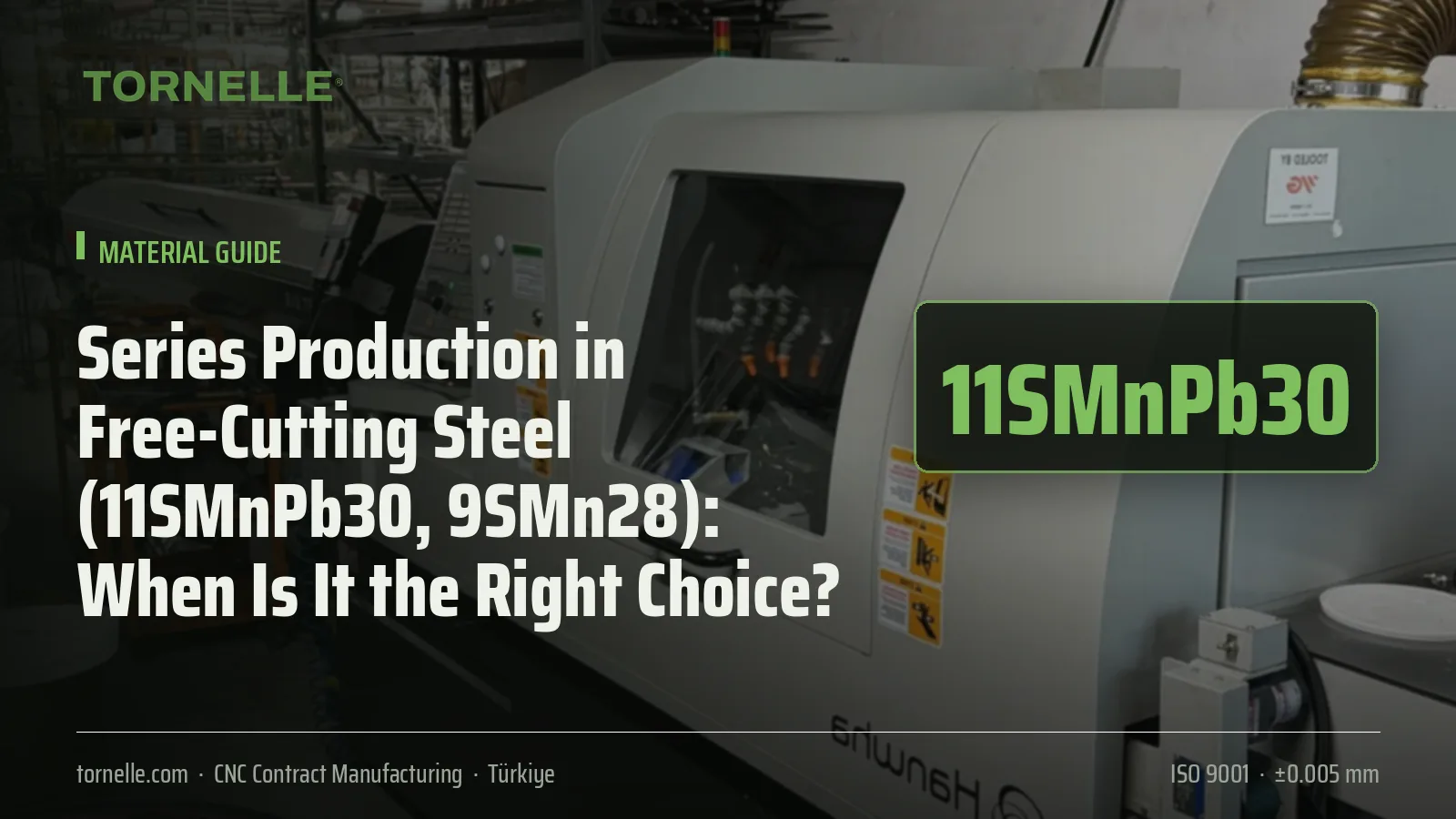
If the drawing of a turned steel part says "St37" or "C45", but the part carries no load, is not welded and is not hardened, it can probably be produced more cheaply and faster: by changing the material to free-cutting steel. Free-cutting steels (Automatenstahl) are low-carbon steels optimised for cutting through a high sulphur content and optional lead content. This guide is the steel counterpart of our brass guide and complements our series production on Swiss-type lathes article from the material side.
Designations: Old and New
| EN 10087 name | Material No. | Old DIN name | Closest US equivalent | Characteristic |
|---|---|---|---|---|
| 11SMn30 | 1.0715 | 9SMn28 | AISI 1213 / 1215 | Lead-free standard free-cutting steel |
| 11SMnPb30 | 1.0718 | 9SMnPb28 | AISI 12L14 | Leaded; best machinability and surface finish |
| 11SMn37 | 1.0736 | 9SMn36 | AISI 1215 | Higher sulphur, more brittle chips |
| 11SMnPb37 | 1.0737 | 9SMnPb36 | AISI 12L15 | Leaded, highest cutting speed |
| 35S20 / 46S20 | 1.0726 / 1.0727 | 35S20 / 45S20 | AISI 1140 / 1146 | Medium-carbon free-cutting steel; hardenable |
"9SMn28" and "9SMnPb28", still often seen on drawings, are the old names of the same material; the supplier uses 11SMn30 / 11SMnPb30 bar. Composition: up to approximately 0.14% C, 0.9–1.3% Mn, 0.27–0.33% S, and 0.20–0.35% Pb in the leaded types.
Why Does It Machine So Fast?
- Manganese sulphide (MnS) inclusions: break the chip, reduce cutting force and form a lubricating film on the tool surface.
- Lead (in Pb types): additional lubrication and chip breaking; surface quality and tool life are even better.
- Low carbon: soft matrix (hardness 110–170 HB), low cutting resistance.
- Result: cutting speeds of 150–250 m/min with carbide tools (1.5–2 times C45), short chips, unattended production, Ra 0.8–1.6 directly from turning, tight tolerances held stably.
In European machinability comparisons 11SMn30 is usually taken as the reference (100); C45 is around 55–65, 42CrMo4 45–55, 1.4305 60–70 and 1.4404 35–45.
Mechanical Properties
- Tensile strength: 380–570 MPa (cold-drawn bar; +C condition), 360–520 MPa hot-rolled
- Yield strength: approximately 300–450 MPa cold-drawn (not specified, not guaranteed)
- Elongation: 6–10% (cold-drawn; low)
- Hardness: 110–170 HB
- Impact strength: low; sulphide inclusions reduce toughness in the transverse direction
Free-cutting steel is not a structural steel: mechanical values are not guaranteed and are for information only. It is not used for parts that carry load, are exposed to impact or work under fatigue.
When Not to Use It: Limits
| Requirement | Is free-cutting steel suitable? | Alternative |
|---|---|---|
| Welding | No; sulphur and lead cause hot cracking and porosity | S235JR, C22, C45 (with preheating) |
| Quenching / quenching and tempering | No; carbon too low | C45, 42CrMo4, 35S20/46S20 (limited) |
| Case hardening | Limited; possible but inclusions reduce core toughness | 16MnCr5, 20MnCr5 |
| Nitriding | Possible; thin layer, used on wear surfaces | — |
| Corrosion resistance | No; plating required (zinc, nickel, black oxide) | 1.4305, 1.4404 |
| High load / fatigue / impact | No | C45E, 42CrMo4, 34CrNiMo6 |
| Cold forming (crimping, riveting) | Poor; low elongation | C10, C15, 10S20 instead of 11SMn30 |
| Pressure equipment (PED) | Generally no; no guaranteed mechanical values | P250GH, 1.4571 |
Rule: if the part only serves a geometry and positioning function (pin, bush, spacer, fitting body, adjusting screw, shaft end, sensor housing), free-cutting steel is ideal; if load, welding or hardness is required, it is not.
Plating and Surface Treatments
- Electrolytic zinc (5–12 µm, blue/yellow/black passivation): most common; indoor and mild corrosion environments.
- Zinc-nickel: standard in automotive; 720+ hours salt spray.
- Nickel plating: appearance and medium corrosion resistance.
- Black oxide / phosphate: low cost, sufficient in oily environments; no dimensional change.
- Nitriding / nitrocarburising: for wear surfaces.
Plating adhesion on leaded free-cutting steel can occasionally be a problem; the plater must know the material. Plating thickness must be included in the tolerance.
Lead Restrictions: RoHS and ELV
Leaded free-cutting steel (11SMnPb30) falls under the exemption for lead in steel up to 0.35% by weight in the EU RoHS and ELV (end-of-life vehicles) directives (RoHS Annex III 6(a), ELV Annex II 1). It can therefore be used in most applications; however, some OEMs and medical/food applications prefer lead-free. Lead-free 11SMn30 and 11SMn37 run at 10–20% lower cutting speed than the leaded type and the surface is slightly rougher; with modern coated tools the difference has narrowed. If there is a restriction, write "Pb-free" or directly 11SMn30 on the drawing. For parts in contact with drinking water, a suitable brass or stainless steel is preferred over steel.
What Determines the Price of a Series Turned Part?
- Material: free-cutting steel bar is priced close to drawn C45 bar; it is 3–4 times cheaper than brass. Bright bar with h9 or h11 tolerance is standard for Swiss-type lathes.
- Cycle time: 10–60 seconds for Ø3–20 mm parts on a Swiss-type lathe; as quantity increases the set-up share drops to zero.
- Plating: the per-part plating cost is often close to the machining cost; bulk (barrel) plating is much cheaper than rack plating.
- Tolerance and surface: Ra 0.8 and ±0.01 come at no extra cost on a Swiss-type lathe; Ra 0.4 and ±0.005 require extra care.
- Quantity threshold: the Swiss-type lathe is economical from 500–1,000 pieces; below that, a conventional CNC lathe. We explain the thresholds in our CNC lathe or Swiss-type article.
Design Tips
- Use standard bar diameters (h9 bright bar: 3, 4, 5, 6, 8, 10, 12, 14, 16, 20, 25 mm); leaving the outer diameter at bar size saves one pass.
- Hexagonal bar (5–36 mm across flats) delivers the hexagon from the raw material for fitting and nut bodies.
- Leave thread run-outs; use standard threads (M, G).
- Keep the length/diameter ratio below 10; long slender parts need support.
- If welding or hardening will be required, do not specify free-cutting steel; use 35S20/46S20 or C45.
Frequently Asked Questions
Are 9SMn28 and 11SMn30 the same material?
Yes; 9SMn28 is the old DIN name, 11SMn30 the current EN 10087 name (1.0715). 9SMnPb28 = 11SMnPb30 (1.0718).
Can free-cutting steel be welded?
In practice, no; sulphur and lead cause cracking and porosity. If welding is required, choose C22 or S235JR.
Are free-cutting steel parts RoHS compliant?
The leaded type is considered compliant under the 0.35% Pb-in-steel exemption; lead-free 11SMn30 is suitable in every case. State your restriction on the drawing.
Which tolerance is realistic?
On a Swiss-type lathe ±0.005–0.01 mm on diameter and ±0.02 mm on length; on a conventional CNC lathe ±0.01–0.02 mm is held routinely. We explain the cost effect in our tolerance selection article.
Conclusion
Free-cutting steel provides the lowest cost and highest production speed for non-load-bearing series turned steel parts; if welding, hardening or high load is required, it is not the right choice. To see whether the material on your drawing is the most economical option for series production, send your technical drawings and quantities via our quote form; receive an itemised quote together with material and plating recommendations. For capacity information see our Swiss-type turning page.