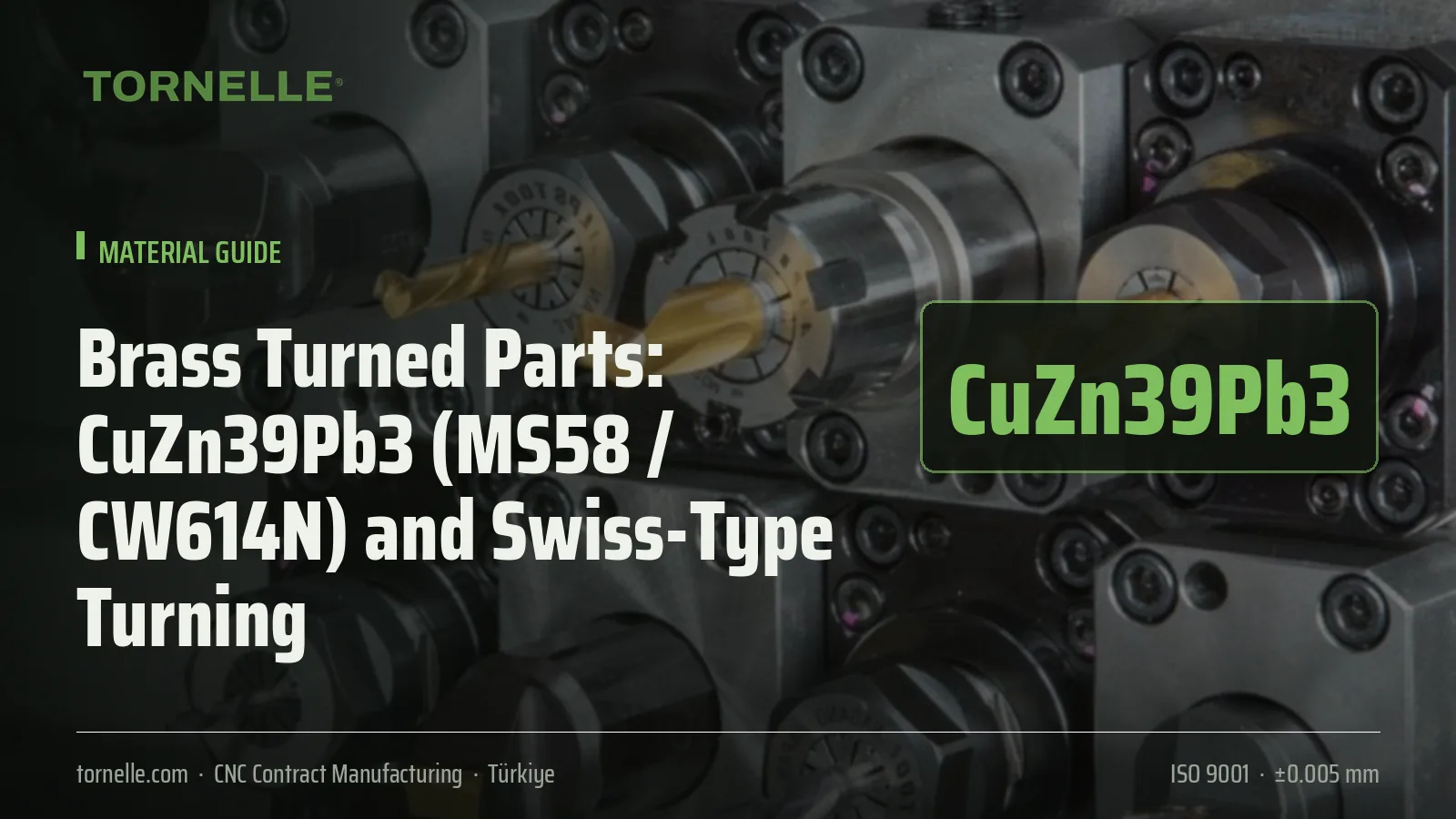
Brass is the most efficient material in machining: high cutting speed, short brittle chips, low tool wear and an excellent surface. That is why it is the first choice for turned parts produced in the millions, such as couplings, hydraulic and pneumatic fittings, valve needles, electrical connectors, sensor housings and meter parts. This guide focuses on the most common grade, CuZn39Pb3; it can be read as the brass continuation of our stainless steel and aluminium guides.
What Is CuZn39Pb3? Designations
The same material is known under different names in different systems, and all of them appear on drawings:
| System | Designation |
|---|---|
| EN (chemical) | CuZn39Pb3 |
| EN (number) | CW614N |
| DIN (old) | MS58 / 2.0401 |
| ASTM / UNS | C38500 (close equivalent, "architectural bronze"); C36000 (CuZn36Pb3, "free-cutting brass") is often compared |
| Common name | Free-machining brass, Automatenmessing, free-cutting brass |
The composition is approximately 57–59% copper, 2.5–3.5% lead, the remainder zinc. The lead is present as small undissolved particles in the copper-zinc matrix; it breaks the chip and acts as a lubricant in the cutting zone. Its machinability index is 100; all other materials are rated against it.
Mechanical and Physical Properties
- Tensile strength: approx. 360–500 MPa (depending on temper; bar is mostly R430–R500)
- Yield strength: approx. 200–350 MPa
- Hardness: 100–150 HB
- Density: 8.4–8.5 g/cm³ (about 8% heavier than steel, 3 times heavier than aluminium)
- Electrical conductivity: approx. 25–28% IACS (sufficient for connectors)
- Corrosion: good against atmosphere, water and many oils; risk of zinc loss (dezincification) in ammonia and some chloride-containing waters
- Welding: limited; soldering and brazing are good
Why Is It the Swiss-Type Material?
The Swiss-type (sliding-head) lathe is designed to produce high volumes of parts from 2–32 mm diameter bar and reaches its highest efficiency with brass:
- Cutting speed: 200–400 m/min; 2–3 times that of stainless steel. Cycle times are measured in seconds.
- Chip control: short, brittle chips cause no bird-nesting; unattended overnight production is run safely.
- Surface: Ra 0.4–0.8 is achieved directly after turning; polishing is usually unnecessary.
- Tool life: thousands of parts with uncoated or PCD tools; tool changes and dimensional drift are low.
- Tolerance: ±0.005–0.01 mm diameter tolerance and tight thread tolerances are held consistently in series production.
Brass turned-part production is traditionally strong in Turkey; exports of couplings, valves and fittings to Europe are widespread. We describe this capacity in our Swiss-type series production article.
Lead Restrictions and Lead-Free Alternatives
Because of its lead content, CuZn39Pb3 is limited by two sets of regulations:
- RoHS (electrical and electronics): an exemption (6(c)) applies for up to 4% lead by weight in copper alloys; CuZn39Pb3 is below this limit and the exemption period is renewed periodically. Check the current status for your product group.
- Drinking water: in the EU, the common positive list for materials in contact with drinking water and national regulations (German UBA list, 4MS) narrow the lead limits; CuZn39Pb3 can mostly not be used in drinking-water fittings. In the USA, the "lead-free" definition is a 0.25% weighted-average lead limit.
Lead-free or low-lead alternatives:
| Alloy | EN number | Property | Machinability (MS58 = 100) |
|---|---|---|---|
| CuZn38As | CW511L | Lead-free, dezincification-resistant, drinking-water approved | ~50–60; long chips, lower speed |
| CuZn21Si3P (silicon brass, "Ecobrass" type) | CW724R | Lead-free, high strength, drinking-water approved | ~70–80; higher tool wear |
| CuZn42 | CW510L | Lead-free, low cost | ~60–70 |
| CuZn40Pb2 | CW617N | Low-lead, for hot forging + machining | ~80–90 |
| CuZn36Pb3 | CW603N | High-copper free-machining brass, better cold forming | ~100 |
With lead-free brasses the cycle time increases by 30–60% and tool costs rise; the part price rises accordingly by 15–40%. If your application is not subject to lead restrictions, CuZn39Pb3 is the economical choice.
Plating and Surface Treatments
- Nickel plating: corrosion and appearance; common on connectors and in plumbing (5–15 µm).
- Chrome (over nickel): decorative and wear resistance; on fittings and taps.
- Tin plating: solderability and contact resistance; on electrical parts.
- Silver / gold flash: on connectors requiring high frequency and low contact resistance.
- Passivation / chromating: tarnish prevention.
- Deburring: vibratory or thermal deburring is standard on series parts; it is essential before plating.
Plating thickness changes the dimension; the drawing must state whether the tolerance applies before or after plating.
Factors That Determine the Price
The material share in a brass part is high: the copper price (LME) directly determines the bar price, and brass bar costs 3–4 times as much as steel. In return, the machining time is very short and the chips are sold back at high value (the scrap credit is reflected in the quote). Therefore the decisive factors in a brass part price are material weight, quantity, plating and tolerance; the labour share is low. When requesting a quote, clarify the copper-index price-adjustment rule. For the other items see our 12 factors article.
Design Tips
- Use standard bar diameters (h9 or h11 drawn bar) and hexagonal bar sizes; on hexagonal fittings the raw material reduces machining.
- For Swiss-type turning keep the part length below 10 times the diameter; longer parts are possible but need support.
- Design threads to standard (M, G, NPT) and leave thread run-outs.
- If there is a lead restriction, write the alloy clearly on the drawing (e.g. "CW511L"); do not just write "lead-free brass".
Frequently Asked Questions
Are MS58, CW614N and CuZn39Pb3 the same material?
Yes; MS58 is the old DIN name, CW614N the EN number, CuZn39Pb3 the EN chemical designation.
What tolerance is realistic for a brass part?
On a Swiss-type lathe ±0.005 mm on diameter, ±0.02 mm on length; on a conventional CNC lathe ±0.01 mm is held routinely.
Are brass parts RoHS compliant?
CuZn39Pb3 falls under the 4% lead exemption for copper alloys and is considered compliant within that framework; check the current validity of the exemption for your product group.
What is the minimum order quantity?
Prototypes and small series (10–100 pieces) are economical on a conventional CNC lathe, 500 pieces and above on a Swiss-type lathe; the exact threshold depends on the part.
Conclusion
CuZn39Pb3 (MS58 / CW614N) is unrivalled in series turned parts for speed, surface and tolerance; in applications with lead restrictions, alternatives such as CW511L or CuZn21Si3P are selected with the cost difference in mind. Send the technical drawings and annual quantities of your brass parts via our quote form; receive a clear quote with alloy and plating recommendations and a copper-indexed price rule. For information on our Swiss-type turning capacity, see our service page.