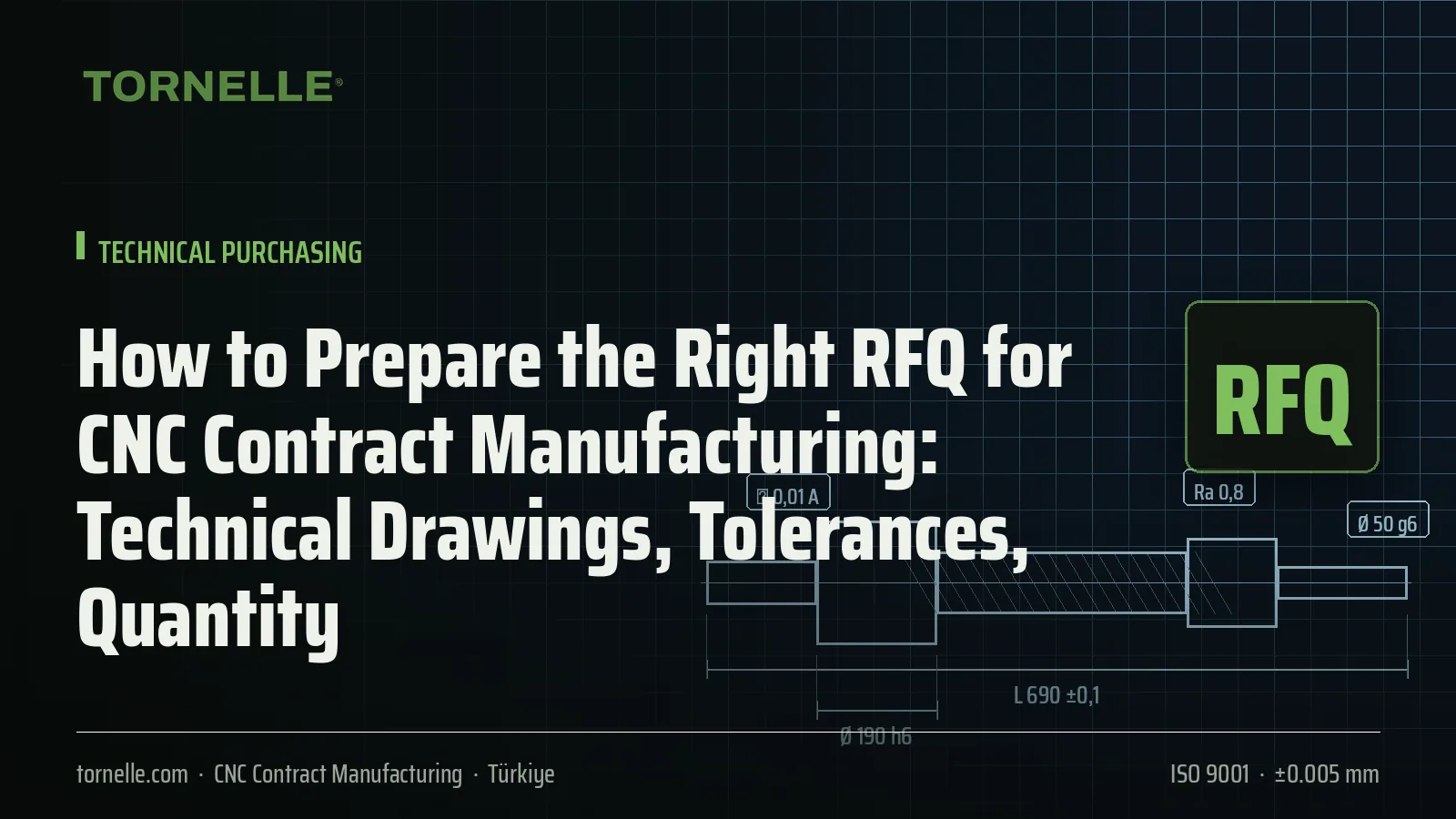
A Request for Quotation (RFQ) sent to a contract manufacturer is not just about asking for a price; it is the foundation for a shared understanding of how the part will be manufactured. Requests with incomplete information result in the supplier either asking questions (a waste of time) or pricing based on assumptions (a risk). A complete RFQ, on the other hand, yields a clear quote within 24–72 hours and often includes cost-saving manufacturing recommendations. This guide explains the components of an RFQ to be sent to a CNC supplier in Turkey—or any contract manufacturer.
1. Technical Drawing (2D PDF)
A 3D model alone is not sufficient; tolerance, surface, and material information are included in the 2D drawing. A good technical drawing should include:
- General tolerance class: ISO 2768-m (medium) or ISO 2768-f (fine) and, if necessary, the geometric class (K/H). If not specified, the supplier will make an assumption.
- Critical dimensions: Functional surfaces, fit dimensions (such as H7/g6), and thread specifications must be clearly specified with tolerances.
- Geometric tolerances (ISO 1101): Coaxiality, perpendicularity, flatness—only where truly necessary.
- Surface roughness: General Ra value and separate values for specific surfaces (e.g., Ra 1.6 general, Ra 0.4 sealing surface).
- Edge rounding / deburring: A general note such as “All edges shall be rounded to 0.2–0.5 mm.”
- Material and condition: Standard number and heat treatment condition (42CrMo4+QT, EN AW-6082 T6).
- Surface treatment: Anodizing type and thickness, coating standard, masking areas.
- Revision number: The quote and order must be based on the same revision.
Technical drawings in German, French, Italian, or Dutch are readable by export-oriented Turkish suppliers; standard notation is common throughout Europe.
2. 3D Model (STEP)
The STEP (.stp/.step) format is readable by all CAM systems and reduces the quoting time. Prefer STEP AP214 or AP242 over local CAD formats (SolidWorks, Inventor, Catia). If there is a discrepancy between the model and the 2D drawing, specify which one is valid (usually the 2D drawing).
3. Material
Specify the material by its standard number, not its commercial name. EN numbers (1.4404, 1.0503, EN AW-7075) are used in Europe, while ASTM/AISI/UNS (316L, 1045, 7075-T6) are used in the U.S.; Turkish suppliers are familiar with both. If necessary, include the following:
- Material certificate type (EN 10204 2.2 or 3.1);
- Country-of-origin restriction (e.g., requirement for steel of EU origin);
- Special requirements (implant-grade quality, RoHS/REACH declaration).
4. Quantity and Delivery Schedule
Quantity is the most significant factor affecting price; setup and programming costs are divided by the quantity. Please provide the following:
- Quantity for this order and, if desired, quantity tiers (100 / 500 / 2,000 units);
- Estimated annual consumption (EAU)—suppliers plan raw materials and capacity based on this, and the unit price decreases;
- Initial delivery date and subsequent delivery schedule (monthly calls, single batch);
- Whether it is a prototype or mass production—the manufacturing method is selected accordingly.
5. Quality and Documentation Expectations
Documentation not specified during the proposal phase will result in additional costs and delays later on. Clarify:
- Scope of measurement reports: sampling of critical dimensions, 100% inspection, or CMM report?
- First sample approval format: EMPB, PPAP (level), FAI/AS9102;
- Certificates: Material 3.1, coating, heat treatment;
- Quality management requirements: Is ISO 9001 sufficient, or are IATF 16949 / AS9000 / ISO 13485 required?
See our quality assurance guide for details.
6. Packaging and Logistics
- Delivery terms (Incoterms): FCA, DAP, EXW;
- Delivery address and shipping preference (road freight, air freight, express);
- Packaging: corrosion protection (VCI), separate packaging per part, labeling, pallet standard;
- Cleaning requirements (oil-free, particle limit).
Logistics guide for shipping options.
7. Commercial Information
- Company information and contact person (technical and commercial);
- Expected validity period of the quote;
- Preferred payment terms;
- Non-Disclosure Agreement (NDA)—it is standard practice to sign this before sharing technical data.
Cost-Saving RFQ Tips
- Specify tolerances based on function. Use ±0.01 mm only where necessary; ISO 2768-m is sufficient for general dimensions. Unnecessary tight tolerances mean additional processing and measurement costs.
- Design close to standard semi-finished product dimensions. Designing a Ø24 mm part instead of a Ø24.8 mm part from a Ø25 mm bar saves material and machining time.
- Review deep and narrow pockets and thin walls. Geometries requiring long cutting tools increase cycle time.
- Specify surface roughness as needed. A Ra of 0.4 requires grinding; a Ra of 1.6 can be achieved on a lathe.
- Combine quantities. Grouping similar parts made from the same material into a single RFQ helps spread setup costs.
- Request DFM feedback. Good suppliers suggest design changes that provide the same function more economically.
RFQ Checklist
| Component | Required | Recommended |
|---|---|---|
| 2D technical drawing (PDF) | ✔ | |
| 3D model (STEP) | ✔ | |
| Material standard and condition | ✔ | Certificate type |
| General tolerance class | ✔ | |
| Surface treatment / heat treatment | ✔ (if applicable) | Standard, thickness |
| Quantity | ✔ | Grades, annual estimate |
| Delivery date | ✔ | Delivery schedule |
| Quality documentation | Report, FAI/PPAP, certificates | |
| Incoterms and address | Shipping preference | |
| Packaging / Cleaning | VCI, separate packaging | |
| NDA | Before Data Sharing |
Frequently Asked Questions
Can I get a quote based solely on a 3D model?
Yes, for a preliminary quote; however, a binding quote cannot be provided without information on tolerances, surface finishes, and materials. Please specify at least the critical tolerances via email.
How long does it take to receive a quote?
Typically 24–72 hours for a complete RFQ; requests involving multiple parts or assemblies may take a bit longer.
Do I have to share the annual quantity?
It’s not required, but sharing an estimate helps improve the unit price and enables capacity planning.
My technical drawing is in German; do I need to translate it into English?
No. Turkish suppliers serving the European market are familiar with standard notation in German, French, and Italian.
Conclusion
A complete RFQ is the first step toward a quick quote, an accurate price, and seamless production. Use this checklist to prepare your document and submit it via our quote form; you’ll receive a response regarding pricing and manufacturability within 24 hours.