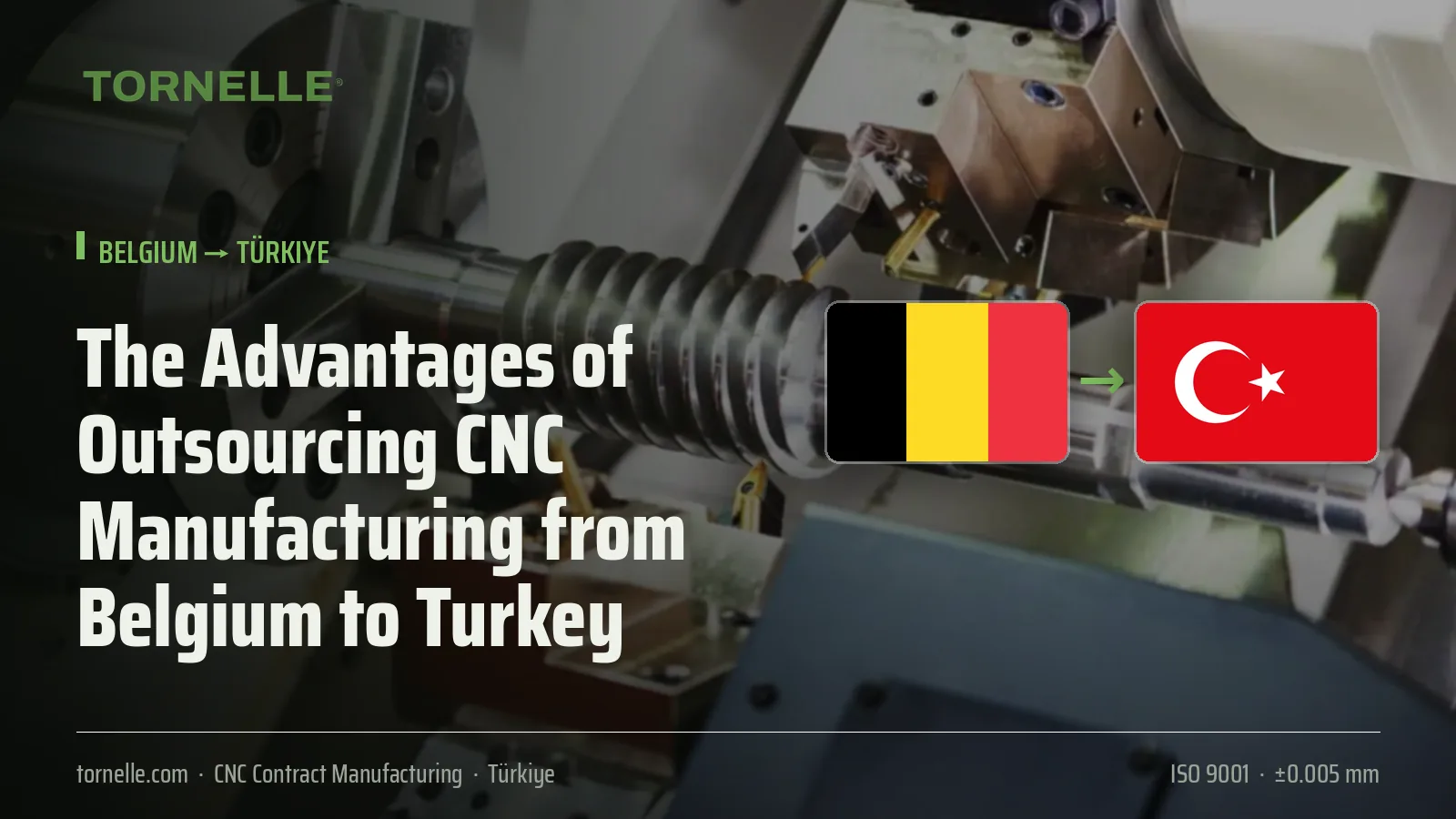
Belgium is at the logistical and industrial heart of Europe: the Port of Antwerp and its chemical cluster, machinery and automation manufacturers in Flanders, and the aerospace and metalworking sectors in Wallonia. A common challenge for these companies is having to compete with some of Europe’s highest labor costs. As local sourcing for turned and milled parts becomes both expensive and limited in capacity, Turkey is becoming an increasingly attractive nearshoring destination for Belgian buyers.
1. Zero Customs Duties Thanks to the Customs Union
Thanks to the EU–Turkey Customs Union, CNC parts manufactured in Turkey enter Belgium duty-free with an A.TR movement certificate. Belgian importers need only declare the import VAT; with an ET 14000 authorization, the import VAT is declared on the periodic VAT return and offset without being paid at customs. There are no customs duties or anti-dumping risks associated with sourcing from Asia. Details: Customs Union and A.TR Guide.
2. By Road in 4–5 Business Days
The distance between Istanbul and Brussels/Antwerp is approximately 2,600 km. Shipments are delivered in 4–5 business days via regular road routes through the Balkan corridor and Germany; distribution to the Antwerp and Liège logistics centers is straightforward. Air freight from Istanbul to Brussels takes 1 day. Compared to the 5–7-week sea freight supply route from Asia to Antwerp, the need for inventory and working capital is significantly reduced.
3. EN/ISO Standards and Multilingual Technical Drawings
Belgian technical drawings are based on NBN EN ISO standards (ISO 2768, ISO 1101, EN 10204)—a common practice among Turkish suppliers. Due to Belgium’s multilingual structure, drawings prepared in French or Dutch can be read directly thanks to standard notation; technical communication is conducted in English. European material designations (1.4404, 1.4571, 42CrMo4, EN AW-6082) are supplied directly.
4. Cost Advantage
Labor costs and social security contributions in Belgium are among the highest in Europe; the hourly rate for CNC machining can exceed that of Germany. In Turkey, labor and overhead costs are significantly lower, and raw material prices are on par with global market rates. Belgian buyers typically see a total cost advantage of 30–45% on labor-intensive, multi-operation parts with tight tolerances. Sample calculation: Germany–Turkey cost comparison.
5. Sectoral Alignment
- Chemical and process equipment (Antwerp): Turned/milled parts made of stainless steel, duplex, and special alloys; valve and pump components.
- Machinery and automation (Flanders): Aluminum and steel housing parts—CNC milling; shafts and bushings—CNC turning.
- Aerospace (Wallonia): Aluminum and titanium milled parts, AS9100 ecosystem.
- Automotive supply industry: Precision turned parts, PPAP experience.
- Textile and packaging machinery: High-volume parts for sliding automatic machines.
6. Capacity and Flexibility
Capacity constraints experienced in Belgium for small and medium-volume production runs are rarely seen in Turkey. Flexible capacity—from prototypes to high-volume production runs—is offered under one roof, along with surface treatment and heat treatment.
7. Time Zone and Transportation
Turkey is 1 hour ahead of Belgium. The flight from Brussels to Istanbul takes approximately 3.5 hours, and there are daily direct flights. Supplier audits can be conducted in a single day.
Practical Notes for Belgian Buyers
- If you do not have an ET 14000 license, consult with your customs broker to evaluate the application; it provides a cash advantage on import VAT.
- For the first order, request a measurement report and an EN 10204 3.1 certificate.
- Select FCA Istanbul or DAP factory as the Incoterms.
- Secure price and capacity guarantees through a framework agreement by sharing your annual forecast.
Frequently Asked Questions
Is customs duty paid on imports from Turkey?
No. Industrial products arriving with an A.TR certificate are exempt under the Customs Union; import VAT is offset on the customs declaration with an ET 14000 permit.
Are technical drawings in French or Dutch accepted?
Yes. Standard notation is based on European norms; technical communication is conducted in English.
What is the delivery time?
Production takes 1–2 weeks for prototypes and 3–6 weeks for mass production; delivery to Belgium takes 4–5 business days by road and 1 day by air freight.
How does the process work?
The steps are the same as for neighboring countries: our Netherlands guide and RFQ guide provide guidance.
Result
Outsourcing CNC machining from Belgium to Turkey offers a duty-free, fast, and competitive alternative to the high-cost manufacturing environment in the heart of Europe. Send us your technical drawings and receive a quote within 24 hours.