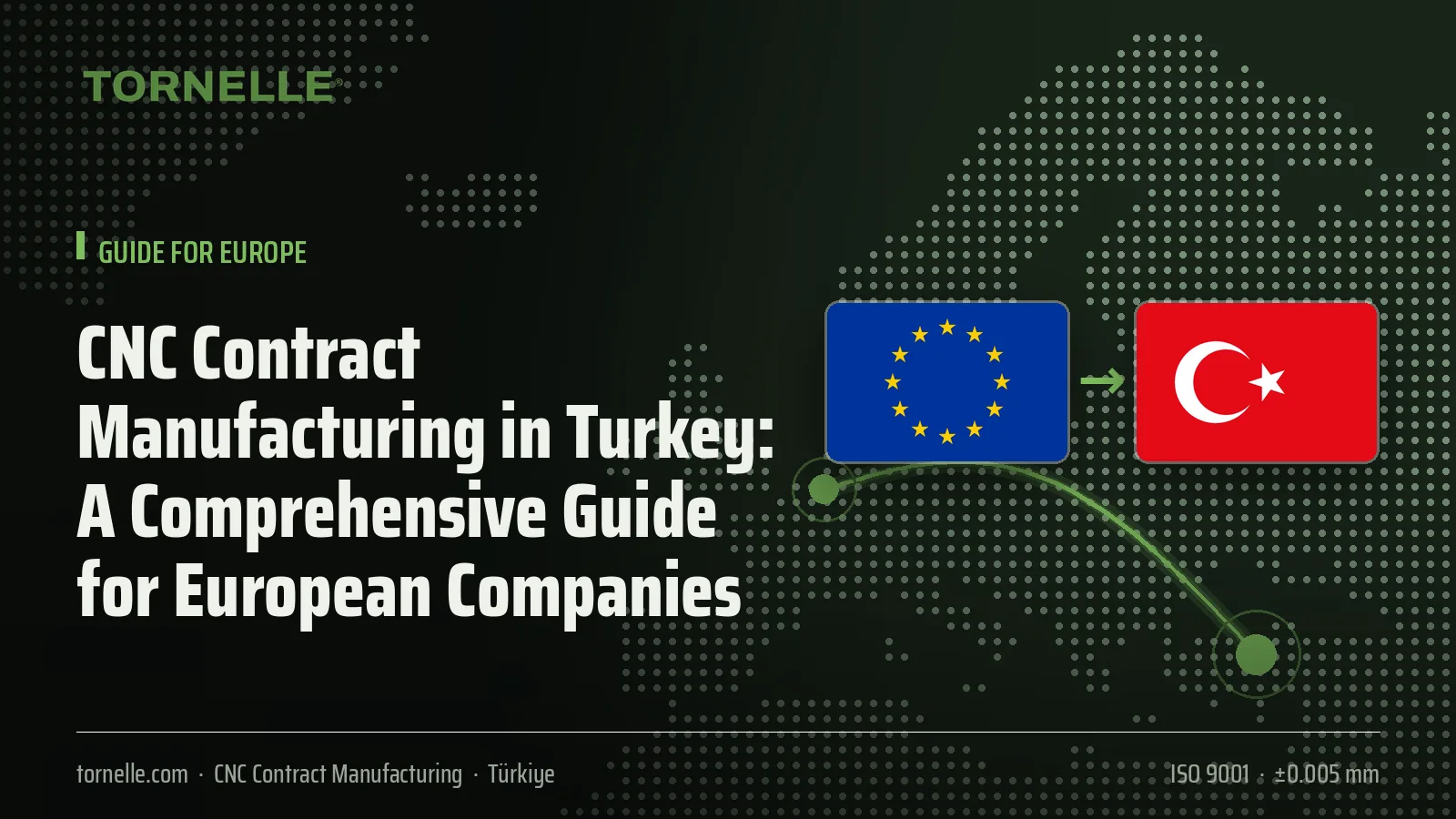
Supply chain decisions for machine manufacturers, automotive suppliers, and engineering firms in Europe have undergone fundamental changes in recent years. Long lead times, fluctuating freight rates, and communication challenges associated with sourcing from the Far East—combined with high labor and energy costs associated with local sourcing—have led many companies to seek “nearshoring” solutions. In this context, Turkey stands out as the largest manufacturing hub geographically and commercially closest to Europe.
This guide examines CNC contract manufacturing in Turkey from the perspectives of both a buyer and an engineer: why Turkey is a good choice, which parts are suitable, how costs are determined, how quality is ensured, how customs and logistics work, and how to place your first order.
Why Is CNC Contract Manufacturing in Turkey a Top Choice?
1. Customs Union with the European Union
Thanks to the Customs Union between Turkey and the European Union, industrial products enter the EU duty-free when accompanied by an A.TR movement certificate. CNC-machined metal parts fall under this category. The customs duties, anti-dumping risks, and lengthy customs clearance processes encountered when sourcing from the Far East do not exist when sourcing from Turkey. For more details, please see our article on the Customs Union and the A.TR certificate.
2. Geographical Proximity and Delivery Times
Delivery by road from Istanbul to Germany, Austria, the Netherlands, or Italy typically takes 3–6 business days; for urgent parts, delivery by air freight is possible within 1–3 days. Instead of delivery times of up to 6–8 weeks by sea from the Far East, sourcing from Turkey allows for lower inventory levels and a rapid response to engineering changes.
3. Strong Machining Ecosystem
Turkey has a machining infrastructure that has been developing for decades to meet the demands of the automotive, home appliance, defense, and machinery manufacturing sectors. CNC lathes, CNC mills, Swiss-type automatic lathes, and 5-axis machining centers—along with auxiliary processes such as heat treatment, coating, and anodizing—are all located within the same industrial zones. This facilitates the delivery of complete parts through a single supplier.
4. Competitive Costs, European Quality Standards
Labor and overhead costs in Turkey are significantly lower than in Western Europe; at the same time, suppliers accustomed to working with German and European customers are well-versed in European expectations regarding DIN/ISO standards, measurement reports, and material certificates. The result is a total part cost that is typically 25–45% lower while maintaining the same quality level.
5. Same time zone, same business day
Turkey operates with only a 1–2-hour time difference from Central Europe. It is possible to receive a quote in the afternoon for a technical drawing sent in the morning and to clarify technical issues the same day via phone or video call. Engineering staff capable of communicating in English and German facilitate this process.
Which Parts Are Suitable for Sourcing from Turkey?
- Turned parts: shafts, bushings, fasteners, hydraulic and pneumatic components—produced via CNC turning from single pieces to tens of thousands.
- Slide-type automatic machine parts: High-volume, tight-tolerance small parts in the Ø1–32 mm range; connector pins, medical components, sensor housings.
- Milled parts: housings, flanges, brackets, mold and fixture parts — produced using 3-, 4-, and 5-axis CNC milling machines.
- Prototypes and small series: Rapid prototyping for R&D and pilot production.
- Assembled subassemblies: components where machining, surface treatment, and assembly are performed under one roof.
How Is the Cost Determined?
The price of a CNC part consists of five main components: material, machining time, tolerance class, surface treatment, and quantity. The advantage in Turkey stems primarily from the low machining time (machine hours and operator costs) and low overhead expenses. Since raw material prices are tied to the global market, the variation in the material cost is limited. Therefore, Turkey’s advantage is most pronounced for parts with a high labor ratio—those featuring complex geometries, multiple operations, and tight tolerances. For a detailed calculation, see our article on the Germany–Turkey cost comparison.
How Is Quality Ensured?
This is the question most frequently asked by European buyers, and the answer is the same as the methods applied in local sourcing:
- Clear technical drawings: The ISO 2768 general tolerance class, critical dimensions, surface roughness (Ra), and material standard must be clearly specified.
- Initial sample approval: A sample part must be approved along with a measurement report (CMM or manual measurement) prior to series production.
- Material certificate: Material traceability must be ensured with an EN 10204 3.1 certificate.
- Quality management system: An ISO 9001 certificate and a defined nonconformity process must be in place.
- Quality agreement: Acceptance criteria, sampling plan, and responsibilities must be documented in writing.
We have detailed all of these steps in our quality assurance guide.
Customs and Logistics
For sales to the EU, customs duties are zero with an A.TR certificate; VAT is declared in the importer’s country. The Free Trade Agreement with the UK and the EFTA agreements with Switzerland and Norway are in effect. For sales to the U.S., the product’s HTS code and any additional duties, if applicable, must be taken into account. In Europe, FCA or DAP are the most commonly preferred delivery terms (Incoterms). Check out our logistics guide for options including ground transport, air freight, and express courier services.
Country-Specific Guides
Each country’s customs regime, sectoral structure, and purchasing habits differ. For this reason, we have prepared country-specific guides:
- Germany — Europe’s largest machinery market and Turkey’s most important trading partner.
- United Kingdom — For companies rebuilding their supply chains post-Brexit.
- France, the Netherlands, Italy, Switzerland, Austria.
- United States — Turkey’s position in transatlantic supply chains.
How to Get Started with Your First Order?
- Prepare technical drawings (PDF) and 3D model (STEP) files.
- Specify the quantity, target delivery date, materials, and surface treatment requirements. We’ve explained how to do this in our RFQ guide.
- Receive a quote and technical feedback (recommendations for manufacturability).
- Start with a sample or pilot batch; evaluate the measurement report.
- After approval, move on to mass production and a regular delivery schedule.
Frequently Asked Questions
Are customs duties payable when importing CNC parts from Turkey?
Customs duties are zero for industrial products entering EU countries accompanied by an A.TR movement certificate. Only the importing country’s VAT is declared.
Is Turkey a viable option for small-volume orders?
Yes. There are suppliers offering fast delivery and low setup costs for prototypes and small runs of 10–500 units. Delivery times via road freight or express courier are comparable to those for intra-European sourcing.
In what language is technical communication conducted?
Export-oriented suppliers provide technical communication in English and, in most cases, German; technical drawings are created and reported in accordance with DIN/ISO standards.
What are the delivery times?
Typically 1–2 weeks for prototypes and 3–6 weeks for mass production; road transport to Europe takes 3–6 business days.
Conclusion
CNC contract manufacturing in Turkey offers a rare combination of duty-free trade, short lead times, advanced manufacturing infrastructure, and competitive costs. By selecting the right supplier and establishing a clear quality agreement, companies in Europe and the U.S. can make their supply chains both more economical and more resilient. Send us your technical drawings and receive a quote within 24 hours.