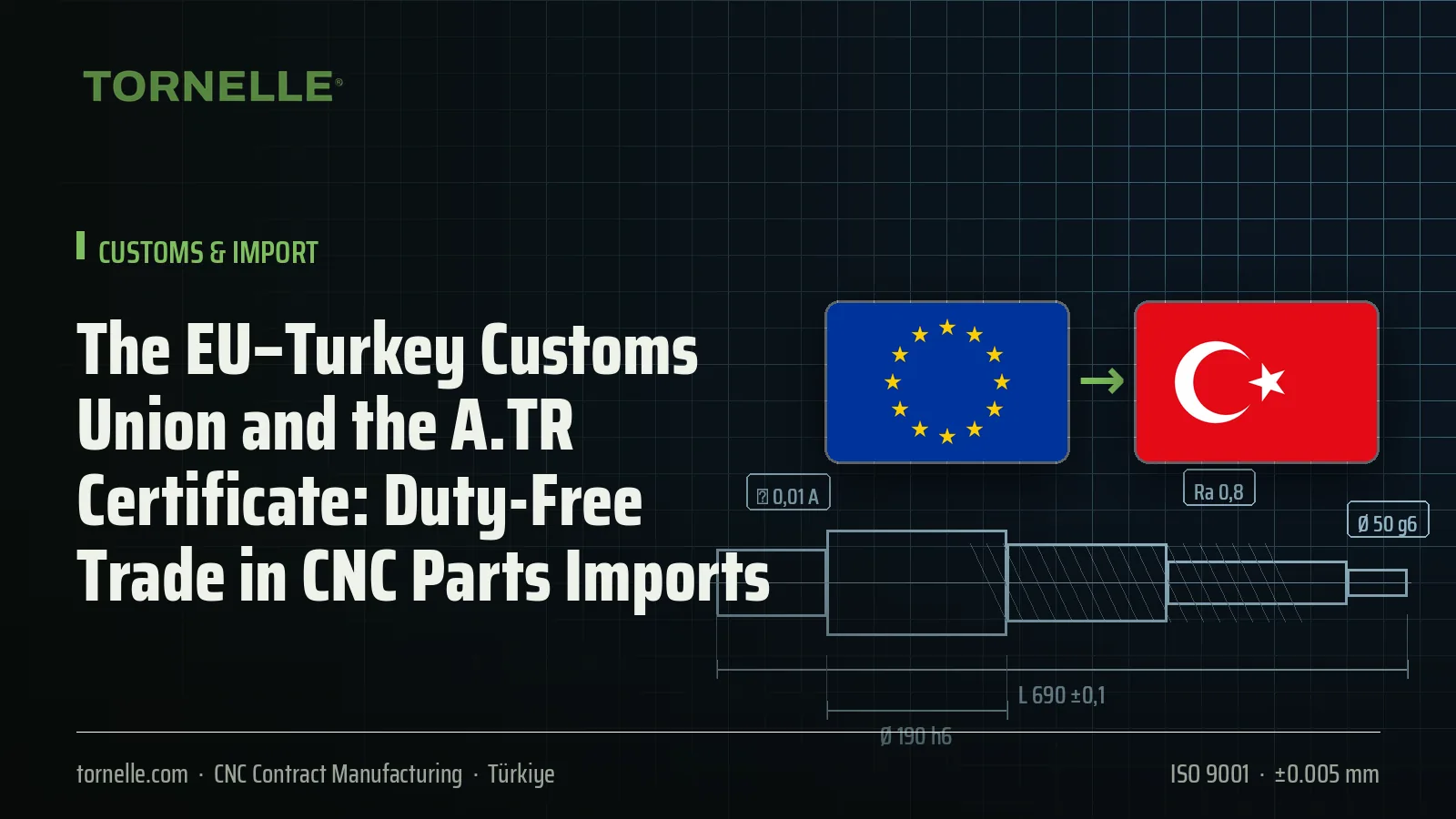
The most common question European buyers ask about sourcing from Turkey relates to customs: “Turkey isn’t an EU member; will we have to pay customs duties, and how much paperwork is involved?” The answer is much more positive than many people expect. The EU–Turkey Customs Union, in effect since 1996, has eliminated customs duties on industrial products between the two parties and introduced a common customs tariff. This article explains how this system works specifically for CNC-machined parts.
What Is a Customs Union?
A Customs Union represents a higher level of integration than a free trade agreement. Turkey and the EU have eliminated customs duties and equivalent taxes on industrial products and processed agricultural products:
- Eliminated customs duties and equivalent taxes between them;
- apply a common customs tariff toward third countries;
- Ensure harmonization in trade policy and technical regulations.
Practical result: An industrial product in free circulation in Turkey—whether produced in Turkey or imported from a third country with duties paid—enters the EU without paying customs duties. Metal parts machined with CNC lathes and milling machines, assembled subassemblies, and machine components fall under this scope.
What Is an A.TR Movement Certificate?
The A.TR is a movement certificate that certifies that the goods are in free circulation in Turkey (or the EU). It is an instrument for implementing the Customs Union and is not a certificate of origin: it proves that the goods are in free circulation, not that they are of Turkish origin. For this reason, parts processed in Turkey from imported raw materials (such as steel or aluminum of European origin) are also exported duty-free with an A.TR certificate.
A.TR Certificate:
- Issued by the Turkish exporter and endorsed by the Turkish customs authority or authorized bodies (electronically via the TOBB system);
- It is provided to the carrier as a single document per shipment, along with the invoice and packing list;
- It is attached to the import declaration at the EU customs office; zero customs duty is applied.
The Difference Between A.TR and EUR.1
| A.TR | EUR.1 / Declaration of Origin | |
|---|---|---|
| Scope of Use | EU–Turkey industrial products | FTA countries: United Kingdom, EFTA (Switzerland, Norway), others |
| What it certifies | Free circulation | Preferential origin (Turkish origin) |
| Raw material restriction | None (raw materials may be imported) | Rules of origin apply |
| Result | 0% customs duty | 0% or reduced customs duty |
For sales to the UK, a declaration of origin under the UK–Turkey Free Trade Agreement (FTA) is used instead of an A.TR certificate; see our UK guide for details. For Switzerland, an EUR.1 certificate or invoice declaration is valid; see the Switzerland guide.
How Is VAT Applied?
Even if the customs duty is zero, imports into the EU are subject to import VAT. This VAT is declared in the importer’s country and is deducted by VAT-registered companies; in other words, it is not a final cost. Practical information by country:
- Germany: Import sales tax is declared and offset as input tax.
- France: Mandatory reverse charge (autoliquidation) starting in 2022—no payment at customs.
- Netherlands: Deferral under Article 23—no payment at customs.
- Austria: Offset in the UVA via EUSt-Verrechnung.
- Italy, Spain, Belgium: Standard declaration and offset; deferral regimes are available under certain conditions.
Required Documents
- Commercial invoice: Exporter and importer information, importer’s EORI number, GTIP/HS code (8-digit CN code), Incoterms, currency, and value.
- Packing list: Part number, quantity, gross/net weight, number of packages.
- A.TR movement certificate: Endorsed and matching the shipment.
- Transportation document: CMR (road), AWB (air), or bill of lading.
- Import declaration: Filed electronically at the EU customs office by the carrier or customs broker.
For routine shipments, customs clearance is typically completed on the same day; in road transport, the vehicle does not wait at the border or at the destination customs office.
HS Codes for CNC Parts
Correct classification is the importer’s responsibility; the most common codes are:
- 7326 90 — other articles of iron or steel (general processed steel parts);
- 7616 99 — other articles of aluminum;
- 7419 80 — other articles of copper or brass;
- 8487 90 — machine parts (not specified elsewhere);
- 8483 — shafts, bearings, gears;
- 8481 90 — valve parts;
- 7318 — bolts, nuts, screws, and similar fasteners.
The part’s end use (e.g., engine parts, pump parts) may require a more specific code. Check with your customs consultant; due to the Customs Union, the code selection affects only statistics and regulatory compliance, not the tax rate.
Common Mistakes
- Failure to include the A.TR certificate with the shipment: The document can be submitted later, but the customs duty guarantee and correction process take time. Ensure your supplier includes the A.TR certificate in the standard set of documents.
- Missing EORI: An importer’s EORI number is mandatory for imports into the EU.
- Invoice–A.TR Discrepancies: Differences in quantity, value, or description may trigger inquiries.
- Sending an A.TR to the UK: Invalid after Brexit; a declaration of origin is required.
- Code error: Even if there is no tax impact, declaration errors carry the risk of penalties.
CBAM (Carbon Border Adjustment Mechanism) Note
The EU’s CBAM regulation will cover certain iron, steel, and aluminum products as of 2026. The scope primarily includes raw materials and semi-finished products (billets, sheets, profiles, wire); processed machine parts are largely excluded, though some HS codes 7326 and 7616 are included on the list. Regular importers should verify the scope on a product-by-product basis with their customs consultants. Turkish suppliers are preparing to provide the emission data required for CBAM reporting.
Frequently Asked Questions
Who issues the A.TR certificate?
A Turkish exporter issues it and has it certified by the Turkish customs authority; the importer does not need to take any action.
Is the A.TR valid for parts made in Turkey from imported raw materials?
Yes. The A.TR is a free circulation certificate, not a certificate of origin; it is valid as long as the raw material has been processed in Turkey and duties have been paid, regardless of where the raw material originated.
Is a customs broker required?
It is not mandatory, but in practice, the freight forwarder or customs broker files the import declaration; a fixed fee is charged per shipment.
Is an A.TR certificate required for sample shipments as well?
It is recommended for all shipments with commercial value; for low-value samples, a simplified declaration is possible, and the customs duty is still zero.
Conclusion
The Customs Union and the A.TR certificate bring the import of CNC parts from Turkey to the same level as intra-EU supply in terms of customs duties. With the correct set of documents, the process becomes completely routine after just a few shipments. For other aspects of sourcing from Turkey, please refer to our comprehensive guide; for shipping options, see our logistics guide; and you can request a quote for your parts.