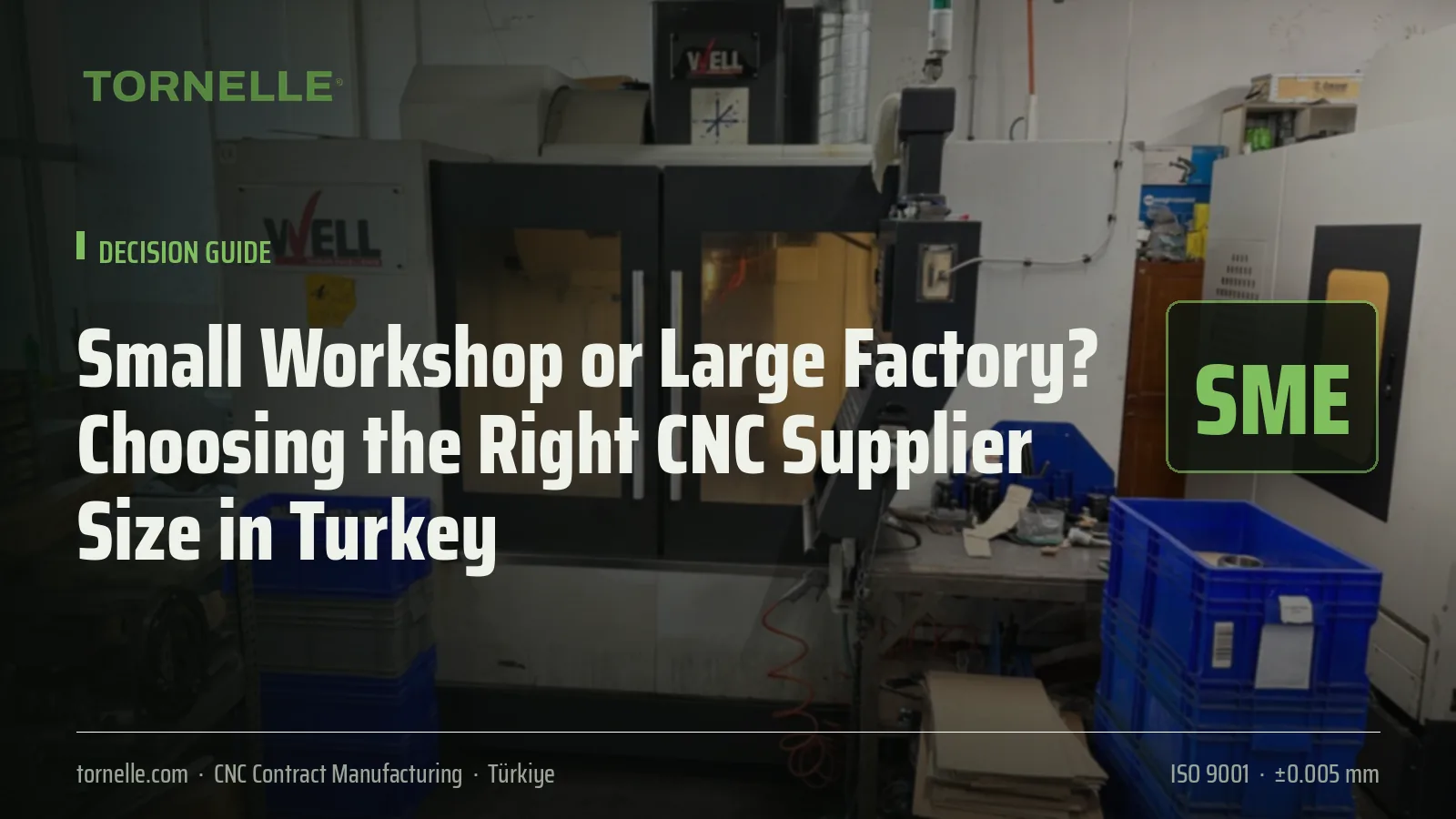
There is a mistake purchasers placing work in Turkey for the first time often make: the generalisation "a large factory is safer" or "a small workshop is cheaper". Reality is more nuanced. In our article how to choose the right supplier we listed the questions; this article focuses on a single dimension, supplier size.
Size Tiers in Turkey
| Tier | Number of machines | Employees | Typical customer |
|---|---|---|---|
| Micro workshop | 2–5 | 3–8 | Local machine builders, repair |
| Small workshop | 6–15 | 10–25 | Domestic OEMs, first export customers |
| Medium-sized | 15–50 | 25–100 | European SMEs, Tier-2 |
| Large factory | 50+ | 100+ | Tier-1, direct OEM supply |
In the organised industrial zones of Istanbul, Bursa, Kocaeli, Ankara, Konya and Izmir all these tiers sit side by side; our Turkey guide describes the overall structure of the ecosystem.
Comparison: Eight Dimensions
1. Price
A small workshop has low overheads; its hourly rate may be 10–25% cheaper. A large factory has scale advantages in raw-material purchasing, tooling agreements and automation; at high volumes (50,000+) it lowers the unit price. Result: small/medium workshop at low–medium volume, large factory at very high volume is usually more economical. Our article on price factors covers the size effect separately.
2. Flexibility and speed
In a small workshop the decision-maker stands next to the machine; an urgent sample, revision or small add-on order enters the schedule within hours. In a large factory planning is weekly; small orders are not prioritised. For prototypes and pilot batches this difference is decisive.
3. Quality-system maturity
In large factories IATF 16949, documented processes, a separate quality department and a CMM are standard. In small workshops ISO 9001 is common but the depth of implementation varies; measuring equipment may be limited. On the other hand, in a small workshop the master machinist's direct command of the part avoids the large-factory problem of "the system exists, but knowledge is lost at shift change". Question the practice, not the certificate; our ISO 9001 article gives the methods.
4. Capacity and dependency risk
For a small workshop your order may be 20–30% of turnover: attention is high, but the workshop losing a major customer or its key machinist leaving affects you. In a large factory you are 1%: the risk is spread, but so is your priority. The medium tier provides the balance for most European SMEs.
5. Communication
In a small workshop you speak directly to the owner or technical manager; English proficiency depends on the person. A large factory has sales engineers and project managers; responses are more corporate but slower.
6. Technology breadth
A large factory can offer turning, milling, grinding, heat treatment and coating under one roof. A small workshop does the core machining and handles secondary operations through reliable sub-suppliers; this is usually not a problem, but the traceability chain should be questioned.
7. Certification and compliance
If there are automotive Tier-1, aerospace (AS9100) or medical (ISO 13485) requirements, the size choice narrows by itself. For general machine building, ISO 9001 and a good measuring infrastructure are sufficient.
8. Financial resilience
On advance payment and payment terms the small workshop is stricter (cash flow); the large factory is open to 60-day terms. Our payment terms article has practical suggestions.
Problems Created by Size Mismatch
- Small customer, large factory: A 200-piece order joins the queue, delivery slips, technical questions go unanswered; and the price is not as low as expected.
- Large customer, small workshop: For 500,000 pieces a year the workshop must invest; if capacity falls short, quality drops and deadlines are missed.
- Certification mismatch: A customer requiring IATF rejects the ISO 9001 workshop at audit; time lost.
Decision Matrix
| Part profile | Recommended size |
|---|---|
| Prototype, 1–50 pieces, frequent revisions | Small or medium workshop |
| Mixed part family, 100–5,000 pieces/year, general machinery | Medium-sized workshop |
| Swiss-type turned part, 50,000–1,000,000 pieces/year | Medium or large supplier focused on Swiss-type turning |
| Automotive Tier-1, IATF mandatory | Large factory or IATF-certified medium-sized supplier |
| Aerospace/medical, special certification | Certified supplier; size secondary |
| Assembled sub-group, multi-process | Medium/large supplier with broad technology base |
Practical Advice: Audit Fit, Not Size
At quotation stage these three questions say more than size: What percentage of the supplier's capacity is your order? For which customer, and for how many years, has it made a similar part? With which instrument does it measure the critical feature and how does it report? A remote video audit is sufficient to verify the equipment and machine park. We explain our process openly on our how we work page.
Verifying Size Fit with a Remote Audit
A visit is not essential to understand a supplier's real size and capacity; a 45-minute video audit answers most questions. Suggested flow:
- Shop tour (15 min): Number and brands of machines, bar feeders, robots or pallet systems; how many machines are running at that moment?
- Measuring room (10 min): CMM, surface roughness tester, hardness tester, gauges and calibration labels; can they show calibration records on screen?
- Documentation (10 min): The traceability chain of one work order: material certificate → work order → inspection report → dispatch. Ask about a random part number.
- Capacity and customer profile (10 min): Monthly machine hours, current utilisation, the largest customer's share of turnover, export experience, who communicates in English?
In a small workshop the owner conducts this audit in person and answers immediately; in a large factory the quality and sales representatives take part. In both cases what you are looking for is the same: consistency between what is said and what is seen. A pilot order (50–200 pieces) after the audit confirms your size decision with concrete data. For the other dimensions of supplier choice see our supplier selection article.
Frequently Asked Questions
Can small workshops export abroad?
Yes; export documents (A.TR, invoice, packing list) are easily arranged with the forwarder. What matters is that the workshop has exported before.
Is a large factory always higher quality?
No; system maturity is high, but attention per part may be low. Medium and small workshops often deliver better results on tight-tolerance, low-volume jobs.
Should I stay with a single supplier?
A second source is recommended for critical parts; two suppliers of different sizes (one flexible, one with capacity) make a good combination.
What size is TORNELLE?
We are a small-to-medium, export-oriented workshop: CNC turning, 3–4-axis milling and Swiss-type turning; we work from prototype to medium series. See our about us page for our scope.
Conclusion
The right supplier size is the fit between your order profile and the supplier's capacity and system maturity; neither "large is safe" nor "small is cheap" is true on its own. Send your part drawings and annual quantity via our quote form; we quote while stating openly whether we fit your profile.