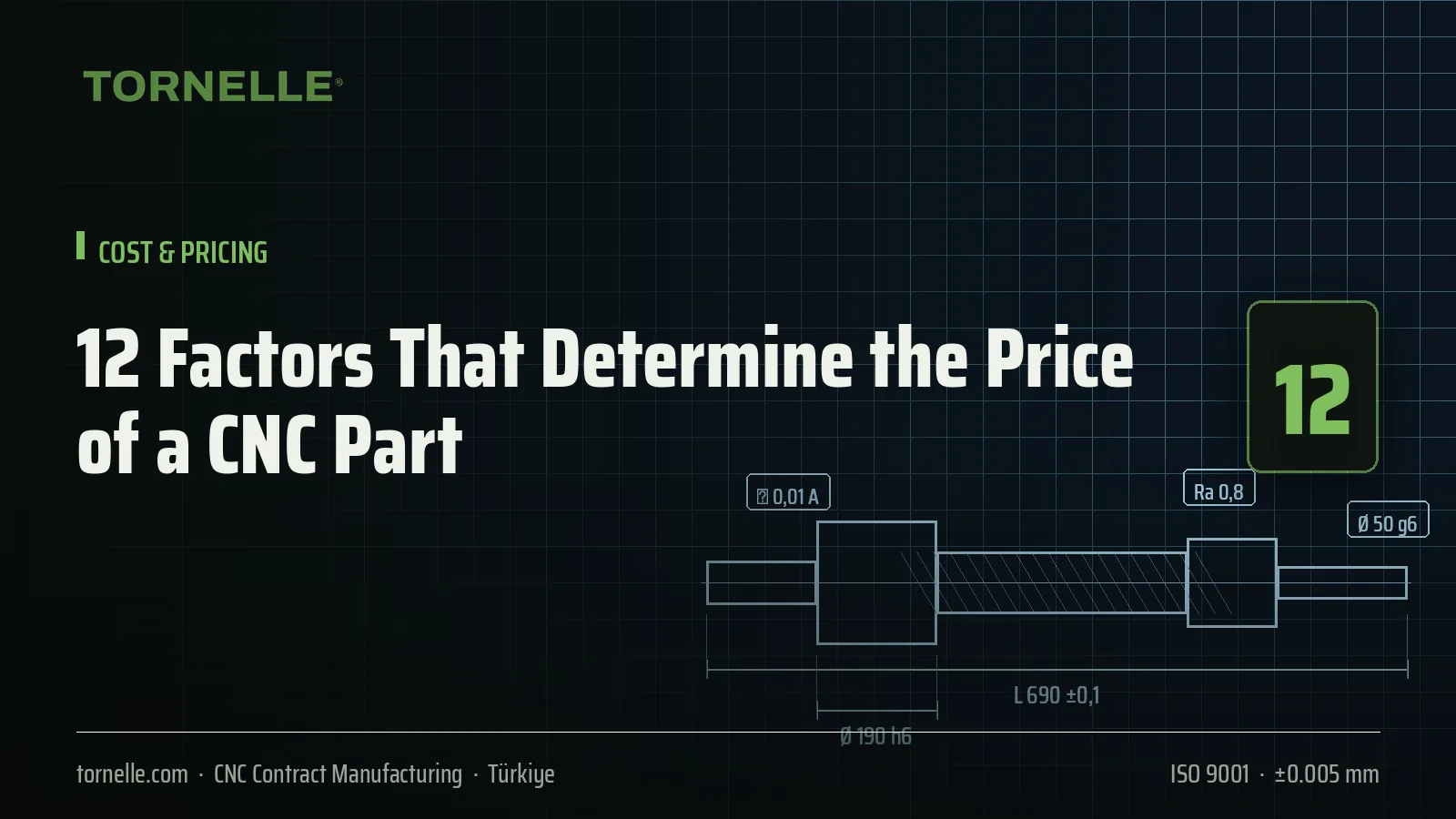
When evaluating a CNC contract manufacturing quote, the question we hear most often is, “Why does this part cost this much?” Price is not determined by a single factor but by the sum of a series of interrelated factors. Understanding these factors enables you to prepare a better RFQ and reduce costs during the design phase. Below, you’ll find the 12 factors that determine the price of a CNC part, their effects, and practical tips.
1. Type and Form of Raw Material
Material can account for 10–40% of the unit price. Auto steel and aluminum are cost-effective and quick to machine; stainless steel, titanium, and high-alloy steels are expensive in terms of both price per kilogram and machining time. The form of the material is also important: parts that can be produced from standard bar stock are less expensive than those requiring custom castings or forgings. Tip: Specifying the material flexibly—such as “1.4404 or equivalent”—allows the supplier to use suitable material from stock.
2. Quantity and Lot Size
Setup, programming, and first-article approval are fixed costs; as the quantity increases, the cost per unit decreases. A part costing 40 € for 10 units may drop to 12 € for 500 units. Sharing the total annual quantity and placing call-off orders in stages throughout the year results in both a lower unit price and reduced inventory.
3. Tolerances
General tolerances per ISO 2768-m class are covered at the standard cost; tolerances of ±0.01 mm or tighter require additional finishing passes, thermal equilibrium waiting time, and 100% measurement. Specifying critical dimensions with individual tolerances and leaving the rest in the general class can reduce the price by 8–20%. See our ISO 2768 guide for details.
4. Surface Roughness
Ra 3.2 µm is achieved directly through turning and milling. Ra 0.8 µm requires a lower feed rate and additional passes; Ra 0.4 µm and below typically require a secondary process such as grinding or honing. Specifying surface quality only on functional surfaces prevents unnecessary costs.
5. Geometric Complexity
Deep pockets, thin walls, small internal corner radii, long and narrow holes, through-holes, and free-form surfaces increase machining time and tooling costs. Matching the internal corner radius to the standard tool diameter (e.g., R4 instead of R3), maintaining a wall thickness of more than 1 mm, and keeping the hole depth below five times the diameter result in significant savings.
6. Number of Operations and Clamping Cycles
The number of times a part must be clamped and unclamped directly affects labor time. There is a significant difference between a turned part completed in a single clamping operation and a body that must be milled from three different sides. 4-axis machining or multi-axis turning reduces the number of clamping operations, thereby lowering the unit price; this is precisely where the choice of a Swiss-type lathe comes into play.
7. Machine Type and Number of Axes
A 3-axis milling hour is cheaper than a 5-axis hour; a Swiss-type lathe, on the other hand, offers the lowest unit cost for small-batch production of parts. The price decreases when the part is designed to be produced on the cheapest machine with the fewest setups.
8. Setup and Programming
CAM software, fixtures, special tools, and initial part approval represent a fixed cost independent of quantity. For repeat orders, this cost is incurred only on the first order; therefore, working with the same supplier over the long term reduces the unit price over time.
9. Measurement and Documentation Requirements
Sample measurement is standard; 100% CMM measurement, FAI report, PPAP file, material certificate, and measurement-based statistical records require additional time. You can use the list in our quality assurance article to determine which documents are truly necessary.
10. Coating and Heat Treatment
Anodizing, zinc plating, nickel plating, hardening, nitriding, and painting are performed by external suppliers; this adds both cost and an additional 3–10 business days. How post-coating dimensional tolerances (including coating thickness) are defined in the drawing also affects the price.
11. Packaging and Delivery Terms
For parts with sensitive surfaces, individual packaging, VCI corrosion protection, and special cases incur additional costs per unit. The choice of Incoterms (EXW, FCA, DAP) determines who pays for shipping; when comparing quotes, standardize all offers to the same delivery term.
12. Delivery Time
While the standard delivery time is 2–5 weeks, requests such as “needed in 1 week” disrupt capacity planning and typically require a 20–50% rush premium. A predictable call-off schedule allows the supplier to optimize their production schedule and keep prices low.
Checklist for Lowering Costs
- Share the annual volume and call-off schedule.
- Use ISO 2768-m for non-critical dimensions.
- Specify surface roughness only for functional surfaces.
- Match internal corner radii and hole depths to standard tools.
- Specify the material along with equivalents.
- Clarify the required documents (certificates, FAI, CMM); omit unnecessary ones.
- Compare quotes under the same Incoterms conditions.
Frequently Asked Questions
What is the largest cost component in the price of a CNC part?
For labor-intensive parts, it’s machine hours and labor (50–70%); for material-intensive parts, it’s raw materials (30–40%). Therefore, in countries like Turkey with low machine-hour rates, the greatest savings come from labor-intensive parts.
If the quantity doubles, how much will the price decrease?
For low quantities, where setup costs are high, the price drops by 20–35%; for high quantities, it drops by 5–10%. Requesting a tiered pricing list is the best approach.
Can I reduce the price without changing the design?
Yes: by optimizing the production volume, lead time, packaging, and documentation requirements. Even greater savings are possible through design for manufacturing (DFM).
In Turkey, in which currency are prices quoted?
Export-oriented Turkish suppliers provide quotes in euros or U.S. dollars; exchange rate risk is not passed on to the buyer.
Conclusion
The price of a CNC part is determined by a combination of 12 factors, most of which are within the buyer’s or designer’s control. By making informed decisions regarding tolerances, surface finish, geometry, and quantity, it is possible to source the same part at a 20–40% lower cost. Submit your technical drawings via the quote form, and we’ll provide our cost-saving recommendations along with the price quote.