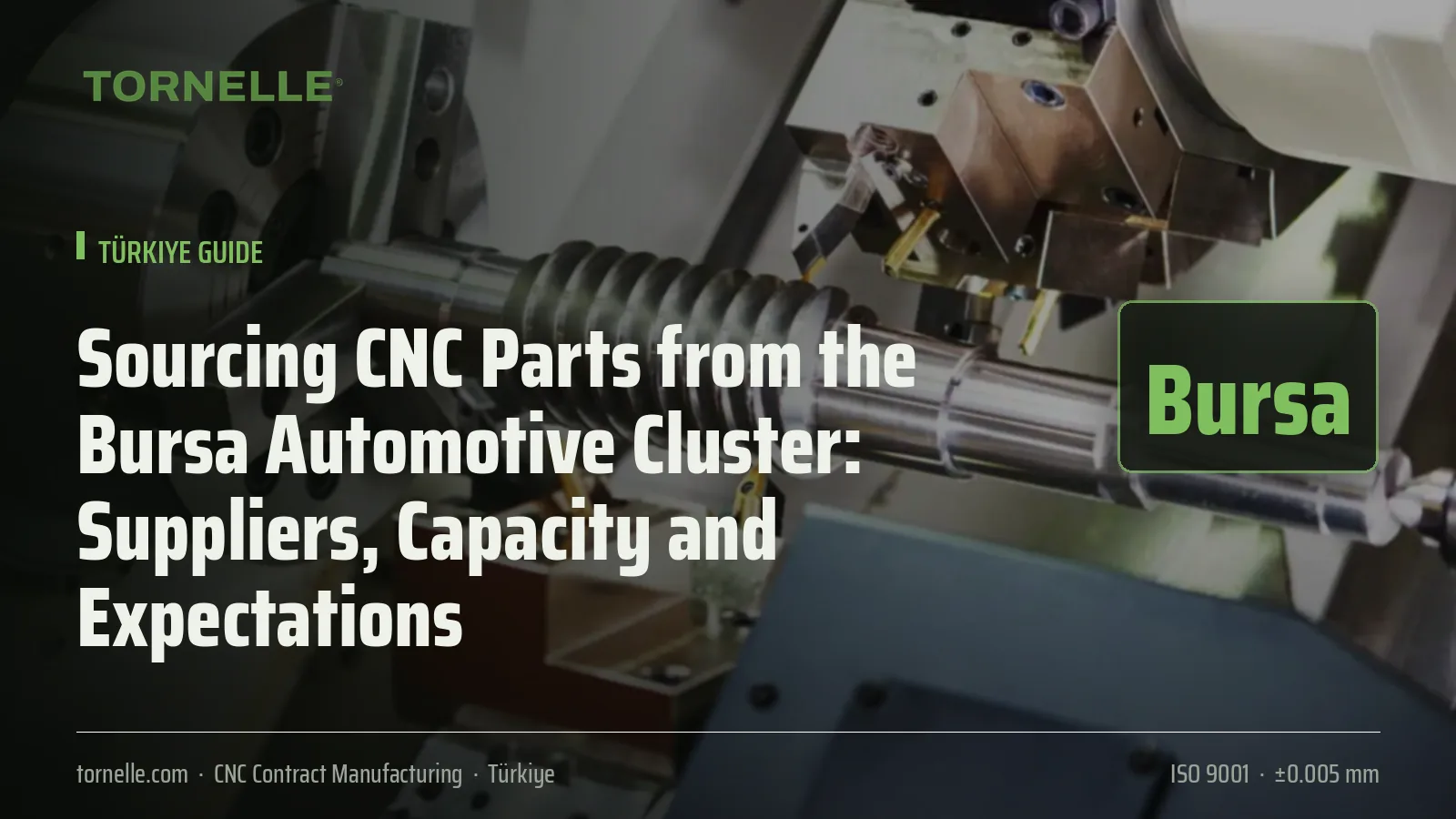
A significant part of Turkey's automotive production takes place in Bursa: the Renault and Fiat (Tofaş) plants, thousands of supply-industry companies and a vast machining, casting, forging and tooling base working for automotive. Continuing our Istanbul ecosystem article, this article explains what Bursa means for the European buyer. Our Turkey for automotive suppliers article provides the sector framework.
Structure of the Cluster
- OEMs: Oyak Renault (passenger car production in Bursa, exports to Europe) and Tofaş (Fiat/Stellantis; light commercial and passenger). Karsan produces buses and light commercial vehicles.
- Tier-1: Large suppliers such as Bosch, Valeo, Mako, Maxion, Beyçelik Gestamp, Coşkunöz and Ermetal; transmission, brake, lighting, wheel and body parts.
- Tier-2/3: Hundreds of SMEs: turned parts, milled housings, casting machining, heat treatment, coating, tooling, fixtures.
- Industrial zones: Bursa OSB, Demirtaş OSB (DOSAB), Nilüfer OSB (NOSAB), Hasanağa OSB, İnegöl OSB, Gürsu, Kestel; the automotive supply industry is concentrated in these zones.
- Institutions: Most members of TAYSAD (Association of Automotive Parts and Components Manufacturers) are in Bursa and Marmara; OİB (Automotive Industry Exporters' Association) publishes export data.
Quality Culture: The Prevalence of IATF
Bursa's distinguishing feature is the quality system that OEMs have imposed on the supply industry for decades. The density of IATF 16949 (and formerly ISO/TS 16949) certified shops is the highest in Turkey; the concepts of PPAP, APQP, FMEA, SPC, MSA and 8D have reached SME level. A German Tier-1 receiving a PPAP level 3 package from a Tier-2 in Bursa is nothing unusual. This culture is valuable for non-automotive buyers too: a buyer from the machinery, white goods or hydraulics sector finds in Bursa a supplier that works with automotive discipline.
Machining Capacity
| Part group | Density in Bursa | Note |
|---|---|---|
| Turned steel parts (shafts, pins, bushings, flanges) | Very high | Multi-spindle and CNC lathe capacity; experience with heat-treatable and case-hardening steels |
| Casting and forging machining (brake, transmission, steering) | Very high | Fixtured series machining, high volume |
| Aluminium milled housings | High | Mainly die-casting machining |
| Swiss-type parts | Medium | Istanbul is denser |
| Gear manufacturing | High | Hobbing, grinding; transmission supply industry |
| Heat treatment and coating | Very high | Case hardening, induction, nitriding, zinc-nickel, KTL |
Bursa Compared with Istanbul
Istanbul leads in variety and Swiss-type density; Bursa leads in automotive discipline, series machining and heat treatment/coating depth. Rent and labour costs in Bursa are 10–20% lower than Istanbul; on the other hand, the capacity pressure created by the OEMs can make it difficult for small customers to find room in busy periods. Because the two cities are 150 km apart (1.5–2 hours via the bridge), in practice they work like a single Marmara ecosystem; a shop in Istanbul routinely works with a heat treater in Bursa, and a shop in Bursa with a forwarder in Istanbul. The regional distribution is in our Turkish machining industry article.
Logistics
Bursa's own port, Gemlik, is connected to Europe and North Africa by Ro-Ro and container lines; most automotive exports go from here. Road: Bursa–Kapıkule 350 km; 4–5 days to Germany, Ro-Ro alternative (Trieste, Sète) to France and Italy. Air freight via the Istanbul airports (1.5–2 hours away). Thanks to the weekly milk-run and JIT shipments of automotive Tier-1s, finding regular groupage trucks on the Bursa–Europe route is easy.
Price and Capacity Dynamics
The price level in Bursa can be 5–10% more competitive than Istanbul for turned and series parts; however, large suppliers tied to OEMs show no interest in small orders. The ideal profile for the European buyer is a 20–80-person Tier-2 shop that has automotive customers but is not 100% dependent on automotive: discipline exists, flexibility is preserved. The cyclical nature of the automotive sector (model changes, demand fluctuations) keeps these shops open to non-automotive customers; particularly competitive quotes are obtained in downturn periods.
Opportunity for Non-Automotive Buyers
Although Bursa's capacity was built for automotive, the same machine park and quality system can be used for machinery, agricultural equipment, white goods, hydraulics and rail parts. A German hydraulics manufacturer can buy case-hardened and ground pistons with IATF discipline from an automotive Tier-2 in Bursa; a Dutch agricultural machinery manufacturer can benefit from the forging machining capacity. For sector notes see our hydraulics and pneumatics article.
When Selecting a Supplier in Bursa
- Verify the IATF certificate and its scope; if there is no certificate, ISO 9001 + automotive customer references may be sufficient.
- Ask about customer concentration: a shop 70% dependent on a single OEM carries capacity and priority risk.
- See the measuring infrastructure: CMM, SPC records, MSA studies.
- Ask who performs heat treatment and coating and about traceability; the approved subcontractor chain in Bursa is strong.
- Confirm export experience: directly to Europe, or only via local Tier-1s?
- Learn the capacity utilisation and model-change periods.
Example: A German Tier-1's Bursa Supplier
A German brake system manufacturer works with an IATF-certified Tier-2 in Bursa for 200,000 pins and bushings a year in case-hardening steel (16MnCr5). The flow: raw material from the steel stockholder in Bursa with 3.1 certificate; turning and milling in the shop; case hardening and tempering at the heat treater 20 km away; grinding in the shop; 100% dimensional inspection on an automatic measuring station; SPC data reported monthly; shipment by weekly groupage truck to Germany, 5 days. PPAP level 3 was completed in the first year, in subsequent years only change PPAPs were made. This model can be set up in the same way in Bursa for non-automotive buyers.
Visit Practicalities
The nearest airport to Bursa is Yenişehir, but the number of flights is limited; in practice you fly to Istanbul Sabiha Gökçen and continue to Bursa by a 2-hour road journey or the Yalova ferry. Visiting Istanbul and Bursa suppliers on the same trip over two days is a common plan.
Frequently Asked Questions
Should I prefer Bursa or Istanbul?
Bursa for automotive discipline, series turned/forged parts and heat-treatment-heavy work; Istanbul for variety, Swiss-type turning and fast logistics. For most buyers the two are a single Marmara ecosystem.
How many automotive supply companies are there in Bursa?
There is no exact figure; according to TAYSAD members and OSB records, hundreds of Tier-1/2 and thousands of sub-suppliers operate in the region.
Are small non-automotive orders accepted?
Large Tier-1s generally no; 20–80-person Tier-2 shops yes, especially in periods when automotive demand falls.
Is shipment from Gemlik port to Europe possible?
Yes; Ro-Ro and container lines serve Italy, France and other ports. For small batches, road groupage is more practical.
Conclusion
Bursa is the cluster with the deepest automotive quality culture in Turkey, and this discipline is accessible to non-automotive European buyers too. TORNELLE is located in Istanbul İkitelli and works with the heat treatment, coating and logistics network of the Marmara ecosystem; send your technical drawings for turned, milled and Swiss-type parts via our quote form and you receive a quote within 24 hours.