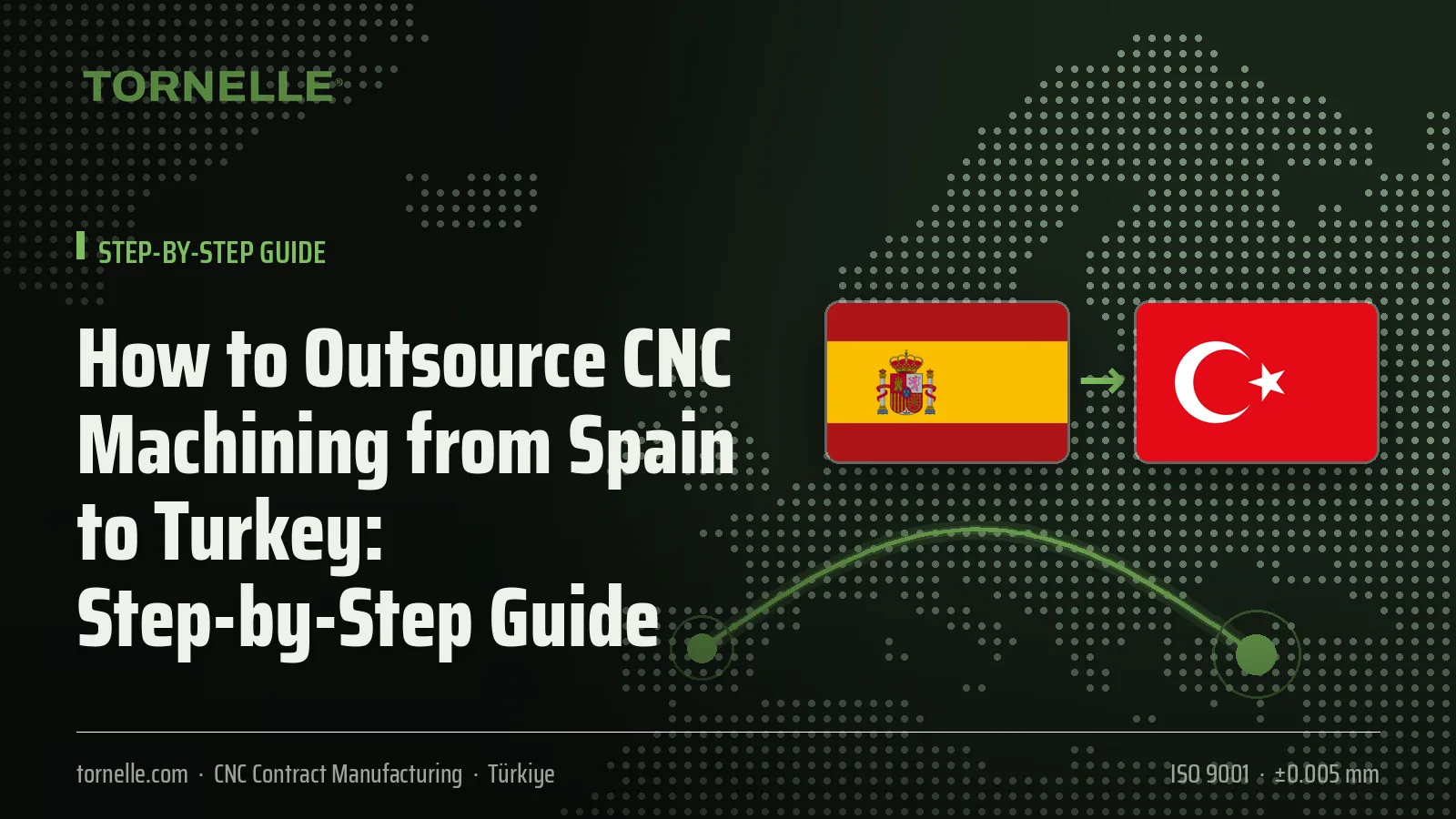
Spain is Europe's second-largest automotive producer, has a strong machine tool (Basque Country) and rail industry, and is among the world leaders in the wind and solar sectors. This industry is turning to Turkey for a balance of capacity and cost. Our article on the advantages for Spain explained the reasons; this article shows the practice step by step.
Step 1: Choose the Right Parts
Machining capacity in Spain is strong especially in the Basque Country and Catalonia; the groups where outsourcing to Turkey makes most sense are turned parts, Swiss-type parts, aluminium milled housings, stainless parts and medium-series work that occupies in-house capacity. Wind and solar equipment suppliers (tracker drive parts, turbine auxiliary system parts) and rail components are profiles where Turkey is strong; our energy sector article gives details.
Step 2: Prepare the Technical Documentation
Spanish technical drawings are based on UNE-EN (ISO-compatible) standards; Turkish suppliers read them without problems. Points to watch: translating Spanish notes into English (acabado superficial → surface finish, tratamiento térmico → heat treatment, tolerancia general → general tolerance), giving the material designation with the EN number (C45 instead of old UNE codes such as F-1140), writing the coating and documentation expectation. File package: STEP + PDF + quantity/annual forecast. Our technical drawing checklist shows the gaps.
Step 3: RFQ and Quote Comparison
Send the same package to 2–3 Turkish suppliers; euro-based quotes arrive in 24–72 hours. Compare quotes on the same Incoterm (FCA Istanbul or DAP Barcelona/Bilbao) and the same scope. Compared to Spanish prices, a 20–35% difference on turned parts and 25–40% on Swiss-type parts is typical; because Spain's own costs are lower than Germany's, the gap is not as large as in Germany. Our RFQ guide helps.
Step 4: Verify the Supplier
A direct flight from Madrid or Barcelona to Istanbul is 3.5–4 hours; a two-day visit is practical. Alternatively a video audit: machine park, measuring room, calibration, reference parts. Question documentation, export experience and capacity with our 15-question list.
Step 5: Samples and Inspection Report
1–5 samples are delivered with a ballooned drawing and inspection report; in automotive projects the PPAP level is set from the start. Spanish automotive suppliers (suppliers to SEAT, Renault, Ford, Stellantis) are used to the IATF culture; confirm that the supplier can prepare a PPAP package. Samples reach Spain by courier in 3–4 days.
Step 6: Customs and Tax
- A.TR: Thanks to the Customs Union, industrial products are free of customs duty; the supplier issues the A.TR. Our A.TR article gives details.
- IVA: 21% IVA is assessed on import; the IVA-registered company reclaims it in the return. For large importers the "IVA diferido" (deferred IVA) regime removes the cash outflow entirely; check with your tax adviser.
- EORI: A Spanish EORI (ES + NIF) is required in the customs declaration.
- Declaration: The forwarder's customs broker (agente de aduanas) files the import declaration; documents: invoice, packing list, A.TR, CMR or bill of lading.
- Intrastat: Not required because Turkey is outside the EU.
Step 7: Logistics
Spain is far from Turkey by road (Istanbul–Barcelona ~3,000 km, Bilbao ~3,500 km); there are two main options:
- Road: Balkans – Austria/Italy – France – Spain; full truck 5–7 days, groupage 7–10 days. Groupage €200–320 per pallet.
- Ro-Ro + road: Turkey (Pendik/Çeşme) – Trieste Ro-Ro (2–3 days) + Italy–France–Spain road (2–3 days); total 5–7 days. Alternative: the Sète (France) Ro-Ro line is one day from Barcelona.
- Sea: Istanbul/Izmir – Barcelona/Valencia container, 7–12 days; economical for large batches.
- Air: 2–3 days to Madrid and Barcelona; for samples and urgent parts.
Transit times are detailed in our logistics article.
Step 8: Payment
On the first order 30–50% advance + balance before shipment; in a regular relationship 30–60 days credit. The 60–90 day terms and "pagaré" (promissory note) practice common in Spain are not customary for Turkish suppliers; a SEPA transfer in euros arrives in 1–2 days. Our payment terms article explains the options.
Step 9: Communication
English is standard in Turkish export shops; Spanish is rare. The level of English in Spanish engineering teams varies; conducting technical communication in writing and supported by sketches/drawings prevents misunderstandings. The time difference is 1–2 hours (summer/winter); take into account in planning that the lunch break in Spain is late (14:00–16:00). Designate one technical and one commercial contact.
Step 10: Series and Continuity
After the first series batch, set up a frame agreement (annual forecast, price validity, call-off frequency); storage of programs and fixtures, revision procedure and OTD/PPM measurement should be in writing. Monthly consolidated shipments and safety stock at a forwarder warehouse in Spain eliminate the effect of the long road route.
Spain-Specific Notes
- Basque machine tool cluster: The Elgoibar–Bilbao axis; Turkey is a suitable source for medium–large turned parts and welded-and-machined assemblies.
- Automotive: IATF-disciplined Turkish suppliers for Tier-2/3 in Catalonia, Valencia, Aragon and Castile; see our Bursa cluster article.
- Renewable energy: High-volume turned/Swiss-type parts for tracker and turbine suppliers; Turkey's strongest profile.
- Rail: Expectation of EN 15085 welding and material traceability for CAF, Talgo and their suppliers; a 3.1 certificate is standard for machined parts.
- Holiday periods: Production slows in Spain in August; the Ramadan and Eid al-Adha holidays in Turkey (1–2 weeks per year in total) should be planned for.
Example Timeline
The first order of an agricultural machinery manufacturer in Zaragoza typically flows like this: week 1 RFQ and quote; week 2 video audit and sample order; weeks 3–5 sample production, inspection report and courier delivery; week 6 sample approval and series order; weeks 8–10 series production; weeks 11–12 delivery to Spain by Ro-Ro + road. About three months in total; 4–6 weeks for repeat orders. After the first part is approved, other parts in the bill of materials are added gradually.
Frequently Asked Questions
Is there customs duty on imports from Turkey?
0% on industrial products with the A.TR; only 21% IVA is assessed and reclaimed (with IVA diferido the cash outflow is also removed).
How long is the delivery time to Spain?
Road or Ro-Ro+road 5–7 days, groupage 7–10 days, sea 7–12 days, air 2–3 days. Production time of 2–4 weeks is added.
Does the supplier speak Spanish?
Usually not; technical communication in English is standard. Written communication supported by drawings and sketches is sufficient.
Are 90-day terms possible?
Not on first orders; in a regular relationship 30–60 days is common, 90 days may be possible exceptionally and with export credit insurance.
Conclusion
For Spanish companies Turkey is accessible with duty-free import via A.TR, reclaimable IVA and 5–7 day logistics; 20–40% savings are realistic in automotive, renewable energy and machinery supply chains. To try your first order, send your technical drawings via our quote form; within 24 hours you receive a euro-based quote with a DAP Spain option.