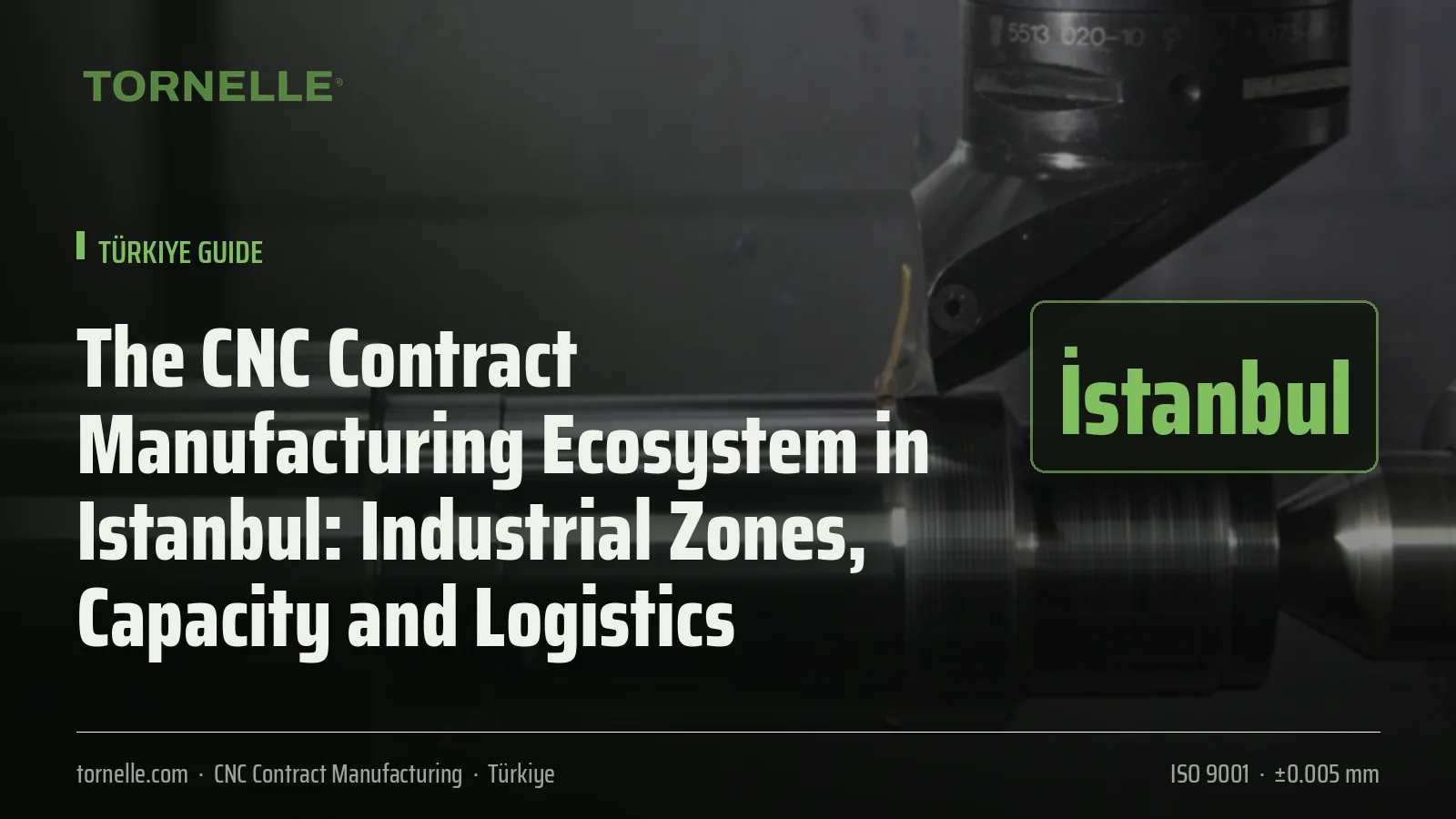
The largest share of Turkey's machining capacity is in Istanbul. Dozens of organised industrial zones and industrial estates on both sides of the city bring hundreds of shops together in a single ecosystem. This article, a continuation of our Turkish machining industry piece, takes a close look at Istanbul. TORNELLE also operates within this ecosystem, in the Ikitelli Organised Industrial Zone.
Why Is Istanbul Different?
- Density: Hundreds of shops sit side by side in one industrial estate; material stockists, heat treatment, plating, grinding, tooling and measurement services are on the same street. A part goes to plating in the morning and comes back in the evening.
- Variety: Swiss-type turning, turn-mill, 5-axis, tooling, precision grinding, wire EDM; there is a specialist shop for every technology.
- Export culture: The cluster closest to Europe and most experienced in exporting; A.TR, packaging and document processes are routine.
- Logistics: Dozens of direct daily flights to Europe from Istanbul Airport and Sabiha Gökçen; the ports of Ambarlı and Haydarpaşa; 250 km to the Kapıkule border crossing.
- Workforce: The largest pool of skilled CNC operators and CAM programmers; vocational schools and universities nearby.
Industrial Zones and Their Character
| Zone | Side | Character | Road access to Europe |
|---|---|---|---|
| Ikitelli OIZ (Başakşehir) | European | Turkey's largest OIZ; metalworking, hardware, tooling, Swiss-type turning, mixed contract manufacturing; thousands of SMEs | Very good; close to the TEM motorway and the airport |
| Hadımköy / Esenyurt / Beylikdüzü | European | Larger factories, automotive suppliers, machinery manufacturing | Very good; towards Kapıkule |
| Dudullu OIZ (Ümraniye) | Asian | Precision machining, hydraulics, defence suppliers, medium-sized shops | Good; bridge crossing required |
| Tuzla / Gebze corridor | Asian | Shipyard suppliers, heavy machining, chemicals, large plants | Good; Anatolian motorway |
| Bayrampaşa / Topkapı | European | Older industry; small shops, repair, quick jobs | Good |
| Kıraç / Çatalca | European | Newly developing areas; plants on large plots | Very good; closest to the border |
For the European buyer, zones on the European side offer half a day's advantage in road logistics; the Asian side is strong in precision machining and defence supply. Transit times are detailed in our logistics article.
Shop Profile
The typical exporting contract shop in Istanbul has 8–30 machines and 10–40 employees, is ISO 9001 certified and is run personally by its owner. The machine park is of Japanese, Taiwanese, Korean and German origin; Swiss-type lathes (Citizen, Star, Hanwha, Tsugami) are concentrated in Ikitelli and Dudullu. Large-scale plants (50+ machines) are found along the Hadımköy and Gebze corridors. In our supplier scale article we explained which profile suits which job.
How Does the Sub-Supplier Network Work?
The real strength of the Istanbul ecosystem is that the limits of a shop's service are set not by its own machine park but by the network around it:
- Material: Steel, stainless, aluminium and brass bar stockists are inside the industrial estates; standard material is supplied the same day.
- Heat treatment: Hardening, nitriding and induction plants turn parts around in 1–3 days.
- Plating: Anodising, zinc, nickel, chrome and passivation plants; details in our surface treatments article.
- Grinding and honing: Cylindrical and surface grinding, honing specialists.
- Measurement: Accredited calibration laboratories and independent CMM measurement services.
- Logistics: Dozens of forwarders running weekly groupage trucks to Europe; export customs close to the industrial zone.
The practical result for the buyer: a single machine shop in Istanbul can deliver finished, plated, hardened and documented parts from one point.
Capacity and Price Dynamics
Rent, labour and energy costs in Istanbul are higher than in Anatolian cities; in return, productivity, export experience and sub-supplier speed largely close this gap. The price level may be 5–15% higher than Konya or Bursa; but for the European buyer the total lead time and document quality usually justify the difference. Utilisation is seasonal: September–December and March–June are busy periods; customers who share annual forecasts are prioritised with capacity reservations.
Visiting and Communication Practice
There are 3–4-hour direct flights to Istanbul from Germany, the Netherlands, the UK and Scandinavia many times a day; arriving in the morning and returning in the evening is possible. Ikitelli OIZ is 25 minutes from the airport. For shops on the Asian side, Sabiha Gökçen is more convenient. Visit plan: shop tour and measuring room in the morning, technical meeting at midday, sub-supplier visit (plating or heat treatment) in the afternoon. Remote audits and video meetings are also common; there is a question list in our supplier selection article.
What to Look for When Selecting a Supplier in Istanbul
- Verify export experience: to which countries, for how many years, with which documents?
- Ask about the sub-supplier chain: who does plating and heat treatment, how is traceability ensured?
- See the measurement infrastructure: CMM, surface roughness, hardness; calibration records.
- Find out capacity utilisation and dependence on large customers.
- Clarify the contact person: who will provide technical communication in English (or German)?
- Request a reference part and a sample inspection report.
Typical Order Flow from Istanbul to Europe
The working rhythm of a German machinery manufacturer with its Istanbul supplier runs like this: a call-off order arriving by e-mail on Monday morning is confirmed the same day; material arrives at the shop from the stockist in the industrial estate in the afternoon; machining takes 3–8 working days; if plating is needed, 2–3 days at the sub-supplier; final inspection and packaging one day; the groupage truck leaving Thursday is in Germany the following Tuesday. Total 2–3 weeks; in urgent cases air freight brings it under a week. This rhythm is possible because sub-suppliers and the forwarder are in the same area; with suppliers in Anatolia, one or two days are added to each step.
Concentration of Swiss-Type Turning
Istanbul hosts the greater part of Turkey's Swiss-type turning capacity; the hardware, fastener, connector and pneumatic component industries created this concentration. For high-volume brass, free-cutting steel and stainless parts from Ø1–32 mm bar, Istanbul shops are among the most competitive options in Europe. You can see our capacity on our Swiss-type turning page.
Frequently Asked Questions
How many CNC shops are there in Istanbul?
There is no official figure; Ikitelli OIZ alone has more than 30,000 businesses, a significant share of them in metalworking. Across the city, thousands of machining shops are estimated.
Are Istanbul prices higher than in Anatolia?
Generally 5–15% higher; but logistics speed, export experience and sub-supplier density usually close this gap in total cost.
European side or Asian side?
The European side for road exports and Istanbul Airport; the Asian side stands out for precision machining and defence supply. The bridge crossing makes half a day's difference in logistics.
Where is TORNELLE in Istanbul?
In Ikitelli OIZ, Başakşehir; 25 minutes from Istanbul Airport, a few minutes from the TEM motorway. Address and directions are on our contact page.
Conclusion
Istanbul is the machining ecosystem closest to Europe and the densest: every technology, every ancillary service and every logistics option gathered in one city. If you would like a quote for CNC turning, milling and Swiss-type turned parts from our shop in Ikitelli OIZ, send your drawings via our quote form; if you would like to visit, we are 25 minutes from the airport.