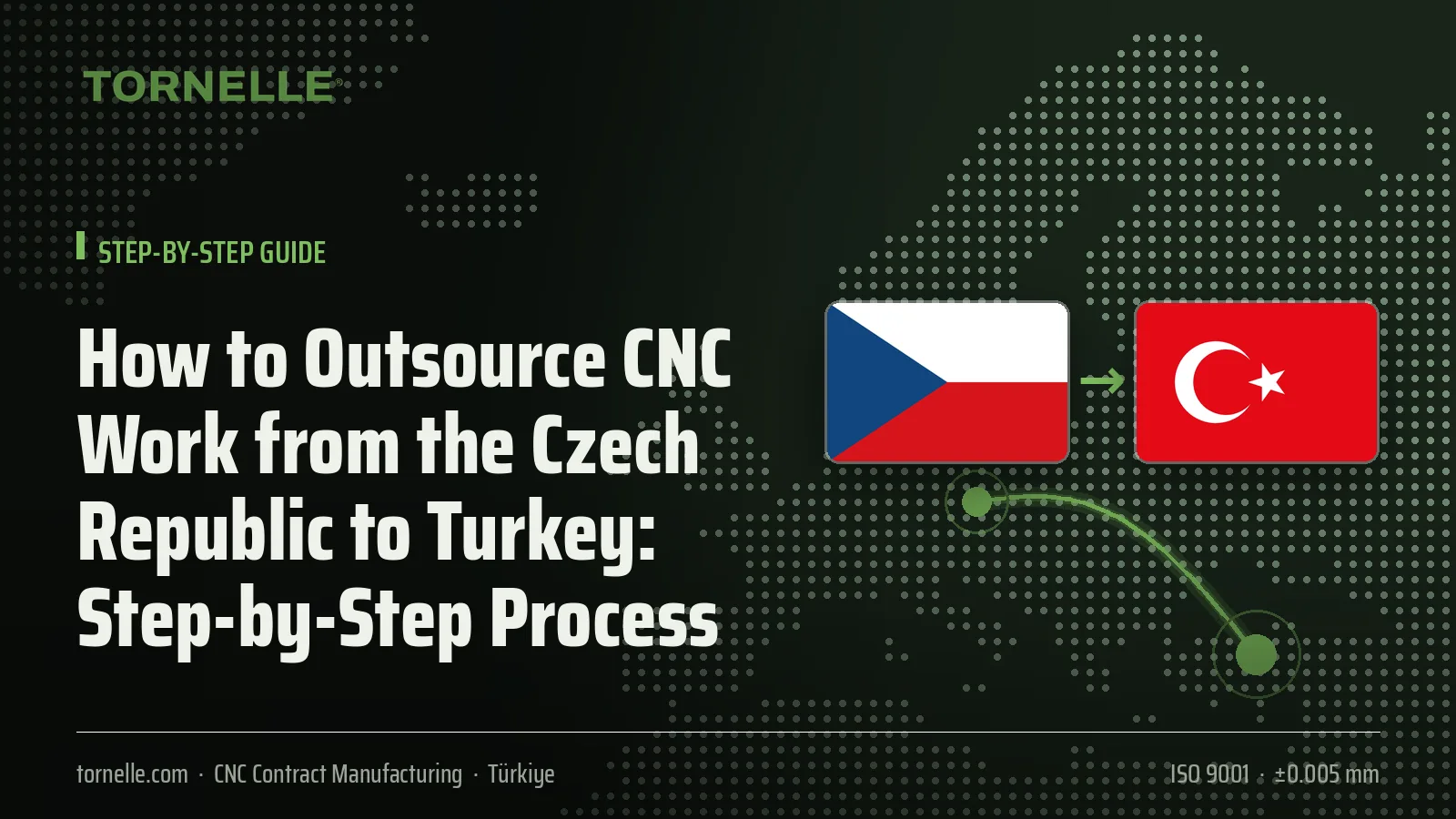
The Czech machining industry is among the most advanced in Europe; in recent years, however, rapidly rising wages, unemployment at the EU's lowest level and the automotive sector locking up capacity have pushed Czech machinery manufacturers to look for additional sources. Our advantages article for the Czech Republic explained the reasons; this article shows the implementation step by step. Our total cost of ownership article is also complementary.
Step 1: Select the Right Parts
Czech manufacturers have strong milling and large-part machining capacity in their own plants; the groups where outsourcing to Turkey makes most sense are turned parts, Swiss-type parts, medium-series aluminium milled parts and routine work that blocks internal capacity. Select 5–10 parts from the BOM weighted by annual turnover; non-critical, design-frozen and repeating parts should be the first candidates.
Step 2: Prepare the Technical Documents
Czech technical drawings are ISO-based and refer to ČSN standards; Turkish suppliers read ISO/EN/DIN equivalents, but ČSN material numbers (for example ČSN 11 373, 12 050, 14 220) must be given with their EN equivalents (S235JR, C45, 16MnCr5). Czech notes on drawings should be translated into English; our technical drawing checklist shows the gaps. File package: STEP + PDF + quantity/annual forecast + documentation expectation.
Step 3: Send the RFQ and Compare Quotes
Send the same package to 2–3 Turkish suppliers; a euro-based quote arrives in 24–72 hours (CZK pricing is rare; the buyer manages the currency risk or buys in euros). Compare quotes on the same Incoterm (FCA or DAP Brno) and the same scope; are certificates and inspection reports included? Against Czech prices a difference of 20–35% on turned parts and 25–40% on Swiss-type parts is typical; because the Czech Republic is itself low-cost, do not expect a gap as large as in Western Europe. Our RFQ guide helps.
Step 4: Verify the Supplier
A direct flight from Prague or Brno to Istanbul takes 2.5–3 hours; a day-trip visit is possible. Alternatively, a 45-minute video audit: machine park, measuring room, calibration records, reference parts. With our 15-question list, question the ISO 9001 certificate, export experience and capacity utilisation.
Step 5: Samples and Inspection Report
Before series, 1–5 samples are delivered with a ballooned drawing and inspection report; in automotive projects the PPAP level is set from the start. The Czech automotive supply industry is used to VDA and IATF culture; confirm that the supplier can prepare a PPAP package. Samples are in the Czech Republic by air freight in 2–3 days.
Step 6: Customs and Tax
- A.TR: Thanks to the Turkey–EU Customs Union, industrial products are duty-free; the supplier issues the A.TR. Our A.TR article gives details.
- DPH (VAT): 21% DPH accrues on import; a DPH-registered company offsets this in the same return (without paying). There is no cash outflow.
- EORI: Your Czech EORI number (starting with CZ) is required in the customs declaration; if you do not have one, it is obtained from the Czech customs administration.
- Declaration: Your forwarder's customs broker files the import declaration; documents: invoice, packing list, A.TR, CMR.
- Intrastat: Because Turkey is not an EU member, no Intrastat declaration is required; the import customs declaration is sufficient.
Step 7: Logistics
Istanbul–Czech Republic by road is about 1,900–2,100 km; route Kapıkule (Bulgaria) – Romania or Serbia – Hungary – Slovakia/Austria – Czech Republic. Full truck 3–4 days, groupage 4–6 days; there are regular weekly groupage lines from Istanbul to Central Europe. Air freight to Prague 1–2 days. Groupage cost per pallet is in the range of EUR 120–220. Transit times are detailed in our logistics article.
Step 8: Payment
On the first order, 30–50% advance + balance before shipment is common; in a regular relationship 30 days net is standard. SEPA transfer in euros takes 1–2 days; Turkish banks use euro accounts. Payment in CZK is generally not accepted; the buyer holds a euro position for the exchange difference. Options are explained in our payment terms article.
Step 9: Communication and Language
Turkish exporting shops have English and mostly German technical communication; Czech should not be expected. Because Czech engineers generally work in English or German, there are no problems. The time difference is one hour; questions are answered the same day. Designate one technical and one commercial contact; confirm decisions by e-mail.
Step 10: Series and Continuous Improvement
After the first series batch, set up a framework agreement (annual forecast, price validity, call-off frequency); put retention of programs and fixtures, the revision procedure and delivery performance measurement (OTD, PPM) in writing. For the Czech automotive supply industry, a kanban or consignment stock model works in practice with Turkey; 4–5-day road freight makes it possible.
Czech-Specific Notes
- Automotive density: For Tier-2/3 suppliers around Škoda, Hyundai and TPCA, IATF-certified or IATF-compliant Turkish suppliers should be preferred.
- Machinery manufacturing: For machine tool and energy equipment manufacturers in Brno and Plzeň, medium-to-large turned parts and welded-machined groups are suitable candidates.
- German bridge: The closeness of Czech–German business culture eases communication with German-speaking Turkish suppliers.
- Geography: The Czech Republic is one day closer to Turkey by road than Germany; this is a concrete advantage in delivery time.
Example Timeline
The first order of a machinery manufacturer in Brno typically flows like this: week 1 RFQ and quote; week 2 video audit and sample order; weeks 3–5 sample production, inspection report, delivery by air freight; week 6 sample approval and series order; weeks 8–10 series production; week 11 delivery to the Czech Republic by road. About three months in total; on repeat orders this drops to 3–5 weeks. Other parts in the BOM are added gradually after the first part is approved; by the end of a year the typical buyer is sourcing 20–40 part numbers from Turkey.
Currency and Price Fixing
Turkish suppliers quote in euros and usually keep the price fixed for 6–12 months; a revision clause tied to a raw material index can be defined in the framework agreement. Fluctuation in the CZK/EUR rate is the Czech buyer's risk; for exporting Czech companies with euro revenues this is a natural hedge.
Frequently Asked Questions
Is there customs duty on imports from Turkey?
0% on industrial products with the A.TR. Only 21% DPH accrues and is offset in the return.
How long is delivery to the Czech Republic?
Road 4–6 days, air freight 1–2 days. Production time of 2–4 weeks is added depending on the part.
Can I pay in CZK?
Generally no; Turkish suppliers work in euros. Payment by SEPA from your euro account is the most practical route.
How much saving should I expect against Czech prices?
20–40% on turned and Swiss-type parts; on large milled parts the difference may be smaller. Capacity and delivery security are often as important a motivation as price.
Conclusion
For Czech companies, Turkey is the nearest way to overcome capacity shortages and save 20–40% on turned parts: duty-free with the A.TR, DPH offset, 4–6-day road freight and a one-hour time difference. To try your first order, send your technical drawings via our quote form; you receive a euro-based quote with a DAP Czech Republic option within 24 hours.