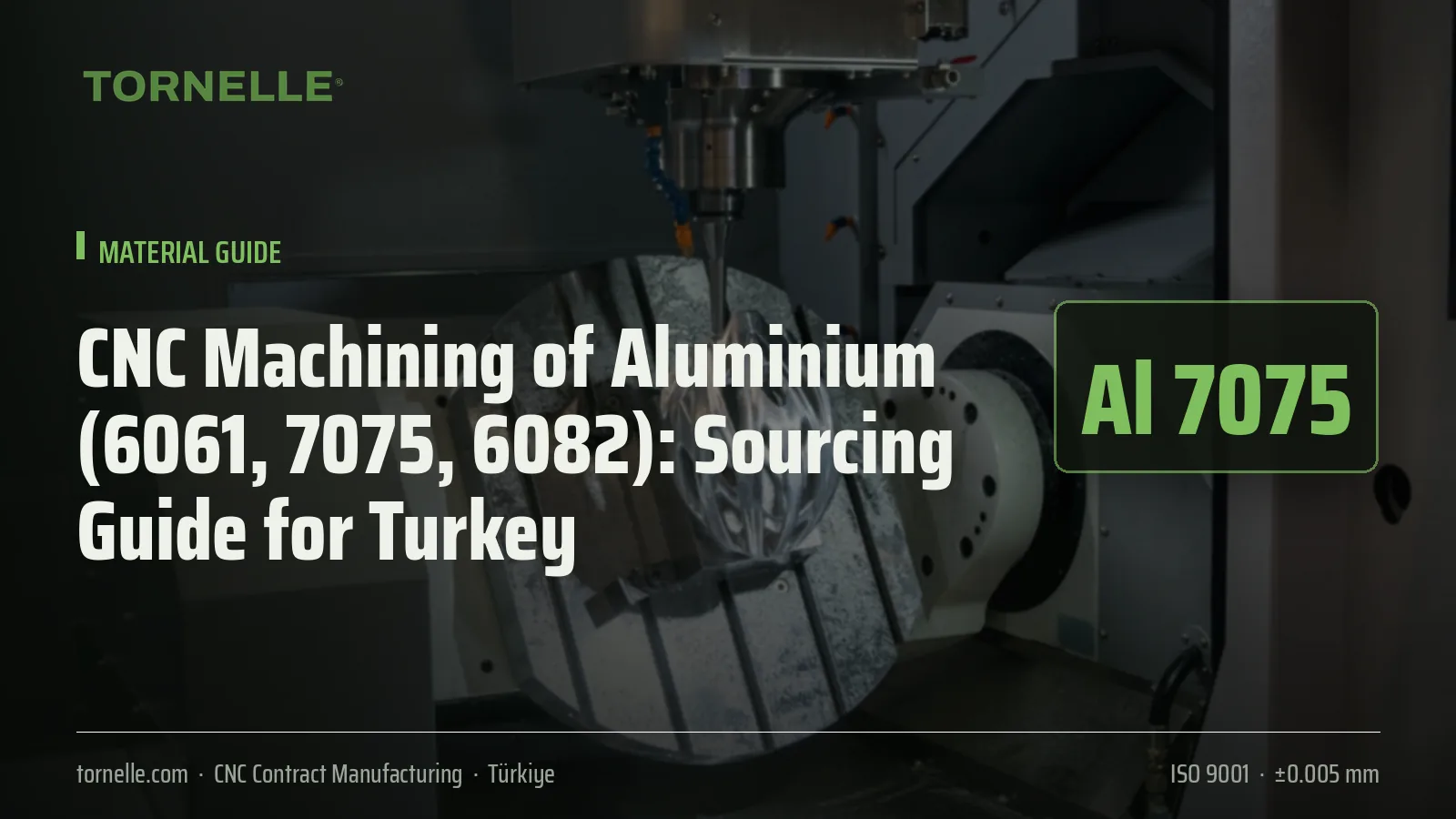
Thanks to its low weight, high machining speed and the surface quality obtained by anodising, aluminium is the most popular material in CNC contract manufacturing. But "aluminium" is not a single material: strength differs by almost a factor of two between 6061 and 7075, 6082 and 6061 are often used interchangeably, and free-machining alloys significantly shorten cycle times on Swiss-type lathes. This guide was prepared to help you choose the right alloy and specify it correctly in your RFQ.
The Most Commonly Used Alloys
| Alloy (EN / AA) | Typical temper | Yield / Tensile (MPa, approx.) | Machinability | Corrosion | Anodising | Typical use |
|---|---|---|---|---|---|---|
| EN AW-6082 / — | T6 | 260 / 310 | Good | Good | Very good | General machine parts, housings, plates in Europe |
| EN AW-6061 / AA 6061 | T6 | 275 / 310 | Good | Good | Very good | Standard on US drawings; structural and general parts |
| EN AW-7075 / AA 7075 | T6 / T651 | 500 / 570 | Good (hard, brittle chips) | Medium (coating required) | Good (colour difference) | High strength: aerospace, moulds, sports equipment, fixtures |
| EN AW-5083 / AA 5083 | H111 / H321 | 125–215 / 275–350 | Medium | Very good (marine) | Medium | Marine, welded structures, low temperature |
| EN AW-2007 / 2011 | T3 / T4 | 240–300 / 340–400 | Excellent (free-machining) | Low | Poor (not decorative) | Series turned parts on Swiss-type lathes |
| EN AW-6026 | T6 / T9 | 270–300 / 320–340 | Very good (lead-free free-machining) | Good | Good | RoHS-compliant turned parts, fittings |
Values are for typical bar/plate products and vary with size and supplier. For ordering, the values in the relevant EN 754/755 or ASTM B211/B221 standard should be used as the basis.
6061 or 6082?
6061-T6 is the standard on US drawings, 6082-T6 on European drawings. Their mechanical properties are very close; 6082 contains slightly more Si and Mn and is far easier to find as bar/plate in Europe. If your drawing specifies 6061 and there is no functional obstacle, writing "6061-T6 or 6082-T6" improves material lead time and price in Turkey. In aerospace and certified applications, however, they are not accepted as equivalent; the alloy on the drawing is used exactly.
7075: When Is It Necessary?
With strength close to that of steel, 7075-T6 is ideal for parts under high load; however, its price is 2–3 times that of 6082, its corrosion resistance is low (anodising or coating is mandatory) and it cannot be welded. It produces hard, brittle chips during machining; in thick sections there is a risk of distortion due to residual stress, so stress relieving after rough machining is planned. It should be chosen only when the strength is really needed; for many fixture and housing parts 6082-T6 is more than sufficient.
Characteristics of Aluminium in CNC Machining
- High cutting speed: cutting speeds of 300–1,000 m/min give cycle times 5–10 times shorter than steel; the labour share falls and the machine hourly rate becomes decisive. This is why Turkey's hourly rate advantage pays off fully on aluminium parts.
- Built-up edge (BUE): especially in the 6xxx series, sharp, uncoated or DLC-coated tools and generous coolant are required.
- Thermal expansion: roughly twice that of steel; on tight-tolerance parts, measurement is carried out at 20 °C and after the part has cooled.
- Thin walls: aluminium allows thin-walled housings, but below 1 mm wall thickness the risk of vibration and distortion increases.
- Surface: Ra 0.8 is achieved directly by milling; tool marks remain visible before anodising, so bead blasting or brushing is planned for decorative parts.
Anodising and Surface Treatments
Most aluminium parts are anodised (natural, black, coloured) or hard anodised (25–60 µm). Points to note: hard anodising increases the dimension by roughly half the coating thickness and must be included in the tolerance calculation; 7075 and the 2xxx series give a different colour tone, so a shade difference appears when used next to 6082 in the same assembly. Anodising, chromate conversion (Alodine/SurTec 650) and powder coating facilities are widespread in Turkey; Tornelle offers these treatments within the scope of the order through its approved suppliers.
Availability in Turkey
The alloys 6082, 6061, 7075, 5083 and 2007/2011 are available from stock in Turkey as bar and plate; supply with EN 10204 3.1 certificates is possible. 6082-T6 bar and plate is the fastest product to source; 7075 plate and large-diameter bar may require a lead time of 1–3 weeks. Non-standard sizes and special alloys (2024, 7050) are imported; stating them in the RFQ makes planning easier. For details on material certificates see our EN 10204 3.1 guide.
Design Tips That Lower Cost
- Choose 6082-T6 instead of 7075 if there is no functional justification.
- Match plate parts to standard plate thicknesses (10, 12, 15, 20, 25 mm); the thickness-reduction operation before machining is eliminated.
- Match internal corner radii to standard tool diameters (R3, R4, R5).
- State the dimensional tolerance after anodising clearly on the drawing ("after coating" or "before coating").
- Prefer a free-machining alloy (6026 or 2011) for series turned parts; cycle time on Swiss-type lathes is shortened by 20–30%.
For other items that affect the price, see our article on the 12 factors.
Frequently Asked Questions
Can 6082 be used instead of 6061?
For general machine parts, yes; the mechanical properties are very close. For aerospace, certified or customer-approved parts, the alloy on the drawing is used exactly.
Can 7075 parts be anodised?
Yes; however, the colour tone differs from the 6xxx series, and anodising or chromate conversion is mandatory for corrosion protection.
Which tolerance is realistic on aluminium parts?
±0.02–0.05 mm on milled housings and ±0.01 mm on turned parts is standard; tighter tolerances require temperature-controlled measurement because of thermal expansion.
Why is the price of aluminium CNC parts from Turkey advantageous?
With aluminium the labour and machine-hour share is high and the material share low; Turkey's hourly rate advantage is reflected directly in the unit price under this structure.
Conclusion
Choosing the right aluminium alloy is a deliberate balance between strength, corrosion, anodising and cost. 6082/6061 is sufficient for most applications, 7075 should be chosen only when necessary, and free-machining alloys deliver clear savings on series turned parts. Send the technical drawings of your aluminium parts via our quote form; we will provide a price together with alloy and surface treatment recommendations. For information on our CNC milling and CNC turning capacity, please see our service pages.