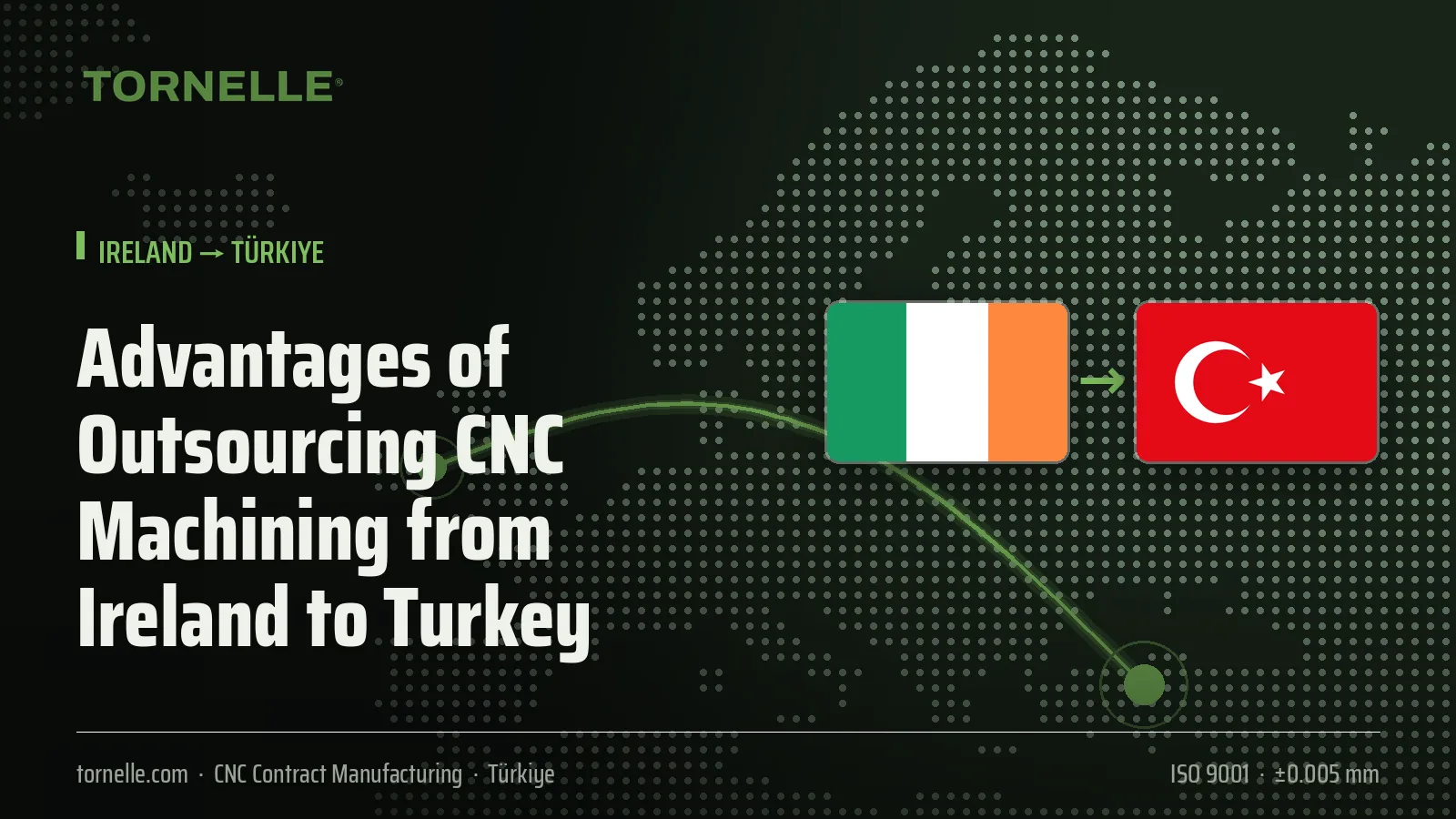
Ireland is the European manufacturing base of the world's leading medical device companies; pharmaceutical and biotech production equipment, data centre infrastructure, aviation maintenance and agricultural machinery are also strong sectors. The CNC part demand of this structure is high-precision, mid-volume and documentation-heavy. Local CNC capacity is limited, while labour costs are among the highest in Western Europe. In this article we look at the advantages that CNC contract manufacturing in Turkey offers Irish buyers.
1. Customs Union: An Advantage Worth More After Brexit
Ireland is an EU member; industrial goods from Turkey enter with the A.TR movement certificate free of customs duty and quotas. Since sourcing from the UK now requires customs declarations, rules of origin and border controls after Brexit, Turkey has become the nearest low-cost source "inside the customs union" for many Irish manufacturers. The buyer pays only the deductible import VAT (23%).
2. Cost: 35–50% Savings
CNC machine hourly rates in Ireland are in the €60–90 range; in Turkey they are €28–45 for 3-axis turning and milling. For labour-intensive precision parts, total savings including freight and customs clearance reach 35–50%. Because of the distance, the freight share is slightly higher than for Germany, but for high-value medical and equipment parts it does not exceed 2–5% of the part value. See our cost comparison article for the calculation method.
3. English: Zero Language Barrier
In export-oriented Turkish workshops the language of technical communication is English; drawing notes, inspection reports, certificates and contracts are prepared in English. There is no translation layer for Irish engineers. The time difference is 2–3 hours; a question sent from Ireland in the morning is answered in Turkey in the afternoon.
4. Sector Fit: Precision, Documentation-Heavy Parts
- Medical devices and equipment: small-diameter precision turned parts in materials such as stainless steel (1.4404/316L, 1.4305/303), titanium and PEEK; Swiss-type turning technology is critical here. For parts within the scope of ISO 13485 you need to verify the supplier's certification and process capability in advance; for equipment and fixture parts the ISO 9001 framework is usually sufficient.
- Pharmaceutical production equipment: stainless steel housings, valve components, fittings; surface roughness (Ra 0.4–0.8) and material certificate requirements.
- Data centres and electronics: aluminium heat-sink housings, connector housings, mounting elements.
- Agricultural machinery: alloy steel shafts, bushings, hydraulic components.
Defining material traceability and quality assurance expectations in the quality agreement is standard practice in medical and pharmaceutical supply chains.
5. Logistics: Distant, but Predictable
There are three options for transport to Ireland:
- Road + ferry: the direct France (Cherbourg) – Rosslare/Dublin ferry keeps the shipment inside the EU; the "land bridge" via the UK requires a transit declaration. Typical duration 7–10 working days.
- Sea freight (container): 12–16 days for high-volume planned shipments.
- Air freight: 2–3 days for small and urgent batches; the most common option for high-value medical parts.
Compared with 40–50 days of sea transport from China, Turkey significantly reduces inventory and revision risk. See our logistics guide for details.
6. Swiss-Type Turning for Small-Diameter Precision Parts
Most medical and electronic parts are produced in the Ø1–20 mm range with high surface quality and tight tolerances. This profile is ideal for Swiss-type turning technology; in Turkey this machine base is concentrated particularly in the Istanbul region. We explain the cost mechanism in our article on series production with Swiss-type lathes.
7. Euro-Based Pricing
Ireland is in the eurozone; Turkish exporters quote in euros and the currency risk is not passed on to the buyer.
Points to Consider
- Clarify the transport route (direct ferry from France or transit via the UK) with your forwarder.
- For medical parts, specify cleanliness, packaging and traceability requirements in writing on the order.
- Define the material certificate (EN 10204 3.1) and the type of inspection report at the quotation stage.
- Plan a sample approval (FAI) step for the first order.
Frequently Asked Questions
Is there customs duty on CNC parts imported from Turkey into Ireland?
No. With the A.TR certificate industrial goods are duty-free; only the deductible import VAT is paid.
What is the lead time?
Production 2–5 weeks; road + ferry 7–10 working days, air freight 2–3 days.
Which documents are provided for medical parts?
Material certificate, inspection report, FAI and, on request, a cleanliness/packaging declaration. For applications requiring ISO 13485, verify the supplier's certification status in advance.
What is the advantage of sourcing from Turkey instead of the UK?
Thanks to the Customs Union there are no rules of origin and no customs duty; labour costs are significantly lower.
Conclusion
For Irish companies Turkey is a strong sourcing alternative with duty-free entry, English communication, precision turning capacity and 35–50% savings. Send your technical drawings and annual quantity forecast via our quote form; you will receive an itemised quote within 24 hours.