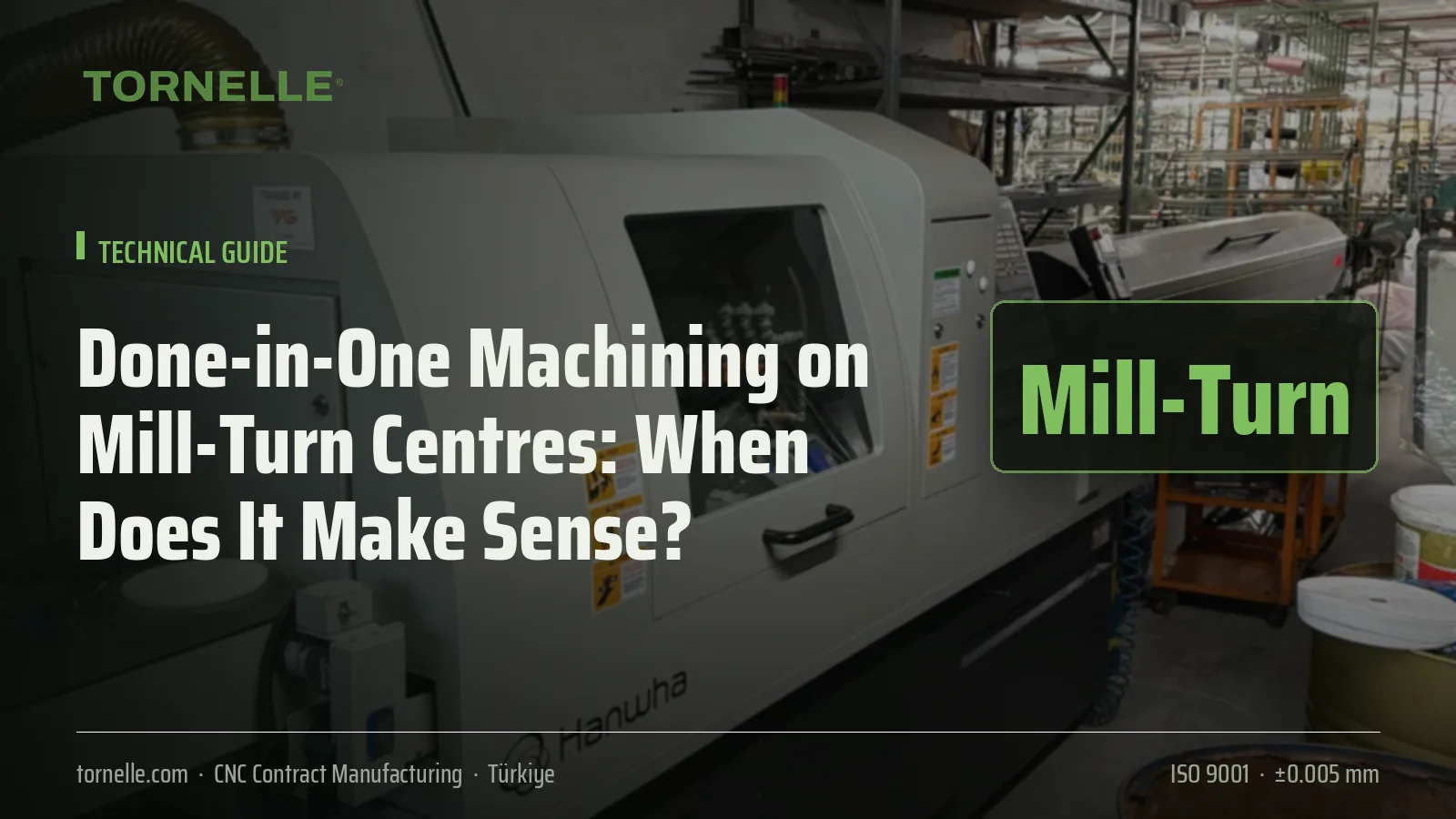
If a stepped shaft carries a cross hole, a keyway and a face-milled flat, the classic route is two machines: CNC lathe, then mill. Every additional set-up brings set-up time, intermediate stock, handling and loss of reference. Mill-turn centres (Dreh-Fräszentrum) and lathes with C/Y axes and live tooling combine these operations in one set-up. Following our lathe or Swiss-type article, this one explains the place of done-in-one machining in contract manufacturing.
Technology Levels
| Machine | Capability | Typical part |
|---|---|---|
| CNC lathe (2-axis) | Rotational surfaces, threads, grooves | Simple shaft, bushing, flange |
| CNC lathe + C axis + live tooling | Face/radial holes, slots, flat milling | Shaft with cross hole, hex-head fitting |
| + Y axis | Off-centre milling, keyways, pockets | Drive shaft, coupling body |
| + Sub-spindle | Back-face machining, finished part in one cycle | Parts machined on both sides |
| Mill-turn centre (B-axis milling head) | 5-axis milling + turning, complex geometry | Aerospace housings, pump impellers |
| Swiss-type lathe (8+ axes) | Complete parts from bar Ø≤32 mm, high volume | Connectors, nipples, medical pins |
What Done-in-One Machining Gains
1. Geometric accuracy
Coaxiality, perpendicularity and position tolerances deteriorate with every set-up; each re-clamping typically adds 0.01–0.03 mm of reference uncertainty. On a part machined in one set-up, the turned diameter and the cross-hole position are cut against the same reference; a 0.02 mm position tolerance is held without a fixture. Our geometric tolerances article explains this relationship.
2. Cycle and flow time
Total machining time does not change — milling may even take slightly longer because of the lower power of live tooling; the gain is in set-up, handling and waiting. A flow that takes 3 days on two machines finishes the same day on one. In small and medium batches (50–2,000 pieces) the effect on lead time is marked.
3. Cost
An additional set-up typically takes 30–90 minutes; in a batch of 100 that is 0.3–0.9 minutes per part. The need for fixtures disappears or shrinks. In return, the hourly rate of a mill-turn machine is 20–40% above a plain lathe. The break-even is set by part complexity; our turned-part pricing article shows how the calculation is built.
4. Quality risk
The risk of scratches, drops and mix-ups between operations falls; traceability is simpler (one work order, one operator).
Which Parts Are Suitable?
- Rotational main body plus a few milled features (cross hole, keyway, hexagon, flat).
- Parts machined on both sides (single cycle with sub-spindle).
- Stepped shafts requiring tight coaxiality and position tolerances.
- Quantities of 20–5,000; above that a Swiss-type lathe or dedicated line, below it the classic method, may be more economical.
Which Parts Are Not Suitable?
- Parts whose milling time is several times the turning time (these are really milled parts; pre-turning is done separately).
- Deep pockets and large chip volumes (live-tooling power is limited).
- Very large or unbalanced bodies.
- Parts under Ø32 mm in quantities of 50,000+: the Swiss-type lathe is far ahead in cycle time; the scope is on our Swiss-type turning page.
What to Ask the Supplier When Requesting a Quote
- In how many set-ups is the part finished? What is the reference of each set-up?
- In which set-up are the critical geometric tolerances cut?
- Is there a sub-spindle, or is the back face a separate operation?
- Is the live-tooling capacity (speed, power) sufficient for the part's milled features?
- Is set-up cost shown separately in the quote, and does it fall on repeat orders?
A good quote explains the machining strategy in a few sentences. For supplier selection see our 15-question checklist.
Notes for the Designer
- Group milled features in a single angular plane where possible; fewer C-axis indexing moves.
- Prefer standard drill diameters for cross holes; a special diameter means an extra tool.
- Select keyway depth according to DIN 6885; the cutter diameter becomes standard.
- If the back face is machined, leave a diameter the sub-spindle can grip.
Mill-Turn Capacity in Turkey
CNC lathes with live tooling and sub-spindles are widespread in Turkish contract shops; Y-axis and B-axis multitasking centres are found at medium and large suppliers. Export-oriented shops apply the single-set-up approach as standard for fittings, valve bodies, shafts and hydraulic blocks from Europe. Swiss-type lathes are the high-volume, small-diameter end of this family; see the scope on our Swiss-type turning page. The practical consequence for the buyer: a note "single-set-up machining preferred" in the RFQ makes the supplier choose the right machine and price accordingly.
Checklist at Quotation Stage
- Is the part finished in one set-up or is a second operation needed? Have the supplier explain the process plan.
- What level of coaxiality is guaranteed at the sub-spindle transfer?
- Are the features requiring a Y axis (off-centre holes, flats) available on the machine?
- Do bar diameter and length fit the machine capacity; is there an automatic bar feeder?
- Measurement plan: which features are checked on the machine, which on the CMM?
- Are unattended-production safeguards such as tool-breakage monitoring and part counters in place?
These questions help you understand whether a unit-price difference comes from machine capability or from a calculation difference.
Frequently Asked Questions
A mill-turn is a more expensive machine; will the part be expensive too?
The hourly rate is higher, but set-up, fixture and handling costs fall. For rotational parts with a few milled features the total cost usually falls; for milling-heavy parts it may rise.
Is 0.01 mm coaxiality guaranteed in one set-up?
A single set-up provides the best conditions; machine condition, tool deflection and thermal effects still play a role. It is verified by the inspection report.
Doesn't a Swiss-type lathe also machine in one go?
Yes; for small-diameter, high-volume parts the Swiss-type lathe is the most economical form of done-in-one machining. Mill-turn suits larger diameters and lower quantities.
Are mill-turns used for prototypes?
Yes; programming takes longer, but because no fixture is needed it is fast even for a single piece.
Is a part machined on a mill-turn centre priced higher than on a plain lathe?
The machine hourly rate is higher, but because the second set-up, handling and intermediate inspection disappear, the total part cost usually falls. For simple turned parts the plain lathe is still more economical; a good supplier calculates both.
Does the inspection report change for a part machined in one set-up?
The report format is the same; the difference is that related features such as coaxiality and perpendicularity come with a tighter distribution. In series production, SPC data shows this difference clearly.
Conclusion
Mill-turn centres and lathes with live tooling beat the classic two-machine flow in accuracy, lead time and total cost for rotational parts with a few milled features. The right decision depends on part geometry and quantity; send your drawing via our quote form and we will explain the machining strategy and number of set-ups together with the quote.