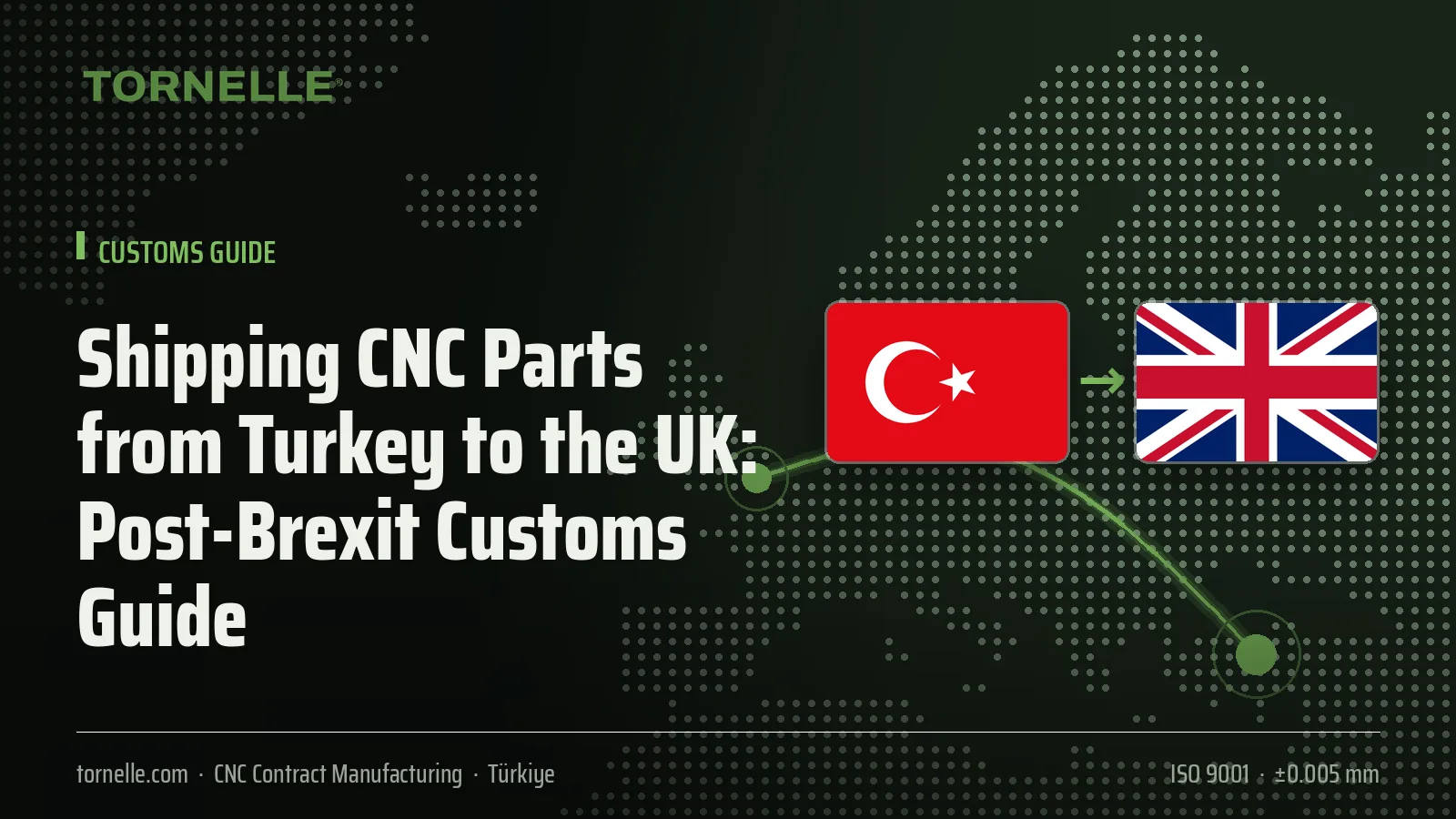
For British machine builders, Turkey became an even more attractive source after Brexit: the customs formalities that appeared with EU suppliers had always existed for Turkey anyway, and a Free Trade Agreement (FTA) between Turkey and the UK has been in force since 1 January 2021. Complementing our guide to outsourcing from the UK to Turkey, this article focuses solely on the customs and import process.
1. Legal Basis: Not A.TR, but the FTA Origin Declaration
While the UK was an EU member, Turkish industrial goods entered duty-free with an A.TR movement certificate. After Brexit, A.TR is invalid on this route. The Turkey–UK FTA largely preserves the conditions of the EU–Turkey Customs Union: industrial goods of Turkish origin enter duty-free with an origin declaration (an exporter's statement on the invoice or another commercial document). For consignments above £6,000 the exporter needs approved-exporter status or the declaration must be drawn up according to the rules; Turkish suppliers are used to issuing this document. Under the origin rules, CNC parts (Chapters 73, 74, 76, 84) generally meet the "sufficient processing" criterion when machined in Turkey; even if the raw material is imported, the change of tariff heading confers origin. The general logic of the documents is explained in our EUR.1 and A.TR article.
2. Tariff Code and the UK Global Tariff
Machined CNC parts are classified according to their use: general steel parts 7326 90, aluminium 7616 99, brass 7419 80; machine parts under the chapter of the machine they belong to (8409, 8412, 8481, 8483 etc.). In the UK Global Tariff the third-country duty on these headings is 0–4%; with the FTA origin declaration it is zero. Determine the code together with your supplier and have it printed on the commercial invoice; a wrong code is the first cause of delay at customs.
3. Import VAT: Postponed VAT Accounting (PVA)
VAT-registered companies in the UK can declare import VAT (20%) on their VAT return through PVA and deduct it on the same return instead of paying at the border; there is no cash outflow. It is enough to tell your forwarder or customs broker to use PVA on the declaration. You download the monthly import VAT statement from your HMRC account.
4. EORI, CDS and the Declaration
- GB EORI number: Mandatory for you as importer; obtained free of charge from HMRC.
- CDS (Customs Declaration Service): The import declaration is lodged in this system; in practice the forwarder or customs broker does it.
- Required documents: Commercial invoice (tariff code, origin declaration, Incoterm, EORI), packing list, CMR or AWB, material certificate if required.
- Northern Ireland: Different rules apply under the Windsor Framework; plan deliveries to Northern Ireland separately with your forwarder.
5. Choosing the Incoterm
Practical options for British buyers:
- FCA Istanbul: Your forwarder collects from the factory; import declaration and freight are yours. The most transparent option for regular volumes.
- DAP (UK address): The Turkish supplier brings the goods to your door; import declaration and VAT remain with you. The lowest-friction route for first orders.
- DDP: The supplier also pays import taxes; because it may require UK VAT registration, Turkish suppliers generally avoid it.
Details in our Incoterms guide.
6. Logistics Options and Transit Times
| Method | Time (door to door) | Suitable load |
|---|---|---|
| Road (via Ro-Ro or Channel Tunnel) | 5–8 working days | Pallet and above |
| Express courier | 2–4 days | Samples, <70 kg |
| Air freight (Istanbul–London/Manchester) | 2–3 days + customs | Urgent, high value |
| Sea (container) | 3–4 weeks | Heavy, bulky, low value |
On the road route, customs waiting time at the France–UK crossing has lengthened compared with before Brexit; the forwarder must lodge the GVMS (Goods Vehicle Movement Service) pre-notification. Experienced forwarders handle this routinely.
7. Common Mistakes
- Expecting zero duty when the invoice carries no origin declaration.
- Confusing the EORI with an EU number (the GB EORI is separate).
- Import VAT being demanded up front at the border because PVA was not selected.
- Leaving the tariff code to the supplier and then using a different code on the import declaration.
- Assuming Northern Ireland delivery follows the same process as Great Britain.
Example Shipment: 4 Pallets of Turned Parts, Istanbul → Birmingham
A West Midlands hydraulic-equipment manufacturer orders 4 pallets (1,200 kg) of steel and brass turned parts on DAP Birmingham terms. The process runs as follows: the Turkish supplier prepares the commercial invoice showing the 8-digit tariff codes (e.g. 7326 90 98 steel, 7419 80 00 brass), the Turkish origin declaration text, the GB EORI number, the Incoterm and gross/net weights. The forwarder closes the export declaration in Turkey; the truck travels via Bulgaria–Serbia or Greece–Italy to France and crosses to the UK by Calais–Dover or Dunkirk–Dover ferry. The British customs broker pre-lodges the import declaration in CDS and the GMR reference is attached to the vehicle; duty is zero thanks to the origin declaration, and VAT falls into the importer's return via PVA. Total door-to-door time is 6–8 working days if the paperwork runs smoothly. Because the goods exceed £1,000 in value, the origin declaration is written on the invoice and signed by the exporter.
The three most frequent hitches and their remedies
- Missing EORI or wrong tariff code: The declaration is rejected and the truck waits. Have your broker approve the invoice before dispatch.
- Missing origin declaration text: Preferential duty is not applied; retrospective correction is possible but takes time. Have the text added to the invoice as a standard field.
- Quantity mismatch between packing list and invoice: Risk of physical inspection. Generate documents from a single source.
Frequently Asked Questions
Is customs duty payable in the UK on CNC parts from Turkey?
Not if an origin declaration under the Turkey–UK FTA is present. Without it, the third-country rate in the UK Global Tariff (0–4%) applies.
Who issues the origin declaration?
The Turkish exporter, using the standard text on the invoice. Depending on value, approved-exporter status may be needed; ask your supplier at quotation stage.
Do I have to pay import VAT up front?
No; if you are VAT-registered you offset it on your return via PVA.
What is the delivery time?
5–8 working days by road after production; samples by courier in 2–4 days. Details in our logistics article.
Do parts shipped to the UK need UKCA or CE marking?
Contract-machined parts (components) are generally not subject to product legislation in their own right; marking is the responsibility of the manufacturer of the final product into which the part is assembled. Special cases such as pressure equipment are exceptions.
Is shipping to Northern Ireland different?
Under the Windsor Framework, Northern Ireland is subject to a regime for goods close to EU customs rules; for Turkish-origin parts, A.TR and EU rules may come into play. Consult your customs broker before shipping.
Conclusion
With the right documents (FTA origin declaration, GB EORI, PVA), importing CNC parts from Turkey to the UK after Brexit is no harder than importing from EU suppliers; duty is zero and there is no VAT cash outflow. Send your drawings via our quote form; we respond with a DAP UK quote in GBP or euros together with our commitment to provide the origin declaration.