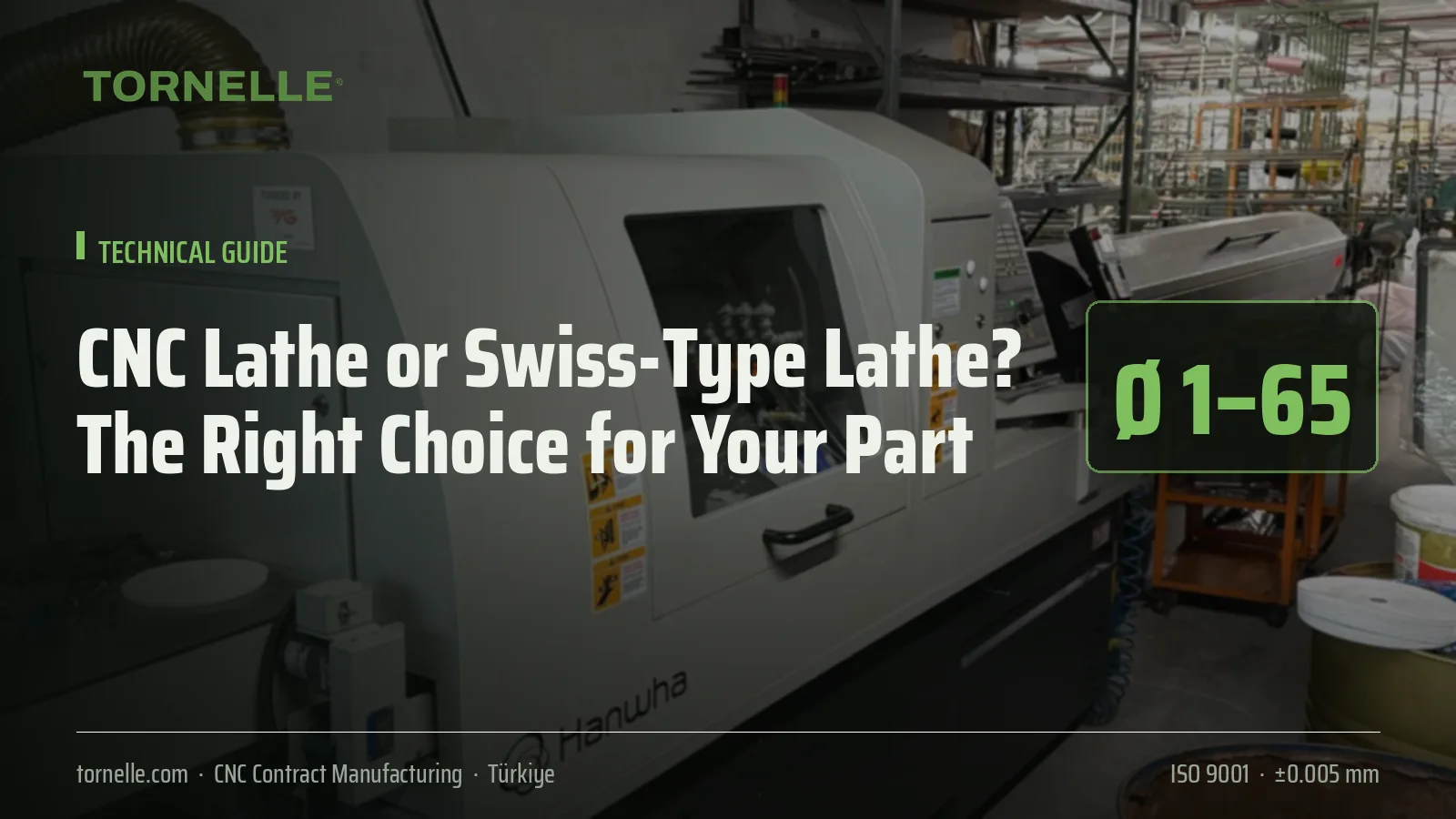
To buyers, “turned parts” may seem like a single category; however, whether a part is produced on a conventional CNC lathe or a sliding-head automatic lathe (Swiss-type) can vary the unit price by two to three times and the lead time by weeks. This guide explains the operating principles of both technologies, their strengths and weaknesses, and which one is the right choice for your part. Since Tornelle offers both technologies under one roof, we make an unbiased decision the moment we see your design.
Difference in Operating Principles
A CNC lathe clamps the part to the chuck, and the tool moves along the stationary part. It can operate with a bar feeder, but the part is supported by the portion extending from the chuck; this helps limit flexing and vibration in long, slender parts. Our CNC lathes also perform milling and drilling operations in the same setup using a C-axis and driven tools.
In contrast, a Swiss-type lathe “slides” the bar stock forward through a guide bushing; the tool operates very close to the point where the material exits the bushing. Since the cutting force is always applied at the supported point, there is no flexing even in thin and long parts. Thanks to the large number of tool stations, the rear spindle, and the number of axes (8 axes on the Tornelle), both the front and back sides of the part are finished in a single cycle. For more details, please visit our Swiss-type lathe page.
Decision Table
| Criterion | CNC Lathe | Swiss-Type Lathe |
|---|---|---|
| Typical Diameter Range | Ø10 – Ø300+ mm | Ø1 – Ø32 mm (Ø38 on some machines) |
| Length-to-diameter ratio | ≤ 3–4 (unsupported) | 10 and above without issues |
| Economic quantity | 1 – 5,000 | 500–1,000,000+ |
| Diameter tolerance (typical) | ±0.01 mm | ±0.005 mm |
| Surface finish (typical) | Ra 0.8–1.6 | Ra 0.4–0.8 |
| Installation time | Short–medium | Medium–long |
| Cycle time | Medium | Very short (parallel operation) |
| Raw material | Cut raw piece or bar | Precision-ground/H9 bar |
| Front/back machining | Single clamping if there are two spindles | Standard single-pass |
| Unit cost (small part, high volume) | High | Low |
| Unit cost (large part, low volume) | Low | Not suitable |
When to Choose a Swiss-Type Machine
- When the part diameter is less than 32 mm and the annual quantity exceeds a few thousand.
- For parts with a high length-to-diameter ratio, such as thin shafts, pins, connector pins, valve needles, and medical screws.
- When a diameter tolerance of less than ±0.01 mm and a surface roughness of less than Ra 0.8 are required.
- When a part has numerous features—such as milling, drilling, threads, and grooves—on both the front and back sides; a Swiss-type machine completes these in a single cycle.
- For high-volume parts where unit cost is a major concern. In our article on mass production with Swiss-type lathes, we explain the cost mechanism with examples.
Situations Where You Should Choose a CNC Lathe
- If the diameter is greater than 32 mm, or if the part is produced from a cast or forged blank rather than a bar.
- When production volume is low (prototypes, 1–500) and setup costs are a determining factor.
- If the part is short and stubby (flange, cover, disc, bushing)—the length advantage of a Swiss-type lathe is irrelevant here.
- If the material cannot be supplied as precision-ground bar stock for a Swiss-type lathe (certain special alloys, large-diameter stainless steel).
- If frequent revisions are expected; program and tool changes are faster on a CNC lathe.
Gray Zone: Ø20–32 mm, 500–3,000 Pieces
In this range, the decision depends on the part geometry. If there are many features on both the front and back sides, a Swiss-type lathe will pay for itself; if it’s a simple bushing or short shaft, a CNC lathe with bar feeder is more economical. Tornelle provides pricing for both options for these types of parts and highlights the difference. You can refer to our article on the 12 factors that determine pricing.
Notes for the Designer
- Design the part to fit standard bar diameters (e.g., Ø6, Ø8, Ø10, Ø12, Ø16, Ø20) for a Swiss-type lathe; intermediate diameters require custom bars.
- Due to the guide bushing, the material’s diameter tolerance is critical; use h9 or better bar stock. This affects the material cost but is more than offset by the reduction in cycle time.
- The part length must not exceed the machine’s bar feeding capacity (typically 200–300 mm per cycle).
- Specify the required features on the rear end; the Swiss-type lathe adds these at no extra cost.
Frequently Asked Questions
Are parts from a Swiss-type lathe more precise?
For small diameters, yes: since the material is always supported close to the cutting point, ±0.005 mm diameter repeatability and a Ra of 0.4–0.8 surface finish are standard.
Is there a minimum order quantity for the Swiss-type lathe?
There is no strict limit, but due to setup time, a CNC lathe is generally more economical for orders under 500 pieces.
My part requires both turning and milling; which machine should I use?
If the diameter is under 32 mm, the Swiss-type lathe performs all operations in a single cycle. For larger diameters, a CNC lathe with a C-axis and driven tool, or a lathe + milling combination, is used.
Do I need to specify the machine type when requesting a quote?
No. It is sufficient to share the technical drawing and annual quantity; the supplier will select the appropriate technology. Our RFQ guide lists the required information.
Conclusion
For small-diameter, long, and high-volume parts, a Swiss-type lathe is the right choice; for large-diameter, low-volume, and bulky parts, a CNC lathe is the right choice. In gray-area cases, the part’s geometry determines the decision. Both technologies are available at Tornelle; submit your drawing via the quote form to receive a quote explaining why a particular machine was selected.