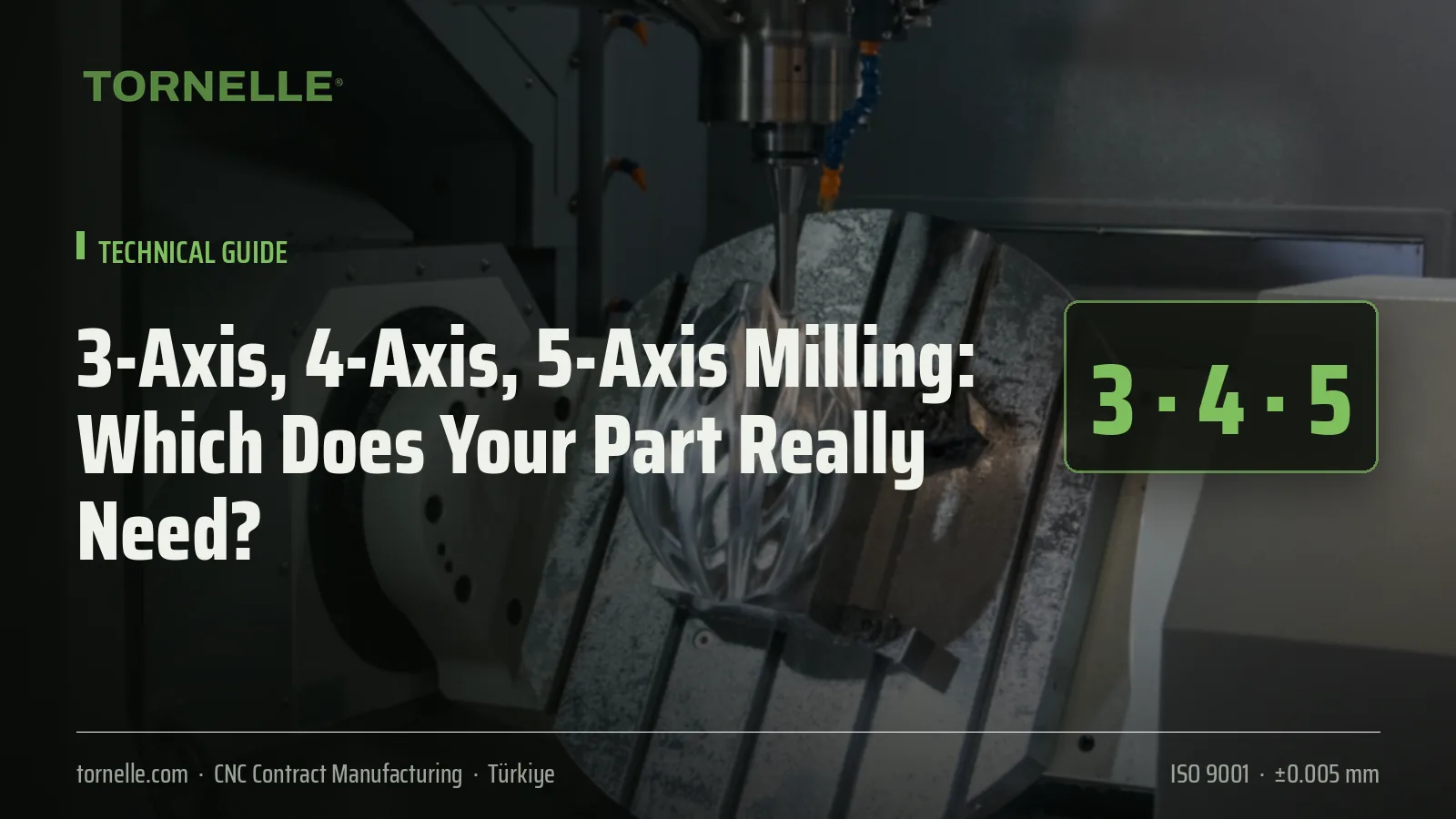
The note "requires a 5-axis machining centre" in an RFQ is often not the designer's sentence but that of a supplier who wants to raise the price. In reality, the number of axes is not a quality indicator but a tool chosen according to the part's geometry. The right axis choice is directly effective among the factors that determine part price through the number of set-ups and the machine class. This article is the milling counterpart of our CNC lathe or Swiss-type article.
What Do the Axes Mean?
- 3-axis (X, Y, Z): the tool moves in three linear directions, the part is stationary. The tool always points perpendicular to the table; only surfaces accessible from above are machined in one set-up.
- 4-axis (X, Y, Z + A): the part rotates on a rotary axis (usually the horizontal A axis). The circumference of cylindrical parts and the four side faces of a prismatic part are machined in a single set-up. On horizontal machining centres the B axis (rotary table) performs the same function.
- 5-axis (X, Y, Z + A + C or B + C): two rotary axes; the tool approaches the part from almost any angle. There are two sub-types:
- 3+2 (positional / indexed): the rotary axes bring the part to an angle and lock; machining is done in 3 axes. Sufficient for multi-faced prismatic parts, angled holes and pockets, and simple to programme.
- Simultaneous 5-axis: all axes move together during cutting. Required for free-form surfaces such as turbine blades, impellers, mould surfaces and implants.
Which Geometry Requires Which Axis?
| Geometry | 3-axis | 4-axis | 3+2 | Simultaneous 5-axis |
|---|---|---|---|---|
| Plate, pockets and holes from one face | Ideal | — | — | — |
| Housing machined from two faces (top + bottom) | 2 set-ups | — | 1 set-up | — |
| Prismatic block with features on four side faces | 4–5 set-ups | 1–2 set-ups (ideal) | 1–2 set-ups | — |
| Pockets, holes, slots around a cylindrical part | Difficult | Ideal | Possible | — |
| Angled holes (compound angle) | Angled fixture required | Possible at a single angle | Ideal | — |
| Deep pocket, small radius (long tool) | Vibration, rough surface | — | Short tool by tilting: ideal | — |
| Free-form surface (mould, blade, implant) | Possible with ball-nose tool, slow | — | Partly | Ideal |
| Undercuts and internal angled surfaces | Special tool | Partly | Mostly | Ideal |
In practice roughly 80–90% of industrial milled parts are produced on 3 or 4 axes, 10–15% with 3+2 and only a few percent with simultaneous 5-axis.
Cost: Hourly Rate and Number of Set-ups
The number of axes affects cost in two opposite directions:
- The hourly rate rises: in Turkey a 3-axis vertical machining centre is in the €30–45 band, 4-axis €35–50, 5-axis €50–80 per hour (roughly double in Western Europe). The difference in machine investment, CAM and operator qualification is the reason.
- The number of set-ups falls: every set-up means 5–15 minutes of labour, a new zero point, error risk and tolerance loss between set-ups. For a part machined on four faces, 1 set-up on 4 axes instead of 4 set-ups on 3 axes saves both labour and positional tolerance.
Rule: if the part can be produced on 3 axes in 1–2 set-ups, 3-axis is the cheapest. If 3 or more set-ups are needed, 4-axis or 3+2 is usually cheaper and improves tolerances. Simultaneous 5-axis is only economical when the geometry makes it mandatory. As quantity increases, the share of the set-up saving grows; in prototypes the difference is small.
Tolerance Effect
Positional tolerance between set-ups is the weakest link: a shift of 0.01–0.03 mm on every re-clamping is normal. If ±0.02 mm positional tolerance is required between holes on different faces, machining in one set-up (4-axis or 3+2) is almost mandatory. Between features on the same face, 3-axis already holds ±0.01 mm. Therefore, thinking about which features will be machined together when assigning tolerances directly affects the price; details are in our tolerance selection article.
Making Your Drawing Suitable for Fewer Axes
- Make angled holes perpendicular: a hole perpendicular to the surface instead of a compound-angle hole makes production on 3 axes possible.
- Group features onto faces: collecting features spread across four faces onto two faces halves the number of set-ups.
- Shorten or split deep pockets: deep pockets requiring long tools push towards 5 axes; keep the depth/diameter ratio below 4.
- Avoid undercuts: undercuts require special tools or 5 axes; if they serve an assembly function, consider a separate part.
- Question free-form surfaces: can non-aesthetic free-form surfaces be replaced with planes and cylinders?
- Leave a clamping surface: a flat surface on which the part can be securely clamped, or a stub to be cut off after machining, reduces fixture cost.
These decisions are covered in a broader framework in our DFM article.
What to Ask the Supplier
- "In how many set-ups would you produce this part?" – shows the axis preference and where the price comes from.
- "How do you guarantee positional tolerance between set-ups?" – zero-point system, fixture, in-process measurement.
- "Which feature increases the price the most?" – usually a single angled hole or a deep pocket.
- "What would you suggest to make it suitable for 3 axes?" – a good supplier answers.
At Tornelle we work with 3- and 4-axis vertical machining centres; geometries requiring simultaneous 5-axis are stated clearly at the quotation stage and alternative solutions (a 3+2 approach, a design suggestion or a separate source) are offered. For capacity see our CNC milling page.
Frequently Asked Questions
Is a part produced on a 5-axis machine higher quality?
No; quality is meeting the tolerances and the surface. A plate produced in one set-up on 3 axes is of the same quality as one produced on 5 axes, and cheaper.
Does the difference between 3+2 and simultaneous 5-axis affect cost?
Yes; 3+2 is simple to programme, has a predictable cycle time and is cheaper. Simultaneous 5-axis requires CAM, simulation and operator qualification; it is only needed for free-form surfaces.
Does my part have to be cylindrical for 4-axis?
No; the four side faces of a prismatic block are also machined in one set-up on 4 axes. Cylindrical parts are likewise a typical 4-axis application.
How much does the number of set-ups affect the price?
Each set-up adds €3–10 of labour depending on part size, plus positional tolerance risk; 3 extra set-ups on 1,000 pieces means €9,000–30,000.
Conclusion
The number of axes is a tool chosen according to geometry and the number of set-ups: 3-axis is cheapest for most parts, 4-axis and 3+2 are both cheaper and more accurate for multi-faced and cylindrical parts, and simultaneous 5-axis is only necessary for free-form surfaces. To see in how many set-ups and on which axes your drawing can be produced most economically, send your STEP and PDF files via our quote form; the set-up plan and design suggestions come with the quote.