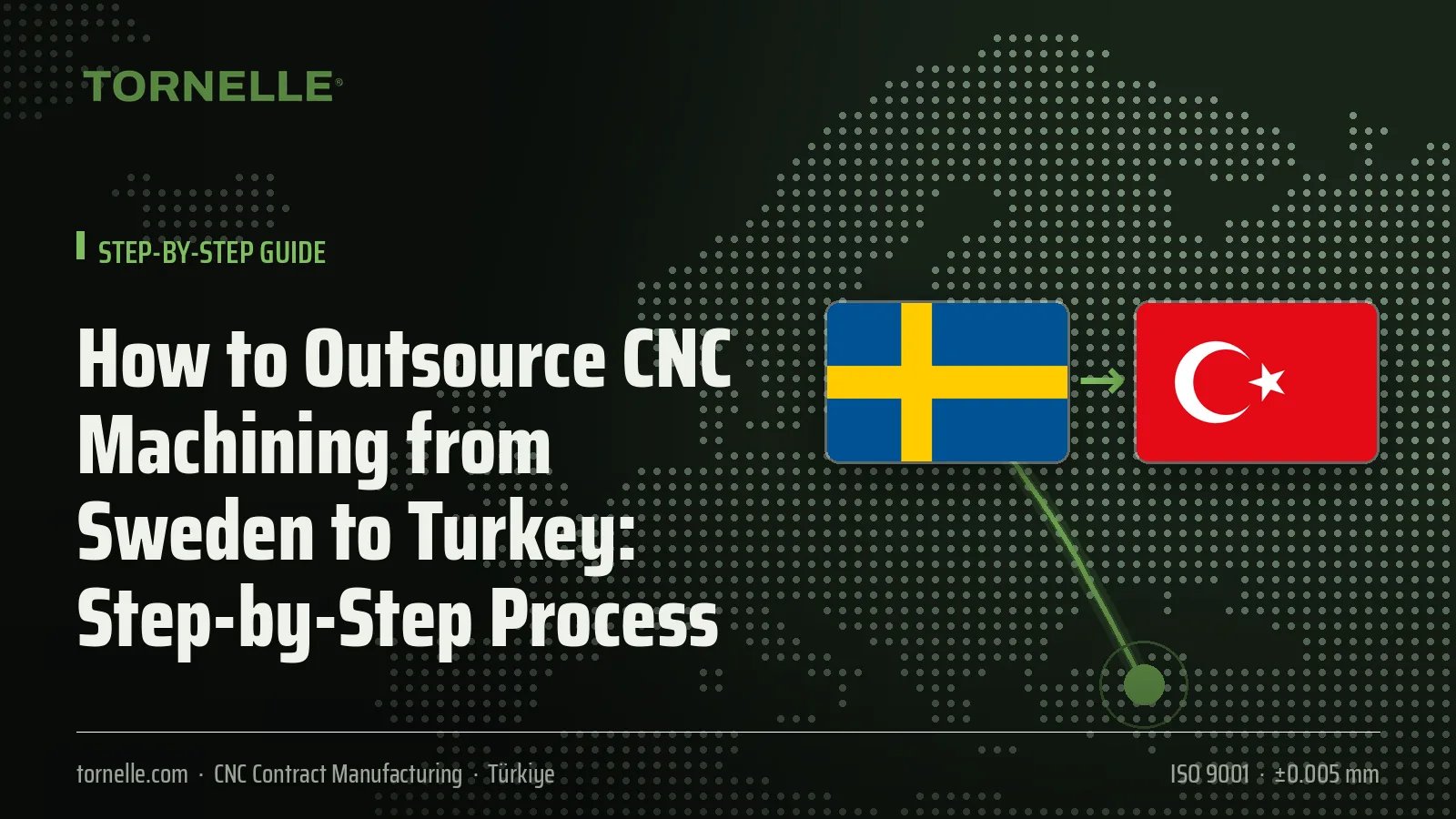
You already know the advantages Turkey offers Swedish companies: a 35–50% cost advantage, the Customs Union, European standards and the quality systems Swedish industry knows. This article explains step by step how to place the first order in practice, with particular attention to Sweden-specific points such as logistics to Scandinavia and SEK-based trade.
Step 1: Prepare the Technical Documents
Swedish drawings are prepared to SS-EN ISO standards and are read without difficulty in Turkey; add an English equivalent to the critical Swedish notes (English drawings are already common in Swedish industry). The ideal package:
- STEP (AP214) 3D model + PDF technical drawing; revision numbers must match.
- Material with its EN grade; instead of or next to old SS numbers (SS 2172, SS 1672, SS 2343) write the EN equivalent (SS 2172 ≈ S355J2, SS 1672 ≈ C45E, SS 2343 ≈ 1.4404, SS 4212 ≈ EN AW-6082).
- General tolerance (ISO 2768-mK) in the title block; geometric tolerances with their datums. ISO GPS is widely used on Swedish drawings; the Turkish supplier knows the ISO 1101 symbols.
- Surface roughness (Ra), edge break, heat treatment, coating.
- Annual quantity, batch size, first-order quantity and target date.
- Documentation expectations: inspection report, EN 10204 3.1, FAI, PPAP in automotive; reference to supplier standards in the heavy-vehicle supply chain (Volvo, Scania).
Step 2: Request and Compare Quotes
Send the RFQ to 2–3 Turkish suppliers; compare the quotes item by item: unit price (quantity tiers), set-up, certificate, inspection report, packaging, Incoterm and lead time. In Sweden sustainability criteria (supplier code of conduct, carbon data) are frequently asked in the RFQ; you can request a signed code of conduct and energy/transport data from the Turkish supplier. For the method see our RFQ guide.
Step 3: Clarify the Commercial Terms
Incoterms
FCA Istanbul (your own forwarder collects) or DAP (the Turkish supplier brings the goods to your door; the import declaration and moms are yours). On the Scandinavian route groupage loads are usually transshipped in Germany; under DAP this is not your problem. Details are in our Incoterms guide.
Payment
In Sweden 30 days net is standard. On export sales Turkish suppliers work with a partial advance payment (30–50%) + balance before shipment on first orders and 30 days open account in a regular relationship. Prices are mostly in EUR; if you want a SEK-based price, write into the contract who bears the currency risk and the update rule. SWIFT transfer is standard.
Contract and confidentiality
An English NDA and quality agreement are sufficient. The supplier Code of Conduct document frequently used by Swedish companies can be signed by the Turkish supplier. The governing law and place of dispute resolution should be specified.
Step 4: Sample and First Article Approval
On the first order, request 1–5 sample pieces and a full inspection report based on a ballooned drawing. For heavy-vehicle and automotive suppliers a PPAP, for medical an FAI + process validation, for general machinery a standard FAI is sufficient. Verify the report with your own measurement; series production starts after approval. The process is described in our FAI guide.
Step 5: Logistics, Customs and Import
- Road: 6–8 working days door to door from Istanbul to Gothenburg, Stockholm or Malmö; via Germany over the Öresund Bridge or the Rostock/Travemünde–Trelleborg ferry. Weekly groupage services are available.
- Sea: for large and heavy loads, Istanbul–Gothenburg container 2–3 weeks; unit cost is low.
- Air freight: Istanbul–Stockholm/Gothenburg 1–2 days; express courier 2–3 days for samples.
- Customs duty: parts enter duty-free under the A.TR movement certificate. Our A.TR guide has the document details.
- Moms (VAT): VAT-registered Swedish companies do not pay import VAT (25%) at customs; they declare it in the periodic VAT return filed with Skatteverket and deduct it in the same return. There is no cash outflow.
- Declaration: the forwarder files the import declaration in the Tullverket system with your EORI number; commercial invoice, packing list, A.TR and CMR are sufficient.
Step 6: Series Deliveries and Continuous Improvement
Framework agreements and call-off orders are common; because of the Scandinavian transit time, planning a 2–4-week safety stock is useful. An inspection report and 3.1 certificate accompany every batch. After the first 2–3 batches, price, packaging and frequency settle; delivery performance (OTD) and PPM data can be shared for Swedish buyers' supplier evaluation.
Common Mistakes
- Sending old SS material numbers without the EN equivalent.
- Planning Scandinavian transit time like Central Europe (3–5 days); 6–8 days is realistic.
- Requesting a SEK price without defining a currency update rule.
- Raising sustainability and code-of-conduct expectations after the RFQ.
- Not allowing a 1–2-day weather-related buffer in Northern Europe in the winter months.
Frequently Asked Questions
Can I send technical drawings in Swedish?
Yes; dimensions and symbols are international. English drawings are already common in Swedish industry; it is enough for the critical notes to be in English.
How much time should I plan for the first order?
Quote 1–2 days, sample 1–3 weeks, series 3–5 weeks after approval, freight 6–8 days: the first series batch is typically in your hands in 7–11 weeks.
How does the process work in case of a complaint?
Notification with photos and measurement evidence, an 8D report, re-production or credit note; defined in writing in the quality agreement. Re-supply by air freight is possible in 1–2 days.
Do I need to visit the supplier in Turkey?
Not mandatory; an overnight audit is possible with the 3.5–4-hour direct flight from Stockholm and Gothenburg to Istanbul.
Conclusion
Outsourcing CNC machining from Sweden to Turkey is a predictable process consisting of the right file package, an itemised quote, sample approval and a simple import that is duty-free under A.TR with moms offset in the return. Send your technical drawings and quantity information via our quote form; you will receive an itemised, euro-based quote (SEK-referenced on request) within 24 hours. For the process steps see our how we work page.