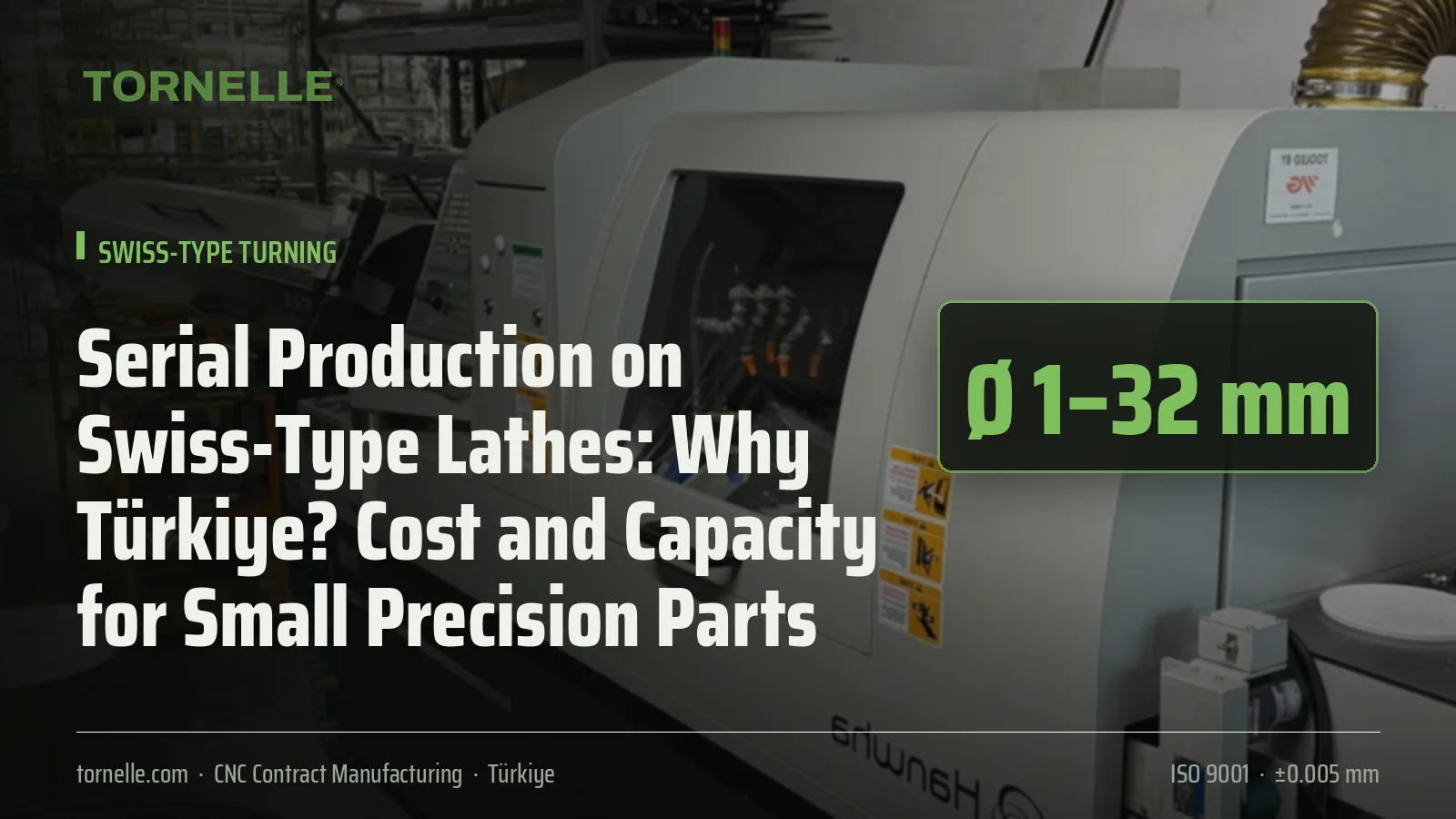
With diameters of a few millimeters, lengths of a few centimeters, tolerances of a few microns, and production volumes in the tens of thousands: connector pins, medical screws, hydraulic nipples, sensor housings, and pneumatic fittings. Conventional CNC lathes are not economical for these parts; the correct method is the Swiss-type lathe (Langdrehautomat). This article briefly explains what a Swiss-type lathe is and why Turkey has become a strong supplier in this field for European buyers.
What Is a Swiss-Type Lathe?
In a Swiss-type lathe, bar stock is fed toward the tool by sliding through a guide bushing; the cutting operation is always performed immediately in front of the bushing—that is, at the material’s most rigid point. As a result:
- Thin and long parts (length-to-diameter ratio of 10:1 or higher) are machined without deflection;
- Tolerances of ±0.005 mm or tighter are repeatable in mass production;
- The workpiece is completed from both the front and back sides in a single cycle using the main and counter spindles;
- Milling with live tools, cross-drilling, threading, and polygon machining are performed on the same machine;
- Unmanned production (night shift) is possible with a bar loader;
- Cycle times are in the order of seconds; unit cost is significantly reduced.
Typical diameter range: Ø0.5–32 mm (up to 38 mm on some machines); typical quantities range from 1,000 to millions. An overview of machining methods: What is machining?
Why Turkey?
1. Extensive and Modern Machine Park
Turkey’s automotive supply, defense, home appliance, hydraulic, and fastener sectors have been demanding high-volume small parts for decades. This demand has created a broad and modern fleet of sliding-head automatic lathes from brands such as Citizen, Star, Tsugami, Tornos, and Hanwha. Suppliers operating a large number of machines have a monthly capacity of hundreds of thousands of parts and can absorb fluctuations in demand.
2. Competitive Machine Hour Rate
The machine-hour rate is the primary determinant of unit cost in sliding automatic lathes; the raw material cost is generally low. In Turkey, the hourly rate for sliding automatic lathes is approximately half that of Germany (see cost comparison). This translates to a 40–50% savings in unit cost for labor-intensive small parts; since the transportation cost is negligible for small and lightweight parts, the savings are almost entirely passed on to the customer.
3. Material Experience
- Automatic steel grades: 11SMnPb30 / 11SMn30 (1.0718 / 1.0715), 9SMn28 — fasteners, pins.
- Stainless steel: 1.4305 (303), 1.4301 (304), 1.4404 (316L), 1.4441 (implant grade), 1.4104/1.4057 (hardenable).
- Brass: CuZn39Pb3 (CW614N), CuZn36Pb3 — pneumatic, hydraulic, fittings.
- Aluminum: 6082, 6061, 7075, 2011 (free-machining aluminum).
- Titanium: Grade 2 and Grade 5 (Ti6Al4V) — medical, aerospace.
- Special: Copper, bronze, Inconel, PEEK, and engineering plastics.
4. Quality: SPC and 100% Inspection
For high-volume precision parts, quality is ensured through process control, not sampling. Turkish automatic machine suppliers implement statistical process control (SPC, Cp/Cpk ≥ 1.33), automated measurement, and, if necessary, optical sorting (100% inspection). PPAP for the automotive industry and ISO 13485 for the medical industry are standard practices. Details: quality assurance guide.
5. Fast Delivery and Small-Lot Flexibility
Since sliding automatic machine parts are lightweight and compact, they can be shipped economically to Europe by road (4–6 days) or courier (1–2 days); customs duties are waived with an A.TR certificate. Instead of the high minimum order quantities (MOQ) and 6–8-week sea freight lead times required for Asian suppliers, small batches are delivered via monthly calls; this reduces inventory costs. See the logistics guide.
6. One-Stop Completion
Heat treatment, plating (zinc, nickel, anodizing, passivation), grinding, deburring, washing, and specialized packaging (bagging, trays) are all completed by a single supplier; the customer receives parts ready for assembly.
Typical Parts for Sliding Automatic Machines
| Industry | Part Examples | Material |
|---|---|---|
| Electronics / Connectors | Pins, sockets, contact elements | Brass, copper, stainless steel |
| Medical / dental | Implant screws, abutments, surgical instrument components | Titanium, 1.4441 |
| Hydraulic / pneumatic | Nipples, fittings, valve needles | Free-cutting steel, brass, stainless steel |
| Automotive | Sensor housings, injector parts, shafts | Free-cutting steel, stainless steel |
| Machinery / automation | Pins, bushings, shaft ends, set screws | Steel, stainless steel, aluminum |
| Defense / aerospace | Precision pins, fasteners | Titanium, stainless steel, Inconel |
Design Tips: Optimize for Sliding Automatic Machining
- Select a standard bar diameter: The part’s largest diameter should be close to the standard bar diameter (h9 drawn); this saves on material and cycle time.
- Consider the length-to-diameter ratio: Ratios greater than 10:1 are possible but require support and specific methods; specify this in the RFQ.
- Specify tolerances based on function: ±0.005 mm only where necessary.
- Cutting face: Is a small cutting mark (Ø0.3–0.5 mm) on the back face acceptable? If not, a counter-shaft operation will be added.
- Teeth and holes: Standard dimensions; M1.6 and smaller are possible but increase the cost.
- Quantity and annual forecast: Setup costs are divided by the quantity; an annual forecast significantly improves the price.
RFQ preparation: RFQ guide.
Numerical Example
Stainless steel 1.4305, Ø6×18 mm sensor body, M4 internal thread, 2 cross holes, Ra 0.8; quantity 50,000/year, monthly call-off 4,000.
- Germany: unit price ≈ 1.45 €, lead time 8–10 weeks (capacity);
- Turkey: unit price ≈ 0.78 € + shipping 0.02 € = ≈ 0.80 €, lead time 3–4 weeks, followed by a monthly lead time of 4–6 days.
Annual savings ≈ 32,500 €; inventory levels are cut in half. Figures are for illustrative purposes only.
Frequently Asked Questions
What is the minimum order quantity for a sliding automatic machine?
The economic threshold is typically 500–1,000 units; for quantities below this, a conventional CNC lathe may be more suitable. In annual call-off contracts, monthly batches may be smaller.
Can a ±0.005 mm tolerance be maintained in mass production?
Yes. The guide bushing design, temperature control, and SPC ensure that ±0.005 mm is repeatable in mass production; tighter tolerances are achieved through grinding.
What diameter range is produced?
Standard Ø0.5–32 mm; up to 38 mm on some machines. CNC lathes are used for larger diameters.
How long does it take for a sliding automatic part to arrive from Turkey to Europe?
The first batch takes 3–4 weeks to produce plus 4–6 days by road; subsequent orders are shipped from the supplier’s inventory within 4–6 days.
Conclusion
For small, precision parts produced in high volumes, sliding automatic machines are the most economical method; Turkey, with its extensive machine park, expertise in materials and quality, competitive machine-hour rates, and proximity to Europe, is one of the strongest suppliers for these parts. Send us your technical drawings for your sliding automatic machine parts and receive a quote within 24 hours.