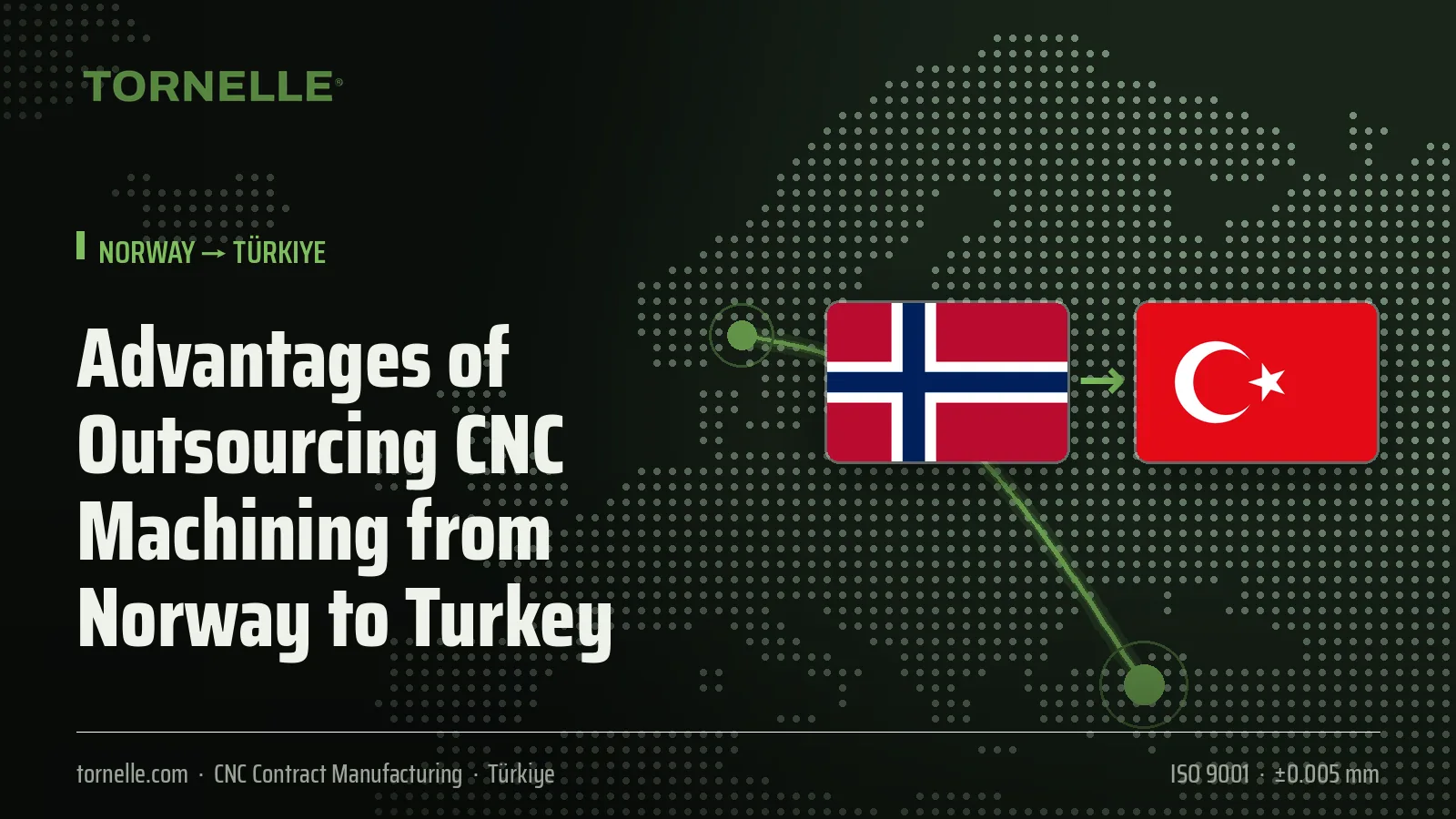
Norway ranks at the top of Europe in terms of per capita income and hourly labor costs. This situation is prompting Norwegian companies operating in engineering-intensive sectors—such as offshore, maritime, aquaculture, hydroelectric power, and defense—to consider outsourcing their CNC turning and milling work abroad. In this article, we address why CNC contract manufacturing in Turkey is a sensible option for Norwegian buyers, using concrete headings.
1. Cost Differences: Machine Hour Rates and Labor Costs
In Norway, the hourly machine rate at a CNC workshop exceeds the Western European average due to high wages, social security contributions, and energy and facility costs. In Turkey, however, hourly rates for 3-axis turning and milling typically range from 28 to 45 €. For labor-intensive parts (multi-operation housings, small precision shafts, parts for Swiss-type machines), the total savings—including shipping and customs clearance—generally reach the 35–50% range. Since raw materials are priced globally, the difference is smaller for simple, material-intensive parts; therefore, determining which of your parts are “labor-intensive” is a good place to start.
2. EFTA–Turkey Free Trade Agreement
Since Norway is not an EU member, it falls outside the scope of the EU–Turkey Customs Union and the A.TR certificate. Instead, the free trade agreement between Turkey and the EFTA countries (Norway, Switzerland, Iceland, and Liechtenstein) applies. Industrial products of Turkish origin enter Norway duty-free upon presentation of proof of origin (an EUR.1 movement certificate or an invoice declaration). Furthermore, Norway already applies zero or very low customs duties on the majority of industrial products. In practice, the cost factors for a Norwegian buyer are not customs duties, but rather the 25% import VAT—which is payable upon importation and deductible for VAT-registered companies—and customs brokerage fees.
3. Industry Alignment: Offshore, Maritime, Aquaculture
The Norwegian industry’s demand for CNC-machined parts is largely concentrated on precision components made from stainless steel, duplex steel, and high-alloy steels: valve bodies, flanges, fasteners, sensor housings, hydraulic blocks, and aquaculture equipment parts. The Turkish machining sector has extensive experience with stainless and alloy steels, thanks to its involvement in the defense and automotive supply chains. For projects with NORSOK requirements, the most critical factors are the EN 10204 3.1 material certificate and full traceability; requesting these documents during the bidding phase prevents surprises later on.
4. Logistics: Distant but Predictable
Road transport between Istanbul and Oslo is longer than that to Germany; the typical door-to-door transit time is 7–10 business days. Alternatives:
- Road freight (less-than-truckload/full truckload): The most economical option for medium and large shipments.
- Air freight: 2–3 days for urgent and small-volume shipments.
- Sea freight: Containers for high-volume, scheduled shipments.
Compared to 30–45 days of sea freight from China, Turkey significantly reduces inventory tie-up and revision risk. You can find details on the various modes of transport in our article on CNC part logistics to Europe.
5. Time Zone, Language, and Communication
There is only a 1–2-hour time difference between Turkey and Norway; technical questions are answered the same day. English is the standard language for technical communication in export-oriented Turkish workshops. The sharing of technical drawings, STEP files, tolerance discussions, and measurement reports is conducted in formats familiar to Norwegian engineers (ISO GPS, ISO 2768).
6. Flexibility for Small and Medium-Sized Production Runs
Most Norwegian companies operate on a project basis; batches ranging from 50 to 2,000 units, frequent revisions, and various material combinations are common. While Far East suppliers respond to this structure with high minimum order quantities (MOQs), Turkish workshops operate flexibly under one roof, from prototyping to mass production. At Tornelle, prototype manufacturing and mass production are carried out by the same team; once the first sample is approved, the process remains unchanged for mass-produced parts.
7. Exchange Rate Advantage and Euro-Based Pricing
Turkish exporters provide quotes in euros (with a reference to the NOK equivalent upon request); exchange rate risk is not passed on to the buyer. In long-term contracts, raw material-indexed price adjustments are a common and transparent practice.
Points to Note
- Confirm proof of origin (EUR.1 or invoice declaration) before shipment; otherwise, delays may occur at customs.
- Require a material certificate for stainless steel and duplex components at the order stage.
- Include a sample and measurement report step in the first order; document your quality assurance expectations in writing.
- Clarify the delivery terms (DAP Oslo, FCA Istanbul, etc.) during the quotation phase.
Frequently Asked Questions
Are customs duties payable when importing into Norway?
Industrial products of Turkish origin are exempt from duties under the EFTA–Turkey Agreement, provided proof of origin is provided. Import VAT (25%) is payable but is deductible for VAT-registered companies.
What is the delivery time from Turkey to Norway?
Typically 7–10 business days by road, 2–3 days by air freight. Production time is 2–5 weeks, depending on the complexity of the parts.
Is material traceability provided for offshore parts?
Yes. An EN 10204 3.1 certificate, traceability based on casting numbers, and independent laboratory testing upon request can be provided.
Are small batches accepted?
Yes. Batches ranging from prototypes to several thousand units are the core business model of Turkish contract manufacturing workshops.
Conclusion
For Norwegian companies, Turkey offers savings of 35–50% on labor-intensive CNC parts compared to high local labor costs, duty-free import under the EFTA agreement, a 1–2-hour time difference, and flexible batch sizes. To get started, submit your technical drawings and estimated annual production volume via our quote form; you’ll receive an itemized quote within 24 hours. You can find the practical steps of the process on our “How We Work” page.