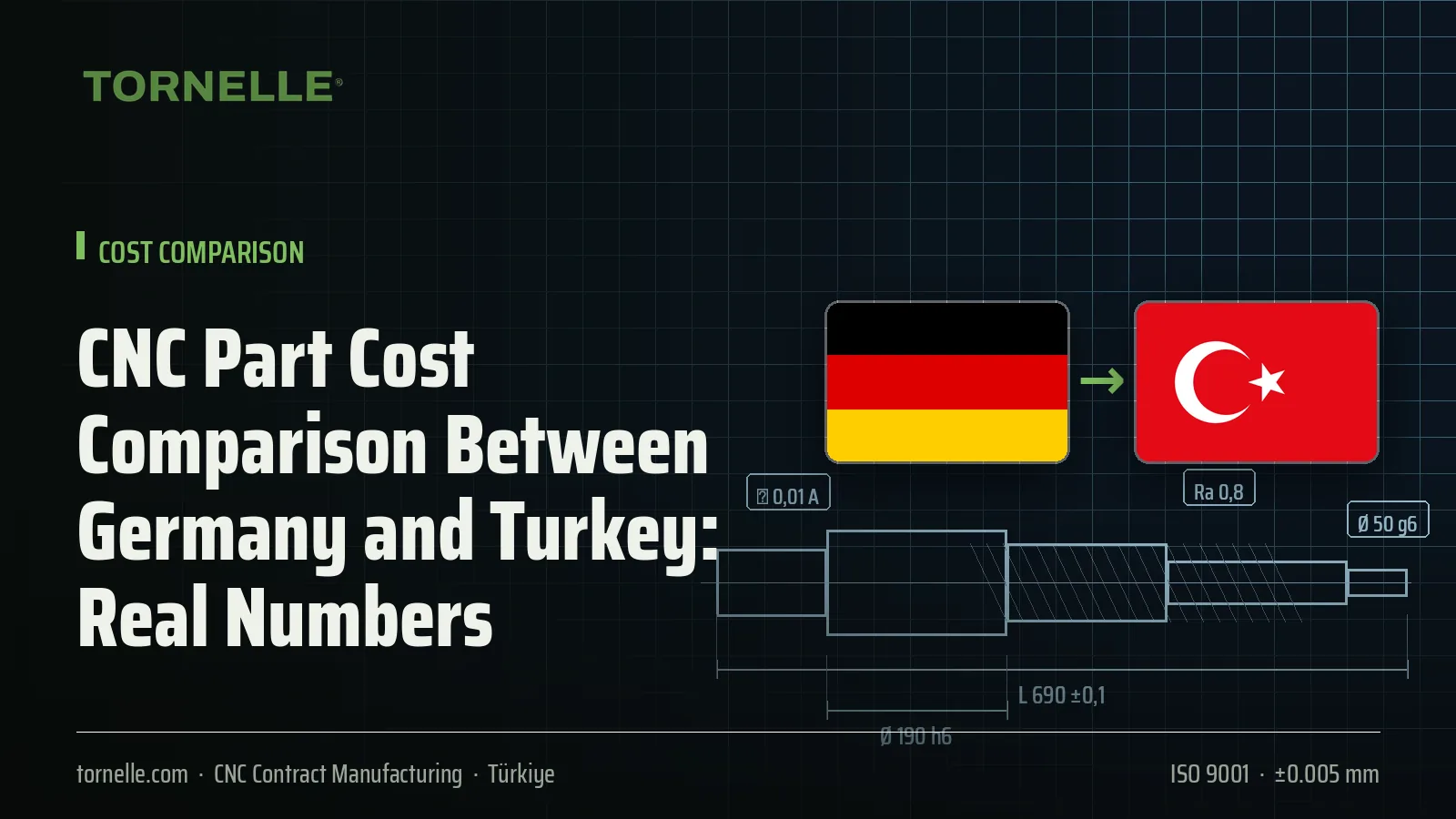
The first question German buyers ask about sourcing CNC parts from Turkey is about cost: “How much will we save, and will these savings remain after factoring in shipping and customs duties?” This article compares cost items one by one—rather than using general percentages—and calculates the total cost for three typical part examples. The figures are typical values reflecting 2025–2026 market conditions; they vary by supplier and part.
Cost Components
The unit price of a CNC part consists of the following components:
- Raw materials: Bar stock, sheet metal, or castings; including cutting allowance and material loss.
- Machine hours: Machine depreciation, maintenance, tools, coolant, energy, and facility costs.
- Labor: Operator, programmer, quality control personnel.
- Setup and programming: Fixed per batch; divided by quantity.
- Secondary processes: Heat treatment, coating, grinding, marking.
- Quality and documentation: Measurement, reports, certificates.
- Overhead and profit.
From the buyer’s perspective, shipping, customs clearance, and inventory/capital costs are added to this.
Item-by-Item Comparison
| Item | Germany | Turkey | Difference |
|---|---|---|---|
| CNC lathe hourly rate (3 axes) | 65–85 € | 28–40 € | ≈ 50–55% lower |
| CNC milling hourly rate (3 axes) | 70–95 € | 30–45 € | ≈ 50–55% lower |
| 5-axis milling hourly rate | 95–130 € | 45–65 € | ≈ 50% lower |
| Sliding automatic machine hourly rate | 60–80 € | 25–38 € | ≈ 55% lower |
| Programming / installation (per hour) | 75–95 € | 30–45 € | ≈ 55% lower |
| Raw materials (steel, aluminum, stainless steel) | Market | Market (±5%) | Similar |
| Industrial electricity (kWh) | 0.17–0.25 € | 0.10–0.14 € | ≈ 40% lower |
| Coating / heat treatment | Market | 20–35% lower | Medium |
| Shipping to Germany (as a percentage of part value) | 0.5–1% | 2–4% | High in Turkey |
| Customs duty | — | 0% (A.TR) | None |
| Customs processing (per shipment) | — | 40–80 € | Fixed, small |
Key point: Since raw materials are priced globally, savings are low for parts where materials account for a large portion of the cost; savings are high for parts where labor and machine hours account for a large portion of the cost. A zero customs duty (Customs Union) ensures that these savings are preserved.
Example 1: Aluminum Milled Housing
EN AW-6082 T6, 120×80×40 mm, 3-axis milling with 2 setups, 12 holes, 3 threads, anodized; ISO 2768-m; quantity 500.
| Germany | Turkey | |
|---|---|---|
| Raw Material | 3.80 € | 3.90 € |
| Machine + labor (18 min) | 24.00 € | 10.50 € |
| Installation/programming (per unit) | 1.20 € | 0.55 € |
| Anodized | 2.20 € | 1.50 € |
| Quality/report | 0.80 € | 0.60 € |
| Overhead + profit | 6.40 € | 3.40 € |
| Factory price | 38.40 € | 20.45 € |
| Shipping + customs processing | 0.30 € | 0.75 € |
| Delivery cost | 38.70 € | 21.20 € |
Savings: ≈ 45%. Labor-intensive milled parts — the category where Turkey excels.
Example 2: Steel Turned Shaft
42CrMo4+QT, Ø40×250 mm, turning + milling of keyway, hardening and grinding (2 diameters h6), ISO 2768-m; 3.1 certificate; quantity 200.
| Germany | Turkey | |
|---|---|---|
| Raw Material | 9.50 € | 9.80 € |
| Lathe + Milling (22 min) | 27.50 € | 12.50 € |
| Heat treatment + grinding | 14.00 € | 8.50 € |
| Installation/programming | 2.50 € | 1.20 € |
| Quality/report/3.1 | 1.50 € | 1.10 € |
| Overhead + profit | 11.00 € | 6.00 € |
| Factory price | 66.00 € | 39.10 € |
| Shipping + customs processing | 0.60 € | 1.60 € |
| Delivery cost | 66.60 € | 40.70 € |
Savings: ≈ 39%. The raw material share is higher, and there are more secondary operations; savings are still significant.
Example 3: Brass Sliding Automatic Part
CuZn39Pb3, Ø8×22 mm, sliding automatic part, M5 thread, 2 cross holes; quantity 20,000.
| Germany | Turkey | |
|---|---|---|
| Raw Material | 0.22 € | 0.23 € |
| Sliding vending machine (45 sec) | 0.95 € | 0.42 € |
| Setup/programming | 0.04 € | 0.02 € |
| Quality (SPC) | 0.05 € | 0.04 € |
| Overhead + profit | 0.30 € | 0.16 € |
| Factory price | 1.56 € | 0.87 € |
| Shipping + customs processing | 0.01 € | 0.03 € |
| Delivery cost | 1.57 € | 0.90 € |
Savings: ≈ 43%. For high-volume small parts, shipping costs are negligible; sliding automatic parts are a strong area for Turkey.
Total Cost of Ownership: Hidden Costs
In addition to shipping costs, the following should also be taken into account:
- Inventory and capital: Shipping from Turkey takes 4–6 days and requires an additional 1–2 weeks of safety stock; this is lower for domestic supply in Germany. With an annual capital cost of 8%, this difference amounts to 0.3–0.5% of the part’s value—negligible.
- Supplier management: Remote communication and an annual audit visit; a small fixed cost.
- Quality risk: Equivalent to Germany with the right quality system (see guide); 1–2 weeks to resolve complaints.
- Capacity and lead time: 8–12-week wait times at German workshops, 3–6 weeks in Turkey—reducing delay costs.
Result: With a properly structured supply chain in Turkey, the total cost of ownership savings remain very close to the savings on delivery costs: typically 30–45%.
Situations Where Savings Are Low
- Large, simple parts where raw materials account for more than 60% of the cost (thick plates, large-diameter bars);
- Prototypes with very low quantities (1–5) — setup and shipping costs dominate;
- Parts requiring daily JIT (Just-In-Time) delivery;
- Simple parts produced in very high volumes via automated, unmanned manufacturing in Germany.
Frequently Asked Questions
How much cheaper are CNC parts from Turkey?
Typically 30–45% cheaper for labor-intensive parts, including shipping and customs clearance; 10–20% cheaper for simple, material-intensive parts.
Are prices quoted in euros?
Yes. Export-oriented Turkish suppliers provide quotes in euros; the buyer bears no exchange rate risk. Raw material indexation is recommended for long-term contracts.
Do shipping costs offset the savings?
No. Road freight to Germany typically amounts to 2–4% of the part’s value; customs duties are zero.
Can I get a quote for my own part?
Yes. Send us your technical drawing along with the information from our RFQ guide, and you’ll receive a comparable quote within 24 hours.
Conclusion
The cost difference between Germany and Turkey for CNC parts stems from machine-hour rates and labor costs, and is passed on to the buyer thanks to zero customs duties. A total savings of 30–45% is a realistic expectation for labor-intensive parts. If you’d like to see the actual figures for your own parts, please send us your technical drawings.