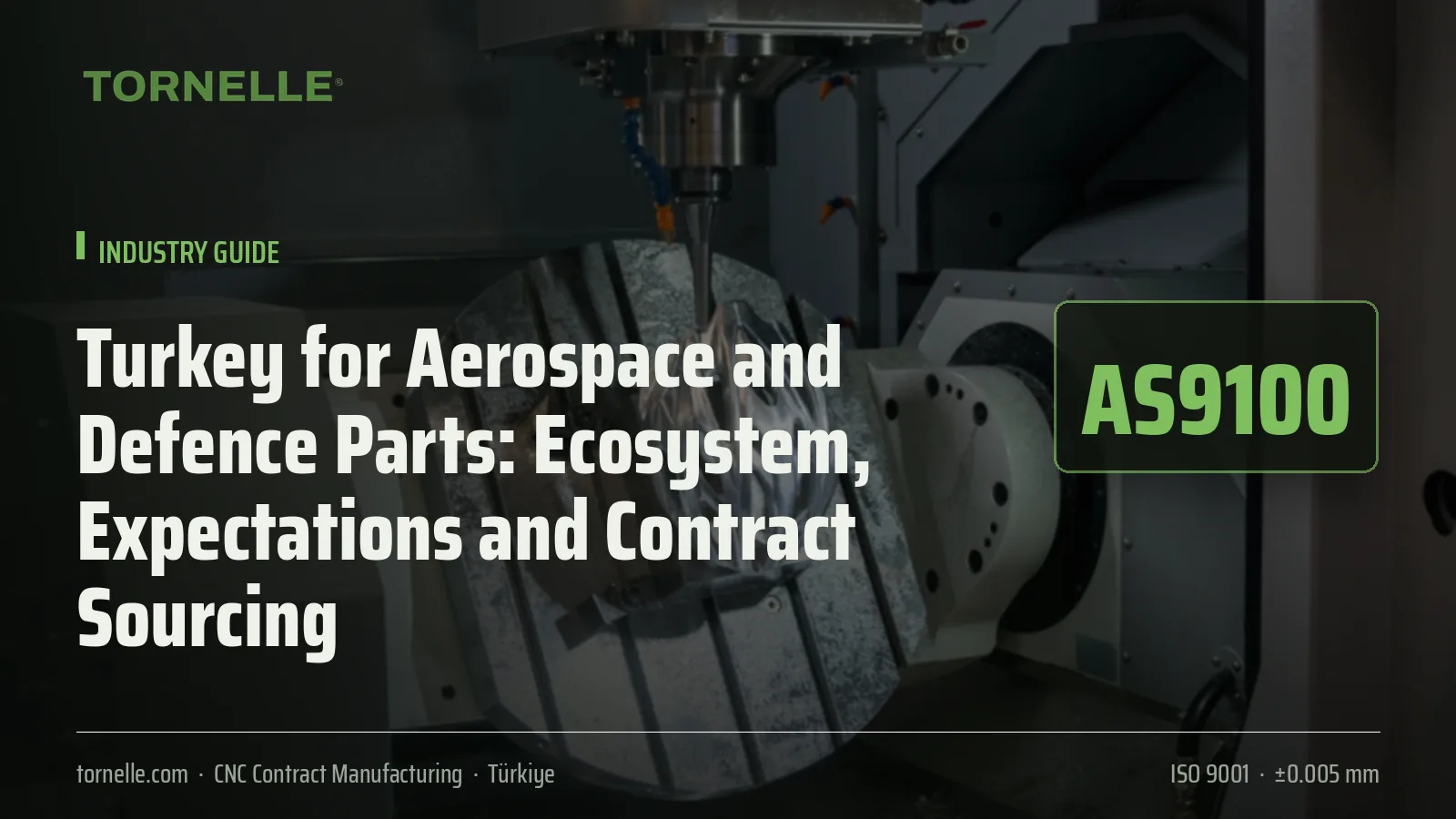
Turkey's defence and aerospace exports have multiplied several times over the last decade; national aircraft, helicopter, UAV and engine programmes, together with structural-part supply to Airbus, Boeing and engine manufacturers, have built tight-tolerance machining capacity and an aerospace quality culture in the country. As the sector-level continuation of our article on the machining industry, this piece aims to give European supply managers a picture without exaggeration.
Structure of the Ecosystem
- Prime contractors and engine suppliers: Large plants producing aircraft structural parts, engine components and landing-gear parts; concentrated in Ankara, Eskişehir and Izmir.
- Certified sub-tier suppliers: AS9100-certified medium-sized shops with 5-axis milling and CMM infrastructure; they work for the primes and their number is limited.
- General precision machining shops: ISO 9001-certified shops capable of tight-tolerance machining but without aerospace certification; they work on non-flight-critical jobs such as ground support equipment, test fixtures, tooling and jigs, and mechanical parts for defence electronics.
The important distinction for the European buyer: for flight-critical parts, AS9100 and customer-approved special processes are mandatory; for parts such as ground equipment, test rigs, simulators, defence-electronics enclosures, optics and camera mechanics, an ISO 9001 precision shop is sufficient and far more economical.
Expectations: AS9100, Special Processes, Traceability
AS9100 / EN 9100
The aerospace quality management system; it adds configuration management, risk, counterfeit-part prevention, product safety and first article inspection (FAI, AS9102) on top of ISO 9001. Certified shops are listed in the OASIS database; the claim can be verified. We discussed the gap between certificate and practice in our ISO 9001 article.
Special processes (NADCAP)
Special processes such as heat treatment, chemical processing (anodising, chemical conversion coating), NDT and welding require NADCAP accreditation. The number of NADCAP-accredited facilities in Turkey is limited; the contract shop has these operations done at accredited facilities and documents them in the traceability chain.
Traceability and FAI
The material certificate (EN 10204 3.1, in aerospace usually to an AMS/ASTM specification), casting/forging lot number, machining lot, special-process certificates and the first article report in AS9102 format are linked together. The material source must be an approved distributor; aerospace aluminium (7075-T6, 2024-T3) and titanium (Ti-6Al-4V) are mostly imported and have long lead times.
Typical Parts and the Suitable Supplier Profile
| Part group | Material | Certification requirement | Suitable profile |
|---|---|---|---|
| Structural brackets, fittings, ribs | 7075, 2024, Ti-6Al-4V | AS9100 + NADCAP processes | Certified sub-tier supplier |
| Engine components, bearing housings | Inconel, stainless, titanium | AS9100, customer approval | Certified, special capability |
| Ground support equipment, test fixtures | Aluminium, steel | ISO 9001, FAI | Precision machining shop |
| Defence-electronics enclosures, heat sinks, rails | 6061/6082, 5083 | ISO 9001, inspection report | 3–4-axis milling shop |
| Optics/camera mechanics, gimbal parts | Aluminium, stainless, brass | ISO 9001, tight tolerance | Precision mill-turn |
| Connectors, pins, fasteners | Stainless, brass, titanium | Case by case | Swiss-type turning |
For aluminium machining details see our aluminium article.
Export Controls and Confidentiality
For defence parts the sharing of technical data is subject to export control: the Dual-Use Regulation in the EU, ITAR/EAR for US-origin data, the Export Control Order in the UK. Turkey is a NATO member and a party to the Wassenaar Arrangement; nevertheless, an export licence from the buyer's country may be required for certain technical data. Before sending drawings to the supplier, clarify the part's classification (ECCN, ML category) with your own compliance department. NDA and data-security practices are described in our intellectual property article.
Realistic Expectations
- Certified aerospace capacity is tight and filled by the main programmes; it is hard for a small European customer to get priority.
- For non-flight-critical parts, Turkey's price advantage (35–50%) applies in full and lead times are short.
- Sourcing aerospace material can take 4–10 weeks; customer-supplied (free-issue) material is a common solution.
- The cost of FAI and the document package can exceed the part price at low quantities; it should be requested as a separate line in the quote.
Where TORNELLE Stands
To be clear: TORNELLE is not an AS9100-certified aerospace supplier. Within an ISO 9001 framework we produce tight-tolerance aluminium, stainless and brass parts on CNC lathes, 3–4-axis mills and Swiss-type lathes; we are a suitable supplier for non-flight-critical work such as ground support equipment, test fixtures, mechanical parts for defence electronics and optical mechanics. For flight-critical parts we refer you to certified suppliers. See our industries page for our scope.
Defence-Electronics Mechanics: Turkey's Strong Area
A significant part of the growth of Turkey's defence industry comes from electronic systems (radar, electro-optics, communications, electronic warfare); the mechanical parts of these systems (aluminium enclosures, cold plates, rails, connector housings, optical mounting plates, gimbal parts) are the areas in which Turkish contract shops are most experienced. Typical requirements: 6061-T6 or 6082-T6 aluminium, ±0.02–0.05 mm position tolerances, Ra 1.6 surface, chemical conversion coating (for conductivity) or anodising, flatness and surface cleanliness for EMI sealing. These parts are not considered flight-critical but demand tight tolerances and documentation discipline; an ideal profile for an ISO 9001 precision shop. For European defence-electronics manufacturers this segment is the lowest-risk, highest-saving first step into Turkey. You can see our enclosure and plate machining scope on our CNC milling page.
What to Specify When Requesting a Quote
- The part's classification (civil/military, controlled/uncontrolled) and NDA requirement.
- Documentation level: inspection report, FAI format (AS9102 or your own template), material certificate specification.
- Special-process requirements and, if applicable, the list of approved facilities.
- Material supply: will the supplier or the customer provide it?
Frequently Asked Questions
Is AS9100 essential for buying aerospace parts from Turkey?
For flight-critical parts, yes. For ground equipment, fixtures and defence-electronics mechanics, ISO 9001 and FAI are generally sufficient; the customer's quality specification is decisive.
Does sending technical data to Turkey run into export controls?
It depends on the part's classification. Civil, uncontrolled parts pose no problem; a licence may be needed for parts on the military list or with a dual-use classification.
Is aerospace aluminium available in Turkey?
It is sourced from approved distributors but lead times are long; for critical projects, customer-supplied material is recommended.
Can the FAI report be provided in AS9102 format?
It is standard at certified suppliers; non-certified precision shops can also prepare a report in the same format on request. The content is described in our FAI article.
Is an NDA with a Turkish supplier sufficient for a defence part?
For commercial confidentiality, yes; but if classified information is involved, a government-level facility security clearance is required and the subcontracting relationship falls under a different framework. Most mechanical parts are unclassified commercial information.
Conclusion
Turkey's aerospace and defence ecosystem is a real and growing capacity; for the European buyer, however, the most efficient entry point is non-flight-critical precision parts. Send your drawings for ground equipment, fixtures, electronics enclosures or optical mechanics via our quote form; for work outside our scope we say so openly and point you in the right direction.