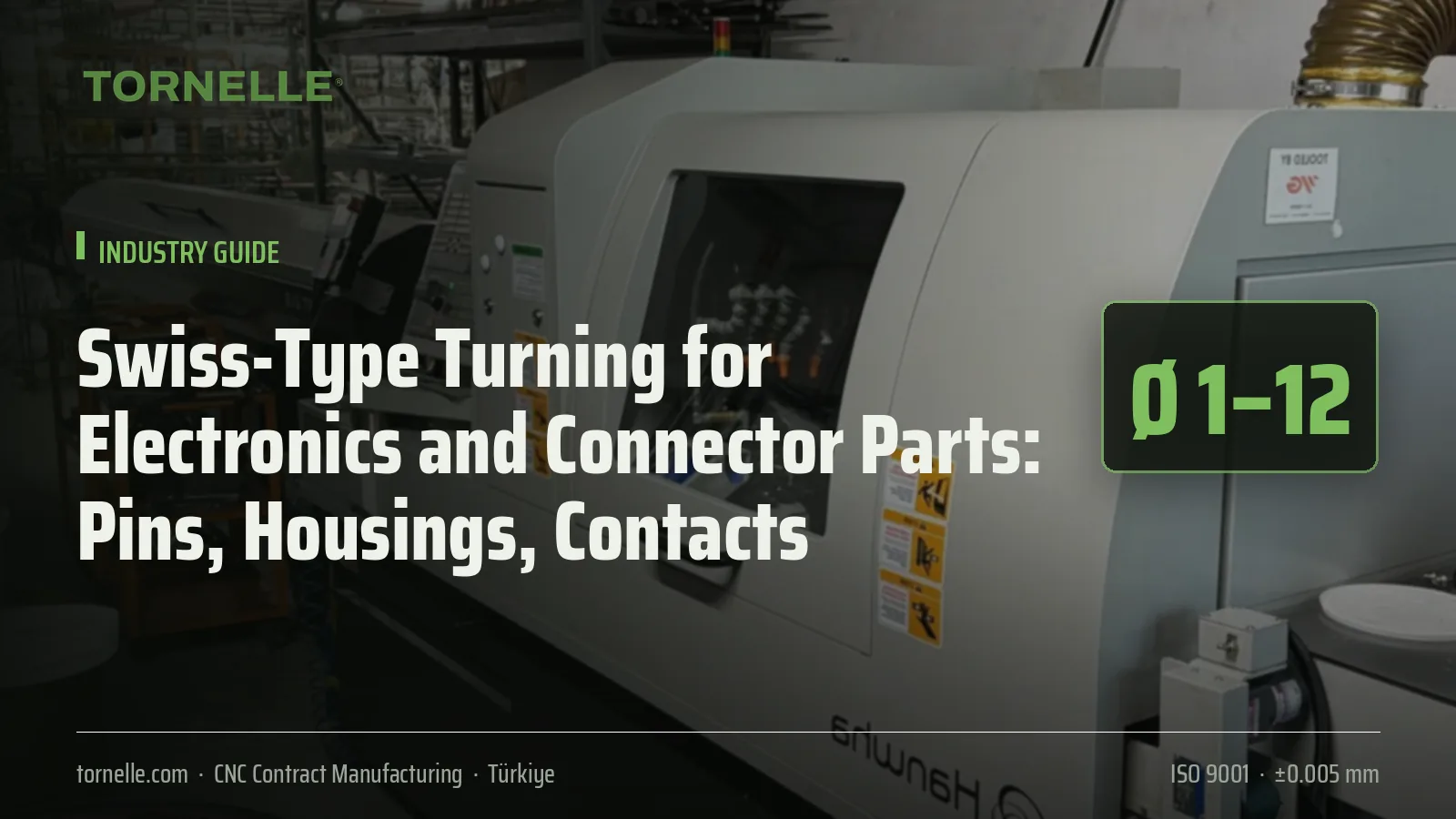
An industrial connector contains on average 10–30 different turned parts: pins, sockets, contact carriers, housings, nuts, locking rings. The common feature of these parts is small diameter, tight tolerance, high volume and almost always a plating operation. As the sector-specific continuation of our Swiss-type turning article, this article is a practical guide for electronics and connector manufacturers. Our capacity is on our Swiss-type turning page.
Typical Part Families
| Part | Diameter range | Material | Critical feature | Plating |
|---|---|---|---|---|
| Connector pin (male contact) | Ø0.6–4 mm | CuZn39Pb3, CuSn6, CuNi2Si | Diameter ±0.01, tip radius, surface Ra 0.4 | Ni underplate + Au or Sn |
| Socket (female contact) | Ø1–6 mm | CuSn6, CuBe2 (alternative CuNi2Si) | Bore, slot, spring force | Ni + Au |
| Connector housing | Ø6–30 mm | CuZn39Pb3, 6082, 303 | Thread (M8, M12, 7/8"), concentricity, sealing surface | Ni, Zn-Ni, anodising |
| Sensor enclosure | Ø8–30 mm | 303, 316L, 6082, CuZn39Pb3 | Thin wall, thread, internal geometry, IP67 surface | Passivation, anodising, Ni |
| RF connector internals | Ø0.5–10 mm | CuBe/CuNi2Si, brass, 303 | Diameter ±0.005 for impedance, surface Ra 0.2 | Au, Ag |
| Standoff, spacer, threaded spacer | Ø3–10 mm | Brass, 303, aluminium | Thread, length ±0.05 | Ni, Sn, passivation |
| Cable gland and nut | Ø10–40 mm | CuZn39Pb3, 303 | Thread (M, PG), sealing | Ni |
| Thermal pin, heat conduction part | Ø2–15 mm | Cu-ETP, CuCrZr | Surface, flatness | Ni, Sn |
Material Selection
Material selection for electronic parts is a balance between conductivity, spring properties, machinability and plating compatibility. CuZn39Pb3 (Ms58) is standard for housings and pins; best machinability, good plating surface, medium conductivity (26% IACS). CuSn6 (phosphor bronze) for sockets requiring spring properties. CuNi2Si and CuNi3Si1Mg are increasingly common alternatives for spring contacts to avoid the health risk of beryllium copper. 303 stainless for unplated sensor enclosures; 316L in chemical environments. Aluminium 6082 for light and anodised housings. Pure copper (Cu-ETP) for thermal and high-current parts; difficult to machine. Each material is described in detail in our copper alloys article. For products in scope of RoHS, exemption 6(c) applies to leaded brass; if lead-free is required, CuZn21Si3P is used (price +15–30%).
Tolerance and Surface
- Diameter: ±0.01 mm is routine on Swiss-type lathes, ±0.005 mm possible on selected parts (RF contacts); the guide bushing and bar quality (h6 bar) are decisive.
- Length: ±0.02–0.05 mm; cut-off face quality and the pin protrusion standard should be specified.
- Concentricity: 0.01–0.02 mm for features machined in one clamping; 0.03 mm for sub-spindle operations.
- Surface: Ra 0.4–0.8 before plating; Ra 0.2–0.4 before gold plating (plating does not hide surface defects, it magnifies them). Drag marks and tool chatter remain visible after plating.
- Edges: Burrs impair plating adhesion and cut cable insulation during assembly; a "burr-free, no sharp edges" standard and the deburring method (vibratory, thermal, electrochemical) should be defined.
The Plating Chain
Most electronic parts are plated and plating can account for 15–40% of the part cost. Typical chain: degreasing → activation → nickel underplate (1–3 µm, prevents copper diffusion) → functional plating: tin (2–8 µm, solderability and low cost), gold (0.1–1.3 µm hard gold, contact resistance and corrosion), silver (2–10 µm, high current), palladium-nickel (gold alternative). Plating thickness and measurement method (XRF) should be defined; the price difference between "flash" gold (0.05–0.1 µm) and functional gold (0.4–0.8 µm) is large. Plating can be done in Turkey; there are electronics plating shops in the Marmara region, but if the buyer has its own approved plater, the parts are shipped bare or nickel-plated and plating is done in Europe. Cleanliness: no oil or chip residues before plating; ultrasonic washing and the cleanliness class should be specified. Our surface treatments article explains plating processes.
Volume and Delivery Model
Electronic parts are in the range of 50,000–5,000,000 pieces per year; Swiss-type turning works at these volumes with cycle times measured in seconds per part. Typical model: annual frame agreement, monthly or bi-monthly call-offs, 4–8 weeks of bar stock at the supplier, 2–4 weeks of safety stock at the buyer. Air freight is economical for small and light parts (1 million pins weigh a few hundred kg); the calculation model is in our TCO article. Packaging: compartment trays, VCI or separator paper for plated parts, a defined packaging unit per quantity; bulk packaging carries surface damage risk.
Quality System and Documents
- Bar material 3.1 certificate (chemical analysis, mechanical properties).
- Plating thickness report (XRF), adhesion test, solderability test (if requested).
- SPC on critical dimensions (Cpk ≥ 1.33 or 1.67); in-process measurement and automatic compensation are standard on Swiss-type lathes.
- RoHS and REACH declaration; format in our declaration article.
- Visual inspection standard: acceptable scratch, colour variation and stain limits; photographed boundary samples.
- Lot traceability: bar lot → production lot → plating lot → shipment.
Points to Watch When Sourcing from Turkey
- Clarify where plating will be done: the supplier's approved plater in Turkey or the buyer's plater in Europe?
- Ask about bar material quality (h6, straightness) and the supply source; on Swiss-type lathes bar quality means tolerance.
- Request the sample batch as two sets, plated and unplated; surface problems become clear after plating.
- Define the burr and cleanliness standard in writing; the electronics assembly line has no tolerance for burrs.
- Ask about the number and maintenance condition of Swiss-type machines; at TORNELLE parts up to Ø32 mm are machined on an 8-axis Swiss-type lathe, and capacity planning is done for higher volumes and smaller diameters.
Example: M12 Sensor Connector Part Set
An M12 connector set for a German sensor manufacturer: brass housing (Ø14, M12x1 thread, internal geometry, nickel plating), 4 CuSn6 contact pins (Ø1.0 ±0.01, gold 0.4 µm), stainless 303 locking nut and brass cable gland. 300,000 sets per year. Flow: housing and nut on a Swiss-type lathe, pins on a separate Swiss-type lathe; vibratory deburring; ultrasonic washing; nickel and gold plating at an approved plater; XRF thickness report; packaging as sets in compartment trays; monthly air freight. This profile is the typical and most efficient form of Swiss-type supply.
Frequently Asked Questions
What is the minimum diameter in Swiss-type turning?
Around Ø1 mm on standard machines; Ø0.5 mm on special small-diameter machines. Ø0.6–4 mm pins are commonly machined.
Can gold plating be done in Turkey?
Yes; but many buyers use their own approved plater. Both options are possible and should be stated in the RFQ.
What is used instead of beryllium copper?
CuNi2Si or CuNi3Si1Mg; slightly lower spring properties, no health risk, similar machinability.
Delivery time for a million-piece pin order?
First batch 4–6 weeks (including bar procurement), then continuous flow with monthly call-offs; air freight 2–3 days.
Conclusion
Electronics and connector parts are the area where Swiss-type turning makes best use of its trio of precision, speed and high volume; when material, plating chain, burr and cleanliness standards are defined from the start, sourcing from Turkey is both economical and safe. Send the technical drawings and annual quantities for your pin, socket, housing and enclosure parts via our quote form; we quote within 24 hours with two options, plated and unplated.