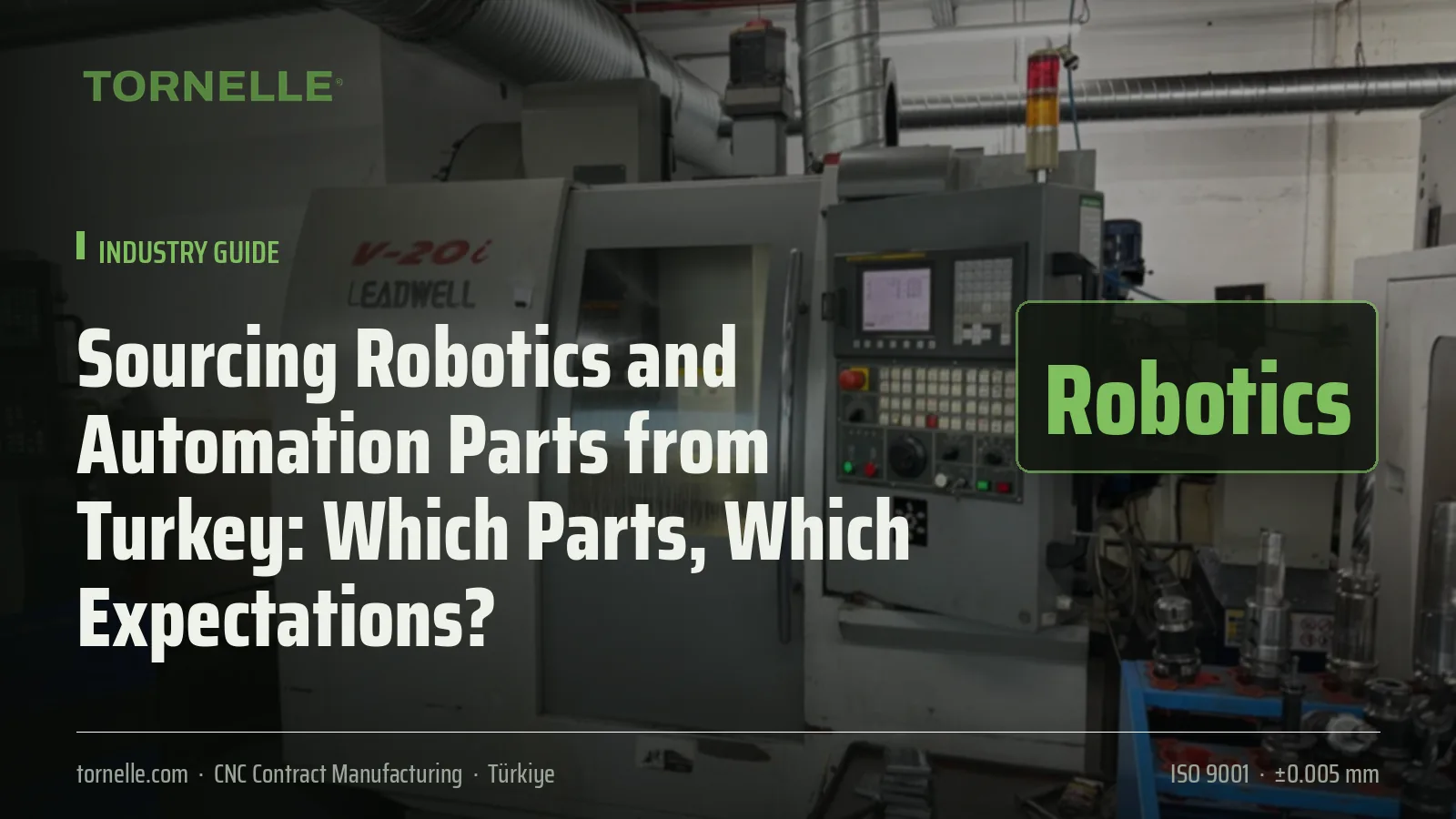
Robotics and automation manufacturers in Germany, Italy, Denmark, Switzerland and the Netherlands buy mechanical parts for a wide product range, from industrial robot arms to collaborative robots (cobots), from linear-axis systems to custom assembly cells. What these parts have in common: small-to-medium quantities, high variety, predominantly aluminium, tight tolerances and continuous revision. This article, a continuation of our hydraulics-pneumatics and medical sector articles, focuses on the needs of the automation sector.
Typical Part Families
| Part group | Material | Tolerance / critical feature | Quantity profile | Suitable method |
|---|---|---|---|---|
| Gripper fingers, jaws, adapter plates | 6082-T6, 7075-T6, POM | ±0.02 mm position; parallelism | 10–500 | 3–4-axis milling |
| Actuator body, cylinder, piston | 6082, 1.4305, C45 | H7 bore, Ra 0.4–0.8 inner surface | 50–2,000 | Turn-mill |
| Linear axis: bearing blocks, supports, shafts | Aluminium, hardened C45, 1.4301 | Parallelism, squareness; shaft runout | 20–1,000 | Milling, turning, grinding |
| Gearbox flange, motor adapter | 6082, C45 | Coaxiality, hole-pattern position | 50–5,000 | Turn-mill |
| Pulleys, shafts, couplings | Aluminium, steel, brass | Keyway, runout, H7/h6 | 100–10,000 | Turning, Swiss-type turning |
| Fixtures, calibration parts, sensor holders | Aluminium, stainless | Variable | 1–50 | Milling |
| Pins, bushings, spacers | 1.4305, brass, aluminium | h6, g6 | 1,000–100,000 | Swiss-type turning |
The Sector's Distinctive Expectations
1. Lightness and rigidity
In a robot arm every gram affects speed and energy consumption; pocketed aluminium parts, thin walls and weight-reduction holes are therefore common. Controlling distortion and vibration in thin-walled aluminium requires supplier experience; alloy selection is explained in our aluminium article.
2. Position tolerance and repeatability
A robot's repeatability (±0.02–0.05 mm) is determined by the position tolerance of the mechanical parts; hole patterns, pin seats and datum surfaces are defined with geometric tolerances. There are practical suggestions in our GD&T article.
3. Variety and small quantities
An automation cell may contain 100 different parts at 5 pieces each. It is critical that the supplier can manage multi-part orders in a single shipment with a single inspection package; a program and fixture library lowers the price on repeat orders.
4. Fast revisions
Product life cycles are short; the move from revision C to D happens within weeks. Revision management with the supplier (which revision is in stock, which is in production) must be transparent.
5. Appearance
Visible aluminium parts on cobots and desktop automation products; uniform anodising, bead blasting and edge quality are expected. A colour reference and marking of visible surfaces are needed; details in our surface treatments article.
Why Does Turkey Fit This Profile?
- Flexible SME structure: Small-to-medium series and high variety are the daily work of Turkish contract shops; orders of 5–50 pieces that large factories are not interested in get priority.
- Aluminium experience: The defence electronics and machinery supply industries have built depth in machining pocketed aluminium housings.
- Swiss-type turning capacity: High-volume, economical production for pins, bushings and spacers.
- 4–6-day logistics: New parts after a revision are in Europe within a week; agility that is not possible with Asia.
- Cost: A 30–45% advantage over Western Europe on aluminium milled parts.
Proposed Working Model
- Part family analysis: Group the mechanical parts in your BOM by material and method; identify the groups suited to Turkey (aluminium milling, turned steel, Swiss-type turning).
- Pilot project: Send all parts of one sub-group (for example a gripper module) in a single RFQ; see the supplier's competence in managing a multi-part order.
- Document standard: STEP + PDF, revision control, critical-feature marking; our technical drawing checklist helps.
- Kit delivery: Receiving parts as labelled assembly kits saves time on the assembly line.
- Framework agreement: Annual forecast and call-off arrangement; retention of programs and fixtures; revision procedure.
The Assembled Sub-Group Option
Many automation manufacturers want not just parts from the supplier but sub-groups with bearings and pins fitted, coated and tested. Turkish shops can offer simple assembly (bearing pressing, pin fitting, thread inserts, helicoils) and coating coordination; complex electromechanical assembly is a separate competence. For detail, follow our article on the single-part versus assembled sub-group decision.
Example: Cobot Gripper Module
Suppose a Danish cobot accessory manufacturer sends the 14 mechanical parts of its new gripper model (6 aluminium milled bodies and fingers, 4 stainless pins and shafts, 2 POM pads, 2 brass bushings) in a single RFQ. The Turkish supplier produces the milled parts on 3–4-axis centres and the pins and bushings on Swiss-type lathes; has the aluminium parts black-anodised at the same plater; delivers the 14 parts as a kit in labelled bags. First batch 50 kits, 4 weeks; series batches 200 kits, 3 weeks; on revision only the changed part is reprogrammed. On the buyer's side: one invoice, one shipment, one inspection package.
Quality Documents
PPAP is rarely requested in the automation sector; the typical expectation is a first-article inspection report, material certificate (3.1 for aluminium, 3.1 for stainless) and a coating declaration of conformity. For series batches, a sampling report for critical dimensions and lot traceability are sufficient. Reading a report is explained in our CMM report article.
Price Expectation
A 30–45% advantage over Western Europe on aluminium milled housings and 35–50% on Swiss-type pins and bushings is typical; as quantities fall the set-up share rises, so part families should be ordered together. Fixture and program preparation is priced as a one-off and not charged on repeat orders.
Frequently Asked Questions
Which tolerances are realistic in robotics parts?
±0.02 mm position and 0.02 mm parallelism are routine on milled parts; H7/h6 fits are standard in turning. Tighter tolerances require grinding and increase cost.
Does Turkey make sense for orders of 5 pieces?
For 5 pieces alone the freight share is high; but in a multi-part order (50 different parts × 5 pieces) the total volume is meaningful and Turkish shops like this profile.
Is anodising colour consistency achieved?
Yes, with the same alloy lot and the same plater; the colour reference sample and tolerance expectation must be set from the start.
Can I get design feedback?
Yes; DFM suggestions (wall thickness, corner radius, clamping surface) are offered at the quotation stage and usually lower the price.
Can POM and plastic parts be bought from the same supplier?
Yes; POM and PA machining for gripper pads, slides and insulating parts is available in most Turkish shops and is delivered as a kit together with the metal parts.
Conclusion
Robotics and automation parts are a natural fit for Turkey's flexible, aluminium-experienced contract manufacturing structure a week away from Europe. For your gripper, actuator, linear-axis or fixture parts, send a sub-group from your BOM via our quote form; for multi-part orders we respond with an itemised quote and DFM suggestions. You can see the scope on our CNC milling page.