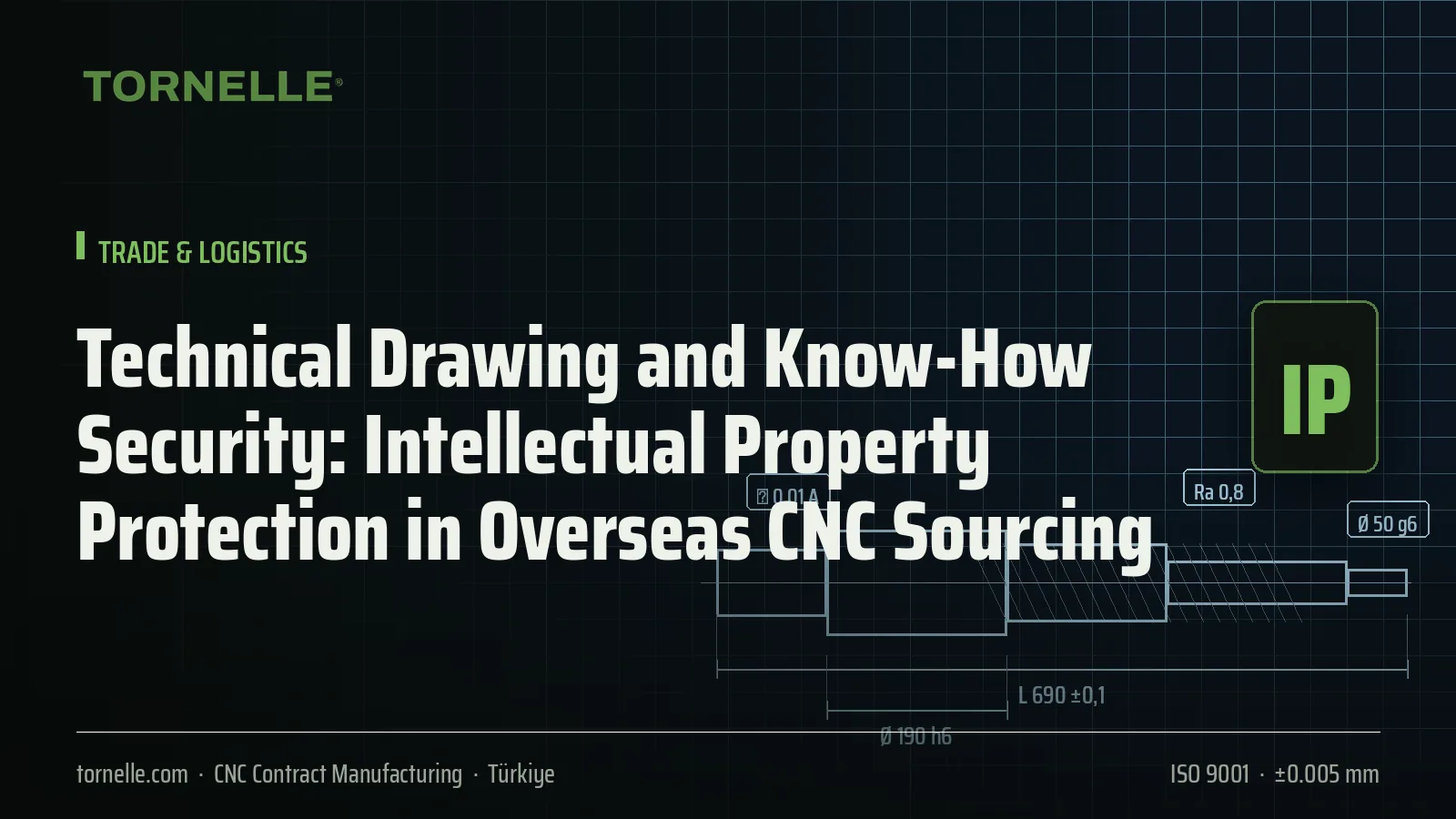
A technical drawing is a company's most tangible intellectual capital; sending it to a third country creates a reasonable reservation. Experience shows this: the risk of copying depends far less on the supplier's country than on the supplier's business model. A subcontract shop with no product of its own, working only from customer drawings, has customer trust as its commercial asset; endangering it destroys the business model. This article nevertheless describes the protection layers for the buyer who wants to "verify rather than trust", and deepens the intellectual-property section of our contract article. It is not legal advice.
What Is the Risk, Realistically?
| Scenario | Likelihood | Impact | Main measure |
|---|---|---|---|
| Supplier uses your drawings for its own product | Low (subcontract shops have no own product) | High | Supplier selection, NDA |
| Supplier sells the same part to your competitor | Low–medium | High | Exclusivity in the NDA, reference ban, audit |
| Leak via sub-supplier (coating, heat treatment) | Medium | Medium | Sub-supplier notification, information minimisation on the drawing |
| Drawings shown for reference or marketing | Medium | Low–medium | Explicit ban in the NDA |
| Cyber leak (e-mail, USB, weak server) | Medium | Variable | Secure sharing, supplier IT practices |
| Reverse engineering from the part (third party) | Independent of the drawing | — | Registration; critical know-how not visible in the part |
Conclusion: the risk is not zero but manageable; the real levers are supplier selection, information minimisation and written rules.
1. Legal Protection
NDA
Signed before the RFQ; may be mutual. Critical clauses: definition of confidential information (drawings, models, quantities, prices, customer identity), purpose limitation (quotation and production only), conditions for transfer to sub-suppliers, ban on production for third parties and on references, term (relationship + 3–5 years; know-how indefinitely), destruction and confirmation, penalty clause (reasonable), governing law and dispute resolution. It is explained clause by clause in our contract article.
Legal framework in Turkey
- Trade secrets and unfair competition: The unfair-competition provisions of the Turkish Commercial Code (Art. 54 et seq.) provide for damages, injunction and declaratory actions against the unauthorised use and disclosure of confidential information; the Turkish Penal Code separately makes the disclosure of trade secrets a criminal offence (Art. 239).
- Industrial property: Industrial Property Law No. 6769 regulates patent, utility model, design and trademark protection largely in line with the EU; Turkey is a party to the European Patent Convention (EP patents can be validated in Turkey) and a member of the Madrid and Hague systems.
- Enforceability: Turkish courts include specialised intellectual and industrial property courts; preliminary injunctions are available. Because of time and language (Turkish) barriers, arbitration and a deterrent penalty clause are in practice more effective in small-to-medium relationships. Turkey is a party to the New York Convention; foreign arbitral awards are enforced.
Registration
If a patent, utility model or design registration exists, protection in the country of production may also be considered: validation of the EP patent in Turkey, design registration via the Hague system. Registration matters more against copies by third parties than against the supplier; for most machined parts the know-how (tolerance, material, process) is not registered but protected by confidentiality.
2. Organisational Protection
- Supplier selection: Pure subcontract shops without their own product are preferred; suppliers whose own product range overlaps your market are avoided. Ask about reference customers and sectors; if the supplier works for your competitor, request separate staff/data segregation or choose another supplier.
- Information minimisation: The supplier should not see more than is needed to make the part: assembly drawings, product name, end use and customer identity are removed from the drawing; part numbers are neutralised; project names are removed from the title block.
- Splitting the critical assembly: The 2–3 parts that form the core of the product (carrying the know-how) are given to a separate supplier or kept in-house; the remaining 90% goes to the subcontract shop. No supplier sees the entire assembly.
- Sub-supplier control: For external operations such as coating, heat treatment and grinding, know which information goes to which sub-supplier; they should receive only the relevant specification (coating thickness), not the full drawing.
- Audit: During an on-site audit, look at drawing management: who has access, where files are stored, control of paper drawings on the shop floor, destruction of old revisions, visitor access. Zurich–Istanbul or Frankfurt–Istanbul is 3 hours.
- Exit at the end of the relationship: Deletion of drawings and programs, return of buyer-owned fixtures and gauges, written confirmation.
3. Technical Protection
- Secure sharing: Encrypted transfer (SFTP, company cloud share, password-protected ZIP with the password sent via a separate channel), expiring links, download logging; e-mail attachments only for small, low-criticality files. Prefer a supplier portal if one exists.
- File format decision: For production, a STEP model provides speed and accuracy; for parts with critical geometry there is the option of sending only a 2D PDF plus critical dimensions, but programming time and error risk increase. Middle way: send the STEP model only for the parts needed for production, without assembly information.
- Markings on the drawing: "Confidential", company name, "for [supplier] only" watermark, revision and date; this makes the source traceable in the event of a leak. Different watermarks per supplier can also be applied.
- Revision control: Only one valid drawing should be with the supplier; old revisions should be recalled; every order should carry the revision number. Our file format guide describes STEP/PDF sharing and revision practice.
- Supplier IT practices: Ask about server backup, access authorisation, internet access of CAM computers, USB policy, retention period for old files. Conscious practice is expected, not perfection.
Practices You Will Want to See on the Supplier's Side
- A standard mutual NDA template and readiness to sign.
- Customer-based folder structure and authorisation; on the shop floor, access only for the relevant operator.
- Paper drawings circulating with the job order and collected and destroyed when the job is finished.
- No unauthorised display of customer drawings or parts as references or on the website.
- Written confidentiality with sub-suppliers and transfer of relevant information only.
- Visitor registration and a photography rule on the shop floor.
- A deletion and written-confirmation procedure at the end of the relationship.
- ISO 9001 document control (revision management) in practice.
Red flags: recognisable photographs of other customers' parts on the website, sharing customer drawings as "references", brushing off the NDA as "not needed", marketing the same part with "we made a similar one for someone else".
The Reality of Reverse Engineering
A part on the market can be measured and copied without a drawing; drawing confidentiality is therefore not the only protection. The know-how that really needs protecting is often what is not visible in the part: material selection and heat-treatment recipe, why the tolerance chain is the way it is, assembly and test method, supply chain. These are removed from the drawing and, where necessary, given in a separate document and only to the supplier who needs them. Commercial protection (patent, design) works against market copies; confidentiality works against leakage of process knowledge.
Frequently Asked Questions
Is an NDA really enforceable in Turkey?
Yes; Turkish law recognises confidentiality agreements, penalty clauses and unfair-competition actions; specialised courts and enforcement of arbitral awards exist. In practice, deterrence and supplier selection are more effective than litigation.
Do I have to send a 3D model?
No; production from a 2D PDF is possible, but programming time and the risk of interpretation errors increase. Most buyers send STEP + PDF stripped of assembly information.
Can the supplier show my part as a reference?
Only with your written permission. Write the reference and photography ban explicitly into the NDA.
How does Tornelle protect drawings?
We sign a mutual NDA before receiving drawings; files are kept in customer-based, access-controlled folders, and paper drawings circulating with the job order on the shop floor are collected when the job is finished; customer parts are not shown as references without permission; sub-suppliers receive only the information relevant to their operation; at the end of the relationship we provide written confirmation of deletion.
Conclusion
Technical drawing security is achieved not by a single contract but by three layers: legal (NDA, trade-secret and industrial-property protection recognised in Turkey, arbitration), organisational (the right supplier, information minimisation, splitting critical parts, audit) and technical (secure sharing, watermark, revision control). When these layers are applied, subcontract sourcing in Turkey is no riskier than sourcing within Europe. For the first step, see our RFQ guide and, after signing the NDA, send your drawings via the quote form; it is enough to state your NDA request in the form.