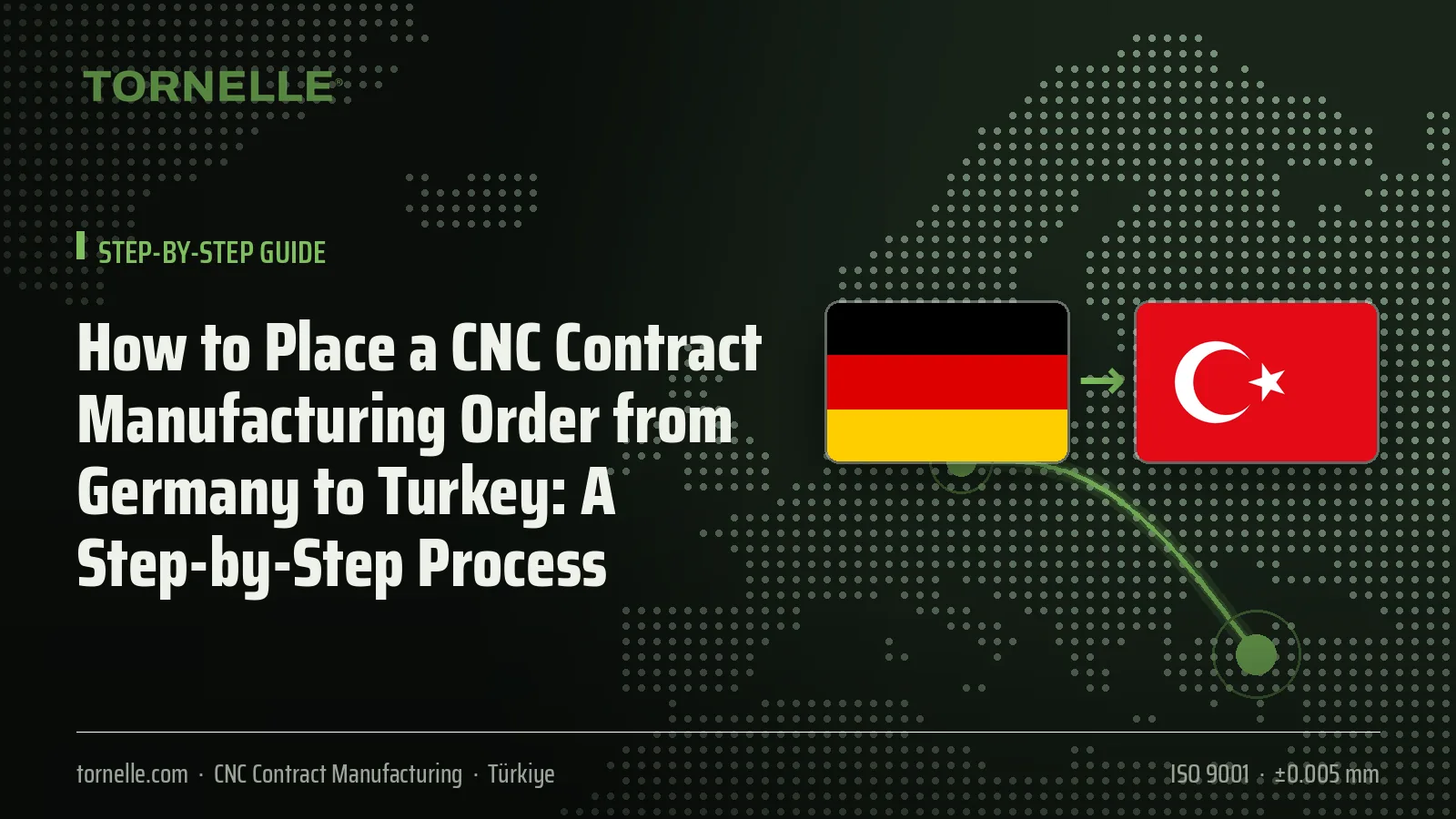
You’re familiar with the advantages Turkey offers German companies; but how do you actually place your first order? This article explains the steps for outsourcing CNC work to Turkey using the process logic familiar to German purchasing departments—Anfrage, Angebot, Bemusterung, Freigabe, Serie.
Step 1: Prepare the Technical Documents
A good quote starts with good documentation. Here’s what you need to send to your Turkish supplier:
- 2D technical drawing (PDF): This can remain in German. The general tolerance class (e.g., ISO 2768-mK), critical dimensions, surface roughness (Ra), edge rounding, and thread specifications must be complete.
- 3D model (STEP): Required for CAM programming and quick pricing.
- Material: Material number (e.g., 1.4404, 42CrMo4+QT, EN AW-7075 T6) and, if required, certificate type (EN 10204 3.1).
- Surface treatment and heat treatment: Anodizing (E6/EV1), zinc-nickel plating, hardening depth, and hardness value (e.g., 58±2 HRC).
- Quantity and delivery schedule: Annual forecast, lot size, first delivery date.
We’ve explained in detail how to prepare a complete RFQ in our RFQ guide.
Step 2: Request and Compare Quotes
Export-focused Turkish CNC suppliers typically provide quotes within 24–72 hours. Look for the following in a good quote:
- Unit price based on quantity tiers (e.g., 100 / 500 / 2,000 pieces);
- Separate listing of installation and tooling costs;
- Material certificates, measurement reports, and packaging details;
- Delivery time and Incoterms (e.g., FCA Istanbul, DAP Stuttgart);
- Design for Manufacturing (DFM) feedback—suggestions regarding unnecessary tight tolerances or complex geometries demonstrate the supplier’s engineering expertise.
When comparing prices with your German supplier, consider the total cost of ownership (TCO) by including shipping, customs brokerage, and payment terms.
Step 3: Clarify the Commercial Terms
Incoterms
German buyers typically prefer FCA (Free Carrier) Istanbul or DAP (Delivered at Place). Under FCA, your own freight forwarder handles the shipping, and the import customs declaration remains your responsibility; under DAP, the supplier delivers the part to your factory, and you are still responsible for paying the import VAT.
Payment
A 30–50% advance payment and payment of the balance prior to shipment are common for initial orders. Once trust is established, open account terms (Zahlungsziel) with a 30–60-day payment period are standard. Even for non-SEPA transfers, a Euro wire transfer takes 1–2 business days.
Contracts and Confidentiality
It is standard practice to sign a non-disclosure agreement (NDA / Geheimhaltungsvereinbarung) before sharing technical drawings. For serial supply, a quality assurance agreement (QSV) and a framework agreement (Rahmenvertrag) are recommended.
Step 4: Sample and Initial Sample Approval
Before moving to mass production, request 1–5 samples or a small pilot batch. Along with the sample:
- A measurement report (a CMM protocol for critical dimensions may be required, in VDA or PPAP format);
- Material certificate (3.1);
- Surface treatment certificate or coating thickness measurement.
If the German side expects an Erstmusterprüfbericht (EMPB) or PPAP Level 3, specify this during the RFQ phase; Turkish suppliers are familiar with these formats. We have compiled the quality assurance steps in this article.
Step 5: Customs and Import
The import of industrial products from Turkey to Germany is exempt from customs duties under the Customs Union using an A.TR movement certificate. Required documents:
- Commercial invoice (Handelsrechnung) — including your EORI number and the product’s GTIP/HS code;
- Packing list (Packliste);
- A.TR movement certificate — to be certified by the supplier at a Turkish customs office;
- CMR waybill (road transport) or AWB (air transport).
On the German side, the import declaration (ATLAS) is filed by your freight forwarder or customs broker; import sales tax is declared and offset as input tax. For routine shipments, customs clearance is typically completed on the same day.
Step 6: Serial Delivery and Continuous Improvement
After approval, a serial delivery plan is established. Models frequently used by German companies:
- Call-off order (Abrufauftrag): The annual quantity is fixed, and deliveries are made via monthly or weekly call-offs. The supplier plans raw materials and capacity in advance, resulting in a lower unit price.
- Consignment or safety stock: The supplier maintains inventory in a warehouse in Turkey or Germany; this reduces the delivery time by road from 4–6 days to 1–2 days.
- Kanban: Used for high-volume parts with fixed lot sizes and fixed cycles.
Define metrics such as on-time delivery rate (OTD), PPM (defects per million), and response time to measure performance, and conduct an annual supplier evaluation.
Common Mistakes
- Focusing solely on unit price while ignoring shipping and inventory costs;
- Setting tolerances too narrowly “just in case”—which unnecessarily increases costs;
- Failing to document acceptance criteria;
- Failing to share annual volume forecasts — the supplier cannot plan for raw materials and capacity;
- Skipping the sample phase and moving directly to mass production.
Frequently Asked Questions
Can I send technical drawings in German?
Yes. Turkish suppliers serving the German market can directly read technical drawings and terminology in German (Werkstoff, Oberfläche, Allgemeintoleranz).
How much time should I plan for the first order?
Typically, allow 2–4 weeks from the RFQ to sample delivery, and 3–6 weeks from sample approval to the first production run.
How does the process work in the event of a complaint?
The 8D process defined in the quality agreement is applied: nonconformity report, root cause analysis, corrective action, and rework/reproduction. Thanks to our proximity, replacement parts can be provided within a few days.
Do I need to visit the supplier in Turkey?
It is not mandatory; virtual factory tours and digital audits are common. However, a one-day visit—a 3-hour flight from Germany—is valuable for long-term partnerships.
Conclusion
Outsourcing CNC work from Germany to Turkey is a process that operates just like local sourcing, following the steps of proper documentation, clear commercial terms, and sample approval. Send your technical drawings and receive a quote and manufacturability assessment within 24 hours.