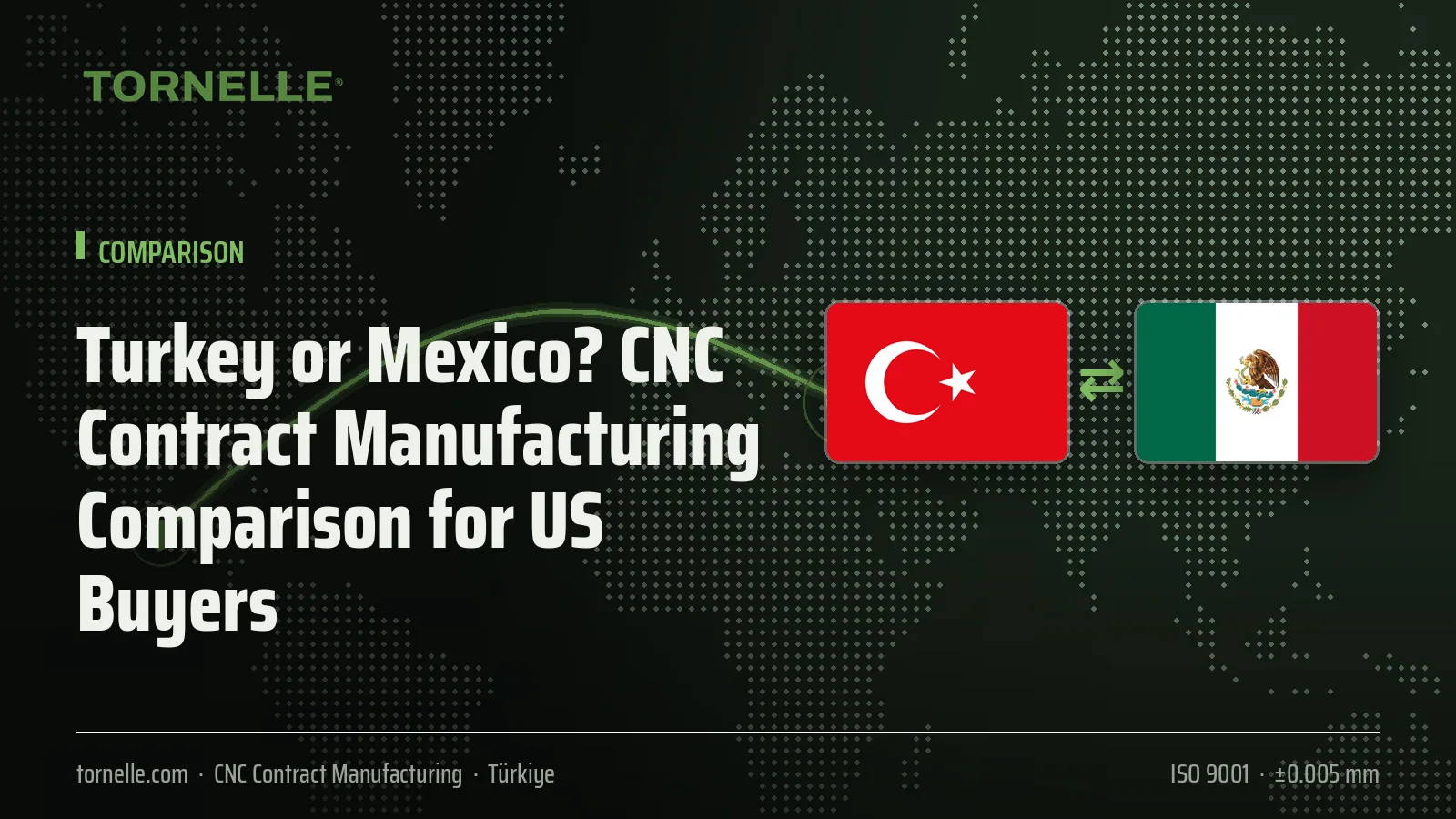
Mexico has become the largest trading partner of US industry; the maquiladora and supply-industry clusters in Monterrey, Querétaro, Guadalajara and the border cities (Tijuana, Juárez) are collecting the work US manufacturers are pulling out of China. This density has created capacity saturation, wage increases and a shortage of skilled labour in Mexico. Continuing our Turkey advantages for the USA article, this comparison examines where the US purchaser can place Turkey alongside Mexico.
Summary Comparison
| Criterion | Mexico | Turkey |
|---|---|---|
| Customs regime | USMCA: 0% if the rule of origin is met | HTS general rate 0–3% + additional tariffs if any |
| CNC operator hourly cost | USD 6–10 | USD 9–15 |
| Machine hour rate (3-axis milling) | USD 30–45 | USD 32–48 |
| Delivery (US Midwest) | Road 2–5 days | Air 3–5 days; sea 25–35 days |
| Time difference (Chicago) | 0–1 hour | +8 hours |
| Capacity situation | Busy; nearshoring pressure | Europe-focused; spare capacity for the USA |
| Quality culture | Automotive (IATF) strong; SME base mixed | Automotive, defence, white goods supply industry; ISO 9001 widespread |
| Swiss-type / small precision parts | Limited | Strong |
| Intellectual property | USMCA framework | EU-aligned legislation |
1. Customs: The USMCA vs HTS Difference
Mexico's biggest advantage is USMCA: parts meeting the rule of origin enter the USA duty-free. But the rule of origin is not automatic; depending on the part's tariff position, a regional value content (RVC) or tariff shift requirement applies. Some parts machined in Mexico from raw material imported from China may not qualify for origin. In addition, Section 232 steel/aluminium derivative product duties have also come up for Mexico, with periodic exemptions and conditions applied under USMCA; the legislation is changeable. For Turkey, the customs regime is relatively simple: the HTS general rate (0–3%) and additional tariffs if any; there is no rule-of-origin headache, Section 301 does not apply. Details are in our HTS and customs article. Result: if USMCA is met, Mexico is 2–3 points ahead on customs; if not, the gap closes.
2. Cost
On labour, Mexico is 20–30% cheaper than Turkey; but machine hour rates are close because machine, tooling and energy costs are globally priced and industrial electricity is expensive in Mexico. Nearshoring demand has pushed CNC shop prices up in Mexico in recent years; wage inflation is high in the border regions. In total cost, Mexico's road freight (under USD 1–3/kg) is advantageous against Turkey's air freight (USD 4–8/kg); by sea the gap closes but the time lengthens. Net result: Turkey is competitive for small and light precision parts, Mexico leads for large and heavy parts because of logistics. Our USA–Turkey cost comparison details the figures.
3. Delivery Time and Communication
Mexico is far ahead with 2–5 days by road and zero time difference; JIT and kanban are routine on the USA–Mexico route. From Turkey, air freight is 3–5 days, sea 4–5 weeks; the 8-hour time difference allows a question sent in the morning to be answered the same day, but the live-call window is narrow (US morning = Turkish evening). Turkish exporters are used to this window.
4. Quality and Capacity
Mexico's automotive clusters (Bajío, Nuevo León) work with IATF discipline; but the nearshoring wave has filled capacity and made it harder to find skilled operators and engineers. New and small US customers may not find priority at Mexican suppliers focused on large OEM programmes. Turkey's capacity is oriented towards Europe; US demand is relatively new and finding spare capacity is easy. Turkey's depth in Swiss-type turning and small precision parts is limited in Mexico; the defence and white goods supply industry has created a strong base in aluminium housing machining.
5. Risk
Mexico: security problems (cargo theft in some regions, waiting at the border), labour turnover, union regulations, the periodic review of USMCA. Turkey: currency volatility (not passed on to the buyer with EUR/USD pricing), tariff policy uncertainty, geopolitical location. For both countries, single-source risk is managed with a second source; US buyers using Mexico and Turkey together achieve geographic diversification.
Which Profile for Which Country?
- Mexico: Large and heavy parts; automotive lines fed by JIT; high-volume, freight-critical work; parts meeting the USMCA rule of origin.
- Turkey: Small to medium precision turned and Swiss-type parts; aluminium milled housings; mid-sized buyers unable to find capacity in Mexico; parts of products also sold in Europe (one supplier, two markets); parts with a high value-to-weight ratio suited to air freight.
- Together: Geographic diversification and bargaining power; Mexico as main line, Turkey as second source, or vice versa.
Numerical Example
30,000 Ø25 mm stainless (303) sensor housings a year, 40 g/piece, Swiss-type turning. Mexican quote USD 4.20, road freight USD 0.05, USMCA 0%; total USD 4.25. Turkish quote USD 3.60, air freight (consolidated, 1.2 t/year) USD 0.25, duty 0–3% ≈ USD 0.08, broker and MPF USD 0.03; total ~USD 3.96. On a small and light part Turkey is 7% ahead; if the part weighed 2 kg the air freight share would exceed USD 6 and Mexico would win. The decision must be made part by part. Our TCO article provides a model.
Starting Proposal for the US Buyer
The practical route for a US purchaser who wants to try Turkey: select 3–5 parts from the BOM that are light, precise and have price or capacity problems in Mexico; request a USD-based FCA quote; have your broker calculate the HTS code and total customs cost; receive the sample by air freight in 3–5 days; compare the inspection report with your own measurement. This cycle takes 4–6 weeks and shows the real cost of Turkey without affecting your main supplier in Mexico. To manage the time difference, set a fixed weekly video call slot (USA 08:00 = Turkey 16:00).
Frequently Asked Questions
Can Turkey replace Mexico?
For heavy parts and JIT lines, no; for small precision parts, Swiss-type turning and mid-sized buyers looking for capacity, yes, it is a strong alternative or complement.
Does USMCA automatically give 0% on every part?
No; the rule of origin (RVC or tariff shift) must be met. Some parts with imported raw material may fall outside the rule.
How long is delivery from Turkey to the USA?
Air freight 3–5 days, sea 25–35 days; production time of 2–4 weeks is added.
Does the time difference make communication difficult?
The US morning coincides with the Turkish evening; exporting shops respond in this window. Working mainly in writing is sufficient.
Conclusion
Mexico leads for the USA in logistics and customs; Turkey, with competitive prices for small-to-medium precision parts, spare capacity and a deep Swiss-type culture, offers a realistic alternative to Mexico's increasingly crowded supplier market. If you want a real comparison for your parts, send your technical drawings via our quote form; we come back with a USD-based FCA or CPT quote and an HS code proposal.