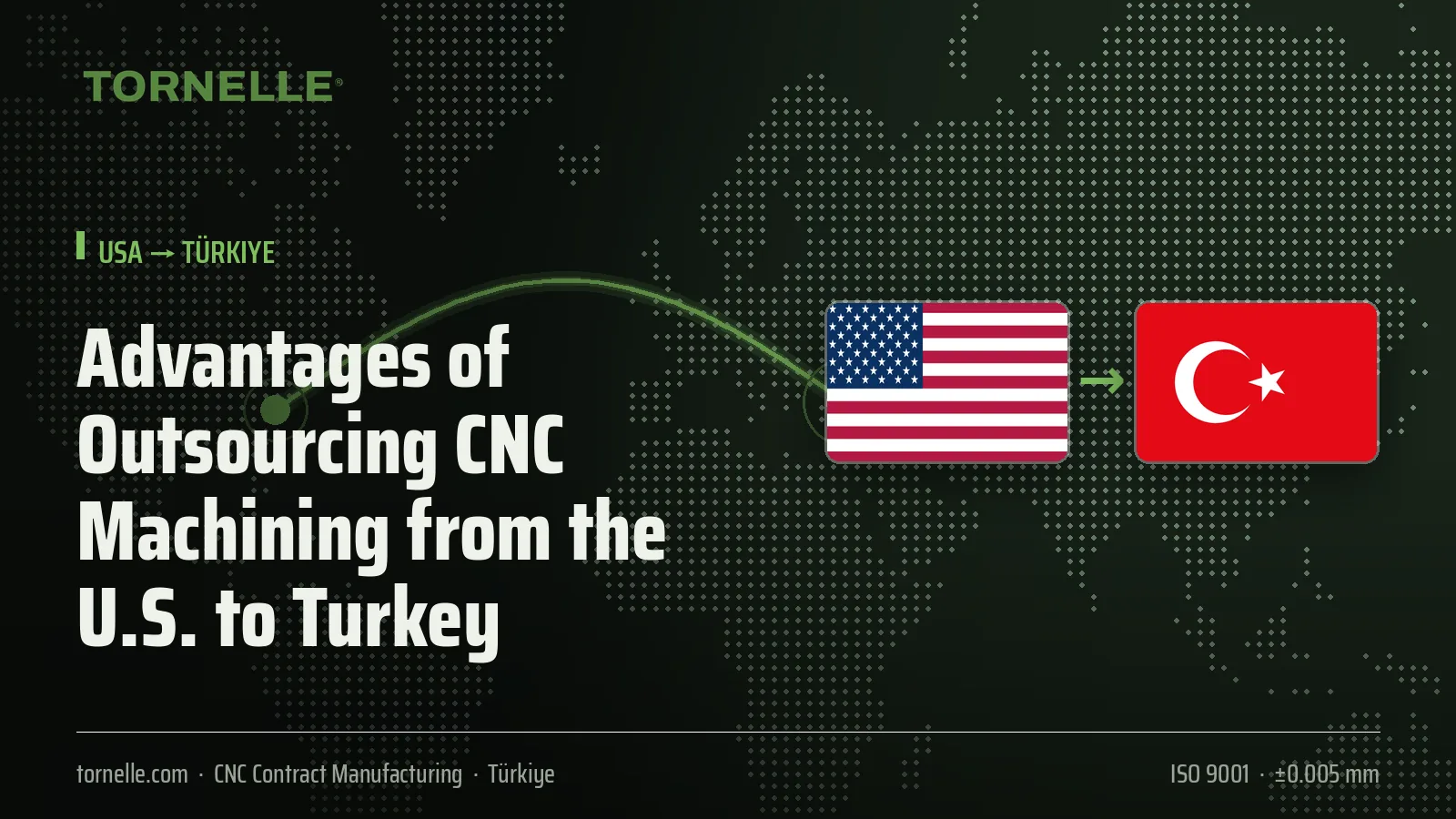
Supply chain diversification has been a key theme for U.S. manufacturers in recent years. Additional tariffs imposed on China, geopolitical uncertainty, freight rate fluctuations, and intellectual property concerns have driven procurement teams toward “China+1” and even “China-free” strategies. Mexico and Vietnam were the first destinations in this search; however, capacity and quality depth for precision CNC parts are not always sufficient. Turkey is an option that American buyers are increasingly considering in this context: a NATO ally, producing to European standards, possessing a strong machining ecosystem, and cost-competitive.
1. A True Alternative to China
Additional tariffs imposed on Chinese-origin machined metal parts (Section 301 and subsequent measures) have significantly increased the total cost and made it unpredictable. Parts originating in Turkey are not subject to these additional duties; standard MFN rates apply (typically ranging from 0% to 5% for processed metal parts; for steel and aluminum products, coverage under Section 232 must be verified on a product-by-product basis). Furthermore, Turkey is a NATO ally with strong defense and trade ties to the U.S.; it is listed as a “trusted country” in terms of supply chain security and compliance.
2. Familiarity with ASTM, ANSI, and the Inch Measurement System
The Turkish machining sector serves both the European and U.S. markets. Export-oriented suppliers:
- are familiar with and supply ASTM/AISI/UNS material designations (4140, 1045, 303/304/316L, 6061-T6, 7075-T6, C360 brass);
- routinely process inch-based technical drawings, the ASME Y14.5 geometric tolerancing standard, and UNC/UNF/NPT threads;
- Directly applies ANSI surface roughness (µin Ra) and hardness values (HRC, HRB);
- Provides ASTM material certificates and MTRs (Material Test Reports).
3. Quality Depth: Defense and Aerospace Ecosystem
Turkey is an established supplier country in international defense and aerospace projects, including the F-35 program. This entails AS9100-certified workshops, experience with challenging materials such as titanium and Inconel, full traceability, and adherence to FAI (AS9102) practices. ISO 9001 and IATF 16949-certified suppliers are common. We have outlined the quality assurance approach in this guide.
4. Cost Advantage
In the U.S., the hourly cost of CNC machining ranges from 75 to 120 USD, and a shortage of qualified operators drives prices up. In Turkey, labor and overhead costs are significantly lower, while raw material prices are global. American buyers typically see a 30–50% total cost advantage, particularly for labor-intensive, multi-operation parts with tight tolerances. Compared to China, the unit price may be similar or slightly higher; however, when additional customs duties, quality risks, and intellectual property risks are factored in, the total cost is usually in Turkey’s favor. See the Turkey–China comparison.
5. Delivery Time and Logistics
Air freight takes 3–5 days via daily direct flights from Istanbul to New York, Chicago, Los Angeles, Houston, and Miami; express courier (DHL, UPS, FedEx) takes 2–4 days. For high-volume shipments, sea freight to the U.S. East Coast takes 3–4 weeks—comparable in duration to shipments from China to the West Coast, but shorter to the East Coast. For sensitive parts requiring short delivery times, air freight is cost-effective relative to the value of the parts.
6. Intellectual Property and Contract Security
Turkey has a contract and intellectual property regime similar to the European legal system; NDAs and quality agreements are enforceable. International arbitration (ICC, ISTAC) is widely accepted. U.S. buyers find a significantly safer environment for the protection of technical data compared to China.
7. Communication and Time Zone
Turkey is 7 hours ahead of the U.S. East Coast and 10 hours ahead of the West Coast. Morning hours on the East Coast correspond to the afternoon in Turkey; there is a daily overlap of 2–3 hours, and email responses are received within the same business day. English is the standard language for technical communication among export-oriented Turkish suppliers. Compared to the 12–13-hour time difference with China, communication is significantly easier.
8. Industry Compatibility
- Aviation and defense: Aluminum, titanium, and Inconel milled parts — 5-axis CNC milling.
- Oil and gas and energy: Alloy and stainless steel turned parts, NPT threaded connections — CNC turning.
- Medical devices: Precision parts made of stainless steel and titanium, ISO 13485.
- Industrial automation and robotics: Aluminum housings, shafts, and brackets.
- Electronics and connectors: High-volume sliding automatic machine parts.
- Heavy equipment and agricultural machinery: Steel turned and milled components.
Practical Notes for U.S. Buyers
- Confirm the HTS code and, if applicable, Section 232 coverage with your customs broker in advance.
- You can send your drawings in inches directly; please list critical tolerances separately.
- Request an MTR and dimensional report with your first order.
- Prefer FCA Istanbul (air freight) or DAP as Incoterms; USD-based pricing is standard.
- Assess export license requirements in advance for parts subject to ITAR.
Frequently Asked Questions
Are U.S. customs duties applied to CNC parts originating from Turkey?
Standard MFN rates apply (typically 0–5% for machined metal parts); the additional Section 301 tariffs applied to China do not apply to Turkey. For steel and aluminum products, Section 232 coverage must be verified on a product-by-product basis.
Will my technical drawings in inches and my UNC/NPT threads be a problem?
No. Turkish suppliers serving the U.S. market routinely handle inch-based measurements, ASME Y14.5, and UNC/UNF/NPT threads.
What is the lead time?
Production takes 1–2 weeks for prototypes and 3–6 weeks for mass production; shipping to the U.S. takes 3–5 days by air freight, 2–4 days by express courier, and 3–4 weeks by sea to the East Coast.
How does the process work?
We’ve outlined the steps in our article titled “How to Outsource CNC Machining from the U.S. to Turkey.”
Conclusion
For U.S. manufacturers, Turkey is a genuine alternative to China—a cost-competitive supply source that is exempt from additional customs duties, well-versed in industry standards, and offers high-quality products. Send us your technical drawings and receive a quote within 24 hours.