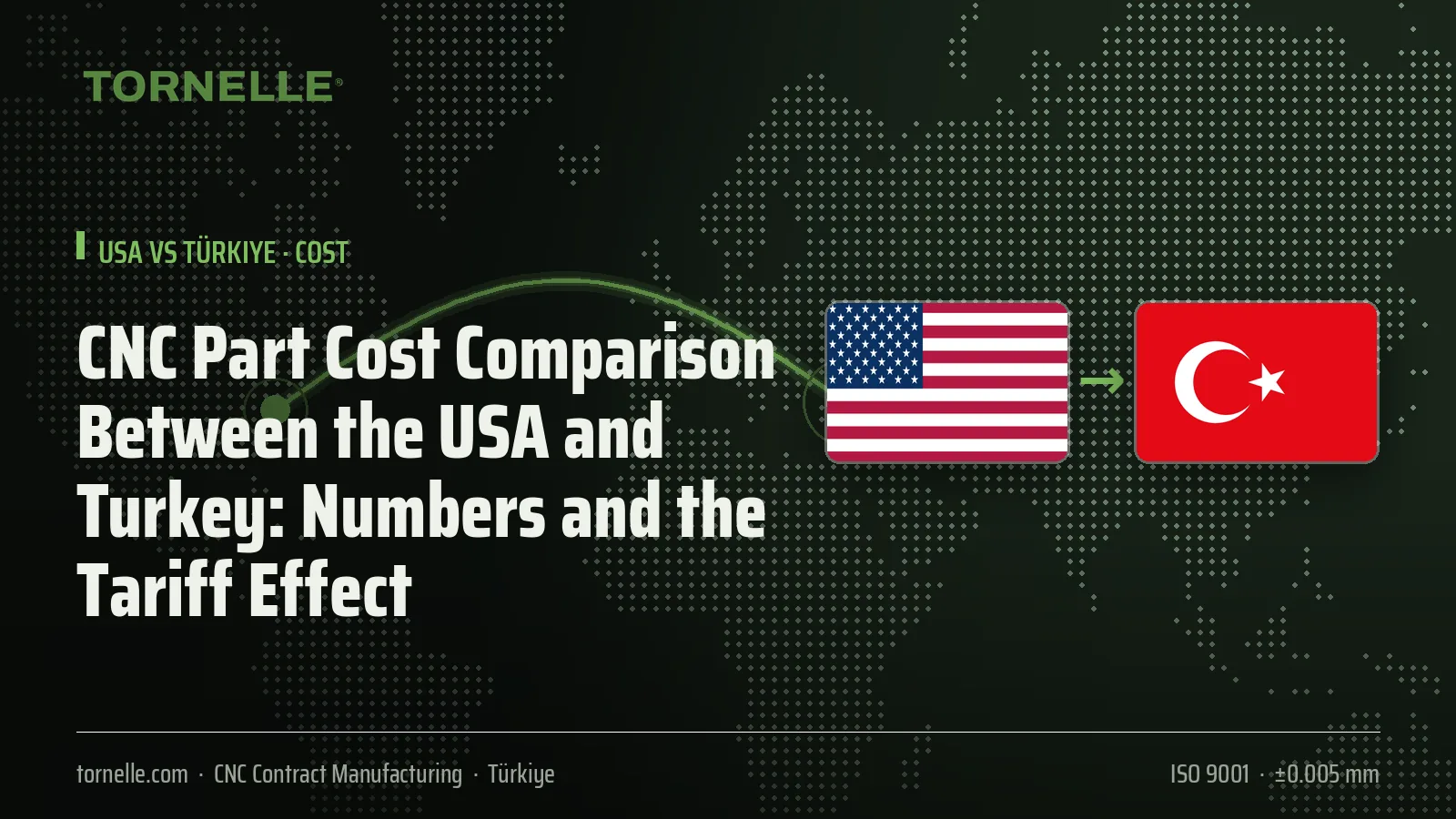
For the US buyer, overseas sourcing was long synonymous with China and Mexico; the additional tariffs applied to China since 2018 and the sweeping tariff changes of 2025 have rebuilt the equation. In this picture Turkey sits in the position of "European quality, short distance compared with Asia, NATO ally". This article completes our USA advantages article with numbers. The figures are typical values for 2025–2026; customs tariffs changed many times during 2025 and may continue to change; confirm the current rate with your customs broker before shipment. 1 € ≈ 1.10 USD is assumed.
Line-by-Line Comparison
| Item | USA | Turkey | Difference |
|---|---|---|---|
| CNC turning hourly rate (3-axis) | $70–100 | $31–44 | ≈ 55% lower |
| CNC milling hourly rate (3-axis) | $75–110 | $33–50 | ≈ 55% lower |
| 5-axis milling hourly rate | $110–170 | $50–72 | ≈ 55% lower |
| Swiss-type turning hourly rate | $65–95 | $28–42 | ≈ 55% lower |
| Programming / set-up (hour) | $85–120 | $33–50 | ≈ 60% lower |
| Raw material (steel, aluminium) | Market (steel and aluminium above world price in the USA due to Section 232 tariffs) | Market | 10–25% lower in Turkey |
| Industrial electricity (kWh) | $0.07–0.12 | $0.11–0.15 | Lower in the USA |
| Coating / heat treatment | Market | 25–40% lower | Marked |
| Freight to the USA (share of part value) | 1–2% (domestic) | Sea 3–6% (25–35 days); air 6–12% (3–6 days) | Higher for Turkey |
| Customs duty | — | Base HTS rate (0–5% for most parts) + 2025 reciprocal tariff + Section 232 if applicable (steel/aluminium derivatives); current rate must be confirmed | Additional cost specific to the USA |
| Customs clearance (per shipment) | — | $100–250 (broker + ISF + MPF/HMF) | Fixed |
| Sales tax | Exempt on resale/production inputs | No VAT on import | Neutral |
The hourly-rate gap with the USA is similar to Germany's (55%); however, because the customs and logistics share is significant, the net saving is narrower than in Europe and depends on the part type.
Tariff Layers: What Is Paid?
- Base HTS rate: 0–5.7% in the tariff headings where machined parts fall (e.g. 8483 shafts and couplings, 8481 valve parts, 7318 fasteners, 7326 other articles of steel, 7616 articles of aluminium, 8487/8479 machine parts).
- 2025 reciprocal tariff: A general additional rate added on top of the base rate for products of Turkish origin; it began to be applied at 10% in 2025, with exceptions and changes published by country and product. The current rate and exemption lists (Annex II) must be checked.
- Section 232 steel/aluminium: A high additional tariff (50% as of mid-2025) on the value of the metal content for steel and aluminium products and for parts on the "derivative product" lists expanded in 2025. Which HTS codes are on the derivative list and how the metal content is to be declared (steel/aluminium value and country of melt and pour) is determined with the broker; this layer does not apply to machine parts not on the list.
- Section 301: Applies to products of Chinese origin; does not apply to Turkey. This is Turkey's advantage over China.
Practical conclusion: at the RFQ stage, clarify the HTS code and total tariff for each part with the broker; compare quotes on a "delivered and cleared" basis (DDP or DAP + calculated duty).
Example 1: Milled Aluminium Housing (Automation Equipment)
6061-T6, 7×5×1.5 in (178×127×38 mm), 3-axis milling in 3 set-ups, pockets, 18 holes, 8 threads, black anodising (MIL-A-8625 Type II); quantity 250. HTS 8479.90 (machine part) assumed; tariff scenario: base 0% + reciprocal 10%; not on the Section 232 derivative list.
| USA | Turkey | |
|---|---|---|
| Raw material | $12.50 | $10.20 |
| Machine + labour (32 min) | $48.00 | $21.30 |
| Set-up/programming (per piece) | $3.60 | $1.50 |
| Anodising | $5.50 | $2.80 |
| Quality/report | $2.50 | $1.80 |
| Overhead + margin | $14.50 | $7.50 |
| Ex-works price | $86.60 | $45.10 |
| Freight (sea LCL) + customs clearance | $1.20 | $2.60 |
| Customs duty (10% × customs value) | — | $4.51 |
| Delivered cost | $87.80 | $52.21 |
Saving: ≈ 40%. If the reciprocal tariff rises to 20%, the saving falls to 36%; with air freight (+$4), 35%. On a labour-intensive part the tariff cannot close the gap.
Example 2: Steel Turned Shaft (Steel Derivative Tariff Scenario)
4140 (≈ 42CrMo4) quenched and tempered steel, Ø1.25×6 in (Ø32×152 mm), turning, keyway, 2 steps h7, black oxide; quantity 1,000. HTS 8483.10 (transmission shaft). Scenario A: reciprocal 10%, Section 232 not applied. Scenario B: 8483.10 on the derivative list and 50% additional duty on the steel content ($3.10).
| USA | Turkey (A) | Turkey (B) | |
|---|---|---|---|
| Raw material | $3.90 | $3.10 | $3.10 |
| Turning (5.5 min) | $8.00 | $3.50 | $3.50 |
| Black oxide + washing | $0.60 | $0.35 | $0.35 |
| Set-up/programming | $0.20 | $0.08 | $0.08 |
| Quality/report | $0.30 | $0.20 | $0.20 |
| Overhead + margin | $2.60 | $1.45 | $1.45 |
| Ex-works price | $15.60 | $8.68 | $8.68 |
| Freight (sea) + customs clearance | $0.20 | $0.55 | $0.55 |
| Reciprocal tariff 10% | — | $0.87 | $0.87 |
| Section 232 steel content 50% × $3.10 | — | — | $1.55 |
| Delivered cost | $15.80 | $10.10 | $11.65 |
Saving: ≈ 36% in scenario A, ≈ 26% in scenario B. The steel derivative tariff narrows the saving but does not erase it; on simple steel parts with a high raw-material share (low machining share), however, the saving can fall below 10% and production in the USA becomes sensible. A part-by-part calculation is essential.
Logistics: Sea or Air?
Istanbul/Ambarlı–New York/Savannah/Houston container 18–28 days port to port; door to door 25–35 days; economical for LCL 1–10 m³. Air freight IST–JFK/ORD 3–6 days door to door, $4–7 per kg. Express courier 3–5 days for samples. For the West Coast the sea transit rises to 35–45 days. Practical model: consolidated sea shipment every 2–3 months + safety stock in the USA (3PL warehouse) or the buyer's own warehouse. The general method is described in our logistics guide.
Turkey's Position in the US Market
- Versus China: On parts of Chinese origin, Section 301 (7.5–25%) + reciprocal tariff + Section 232; the total burden on most parts is well above Turkey's. Perceptions of quality, IP security and supply-chain risk also favour Turkey.
- Versus Mexico: Mexican products meeting the USMCA rules of origin are tariff-free and arrive by road in 2–5 days; for the US buyer, Mexico is unrivalled logistically. Turkey's argument is precision-part quality to European standards, a wide material range and the ability to use a common supplier with plants in Europe (the same part going to the EU plant duty-free with A.TR).
- Versus India and Vietnam: Similar tariff layers; Turkey's advantage is the shorter sea transit (25–35 vs 35–50 days), European business culture and the ISO 9001 base.
Where the Saving Remains Low
- Steel or aluminium parts whose raw-material share exceeds 50% (especially if on the Section 232 derivative list);
- Very low-quantity (1–5) prototypes (freight and broker fixed costs dominate);
- Parts requiring weekly JIT delivery (incompatible with sea transit);
- Defence parts under ITAR (overseas production subject to authorisation) and public procurement with "Buy American"/DFARS requirements.
Frequently Asked Questions
How much cheaper are CNC parts from Turkey for the USA?
Including tariffs and sea freight, typically 25–40% on labour-intensive parts; 5–20% on raw-material-heavy steel parts and lower under Section 232. A part-by-part calculation is needed.
Who pays the tariff?
The importer of record pays; the buyer under DAP, the seller under DDP. Turkish suppliers mostly quote DAP or FCA/FOB; DDP is rare because the tariff risk is unpredictable.
Is payment made in USD?
Yes; export-oriented Turkish suppliers quote and invoice in USD; the currency risk is not with the buyer. The options are in our payment terms article.
Can I get numbers for my own part?
Yes. Send your technical drawing and HTS code (if you know it) with the information in our RFQ guide; you will receive a USD-based, quantity-tiered quote and a tariff estimate you can verify with your broker.
Conclusion
The CNC part cost gap between the USA and Turkey is on a European scale in labour; tariffs and sea freight narrow this gap to 25–40%, and lower still on simple parts under the steel derivative tariff. For the US buyer, Turkey offers lower tariffs and a shorter distance than China, and, compared with Mexico, precision to European standards and the advantage of common sourcing with EU plants. Because tariffs are volatile, an up-to-date calculation must be made for every part. To see the numbers for your own parts, send us your technical drawings.