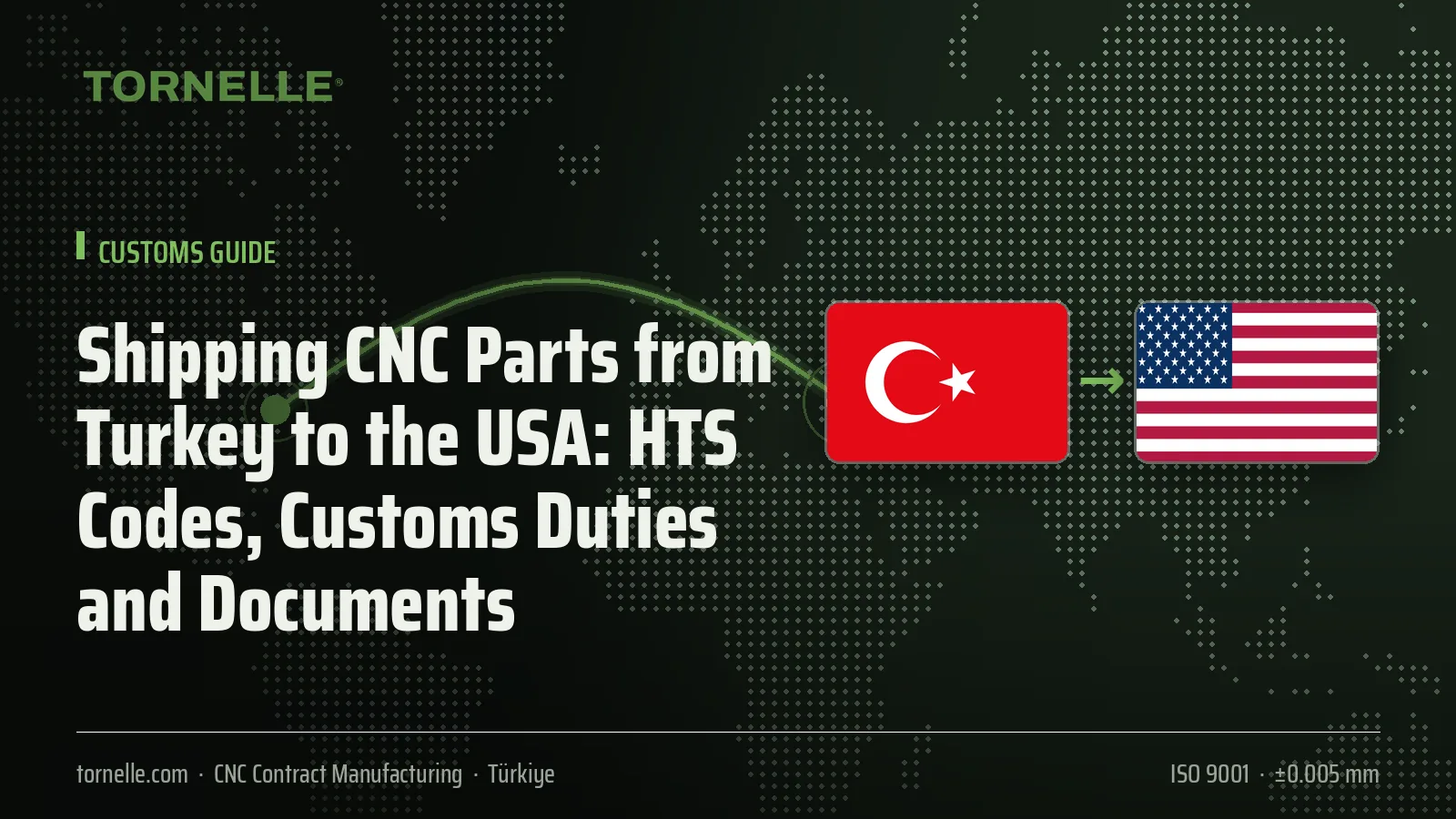
Our guide on placing work in Turkey from the USA explained the process; this article focuses on the customs and duty side. Important caveat: US tariff policy has changed frequently in recent years; the information below gives the general framework, and for exact rates obtain up-to-date confirmation from your licensed customs broker before shipment.
The Key Difference: No Customs Union
While Turkish parts going to the EU circulate duty-free with the A.TR, there is no free trade agreement between the USA and Turkey. Turkey was removed from the US Generalized System of Preferences (GSP) in 2019. Consequently every part is taxed at the rate in the "General" column of its HTS (Harmonized Tariff Schedule) code; additional tariffs, if any, are added on top.
HTS Classification
The HTS is the US-specific 10-digit extension of the international HS system (6 digits). The code of a CNC-machined part is determined by what the part is and where it is used; material or manufacturing method alone is not decisive. Typical examples:
| Part type | HTS heading (example) | General duty (approx.) |
|---|---|---|
| Part of a specific machine (e.g. pump, valve, gearbox part) | 8413.91, 8481.90, 8483.90 | 0–2.5% |
| General-purpose steel part, not elsewhere classified | 7326.90 | 2.9% |
| Other articles of aluminium | 7616.99 | 2.5% |
| Other articles of brass/copper | 7419.80 | 3% |
| Screws, bolts, nuts (steel) | 7318.15 / 7318.16 | 0–8.5% |
| Motor vehicle part | 8708.99 | 2.5% |
| Medical device part | 9018.90 | 0% |
Code selection is the importer's legal responsibility; in unclear cases a binding ruling can be requested from CBP. The Turkish supplier proposes the 6-digit HS; the broker determines the 10 digits on the US side.
Additional Tariffs: Section 232 and Others
Section 232 imposes additional duty on steel and aluminium imports on national security grounds. The critical point: the scope of 232 covers not only raw steel/aluminium products (plate, bar, tube etc.; specific headings of chapters 72 and 76) but also "derivative product" lists that have been expanded over time. Whether a machined part falls under 232 depends on its HTS code and the published derivative lists; in some cases the duty is calculated only on the value of the steel/aluminium content in the part. The 232 rate applied to Turkey has changed several times in the past. In addition, country-based reciprocal/additional tariffs come onto the agenda from time to time; the total rate = general duty + 232 if applicable + other additional tariff if applicable must therefore be calculated by the broker before shipment. Section 301 targets products of Chinese origin and does not apply to parts of Turkish origin; this is a concrete advantage when switching from China to Turkey.
Rules of Origin and Origin Marking
A part machined in Turkey counts as Turkish origin because it undergoes "substantial transformation"; imported raw material does not change the origin. The USA requires every imported article to show its country of origin to the ultimate purchaser (19 U.S.C. 1304): a permanent "Made in Turkey" mark on the part (laser, engraving) or, if this is not possible, marking on the packaging. The marking method must be agreed with the buyer from the start; missing marks create additional duty and delays.
Entry Process and Roles
- Importer of Record (IOR): The party that pays the duty and is responsible for the entry; usually the US buyer. A customs bond is required; a continuous bond costs ~USD 500 a year.
- Customs broker: Licensed agent; classification, entry filing, duty payment. USD 100–250 per shipment.
- ISF (10+2): Electronic pre-loading filing for ocean shipments; not required for air freight.
- Entry and liquidation: Entry filing, duty payment, CBP review; final liquidation may come months later.
De Minimis: The 800-Dollar Threshold
The USA has a de minimis rule exempting shipments under USD 800 from duty and formalities; sample and small prototype shipments enter quickly and duty-free under this rule. However, the scope and application of the rule have recently been narrowed and its validity for products under additional tariffs may vary; do not rely on this exemption for commercial batches.
Logistics and Incoterms
Air freight between Turkey and the USA takes 3–5 days (direct flights from Istanbul to New York, Chicago, Los Angeles), sea freight 25–35 days (from Ambarlı/Izmir to East Coast ports). Sea is preferred for heavy and bulky parts, air freight for tight-tolerance and time-critical parts. Incoterm: FCA Istanbul or CPT/CIP for first shipments; DDP (delivered duty paid) means the Turkish supplier assumes US duties and is rarely recommended because it is risky under additional-tariff uncertainty. Our Incoterms guide gives details.
Required Documents
- Commercial invoice (USD or EUR; HTS code, country of origin, Incoterm, quantity, unit price).
- Packing list.
- Bill of lading (AWB or B/L).
- Origin declaration (on the invoice is sufficient; a separate certificate of origin is usually not required).
- Material certificate and inspection report (for the buyer, not customs).
- Declaration of steel/aluminium content and value (if a 232 calculation is needed).
- ISF data (ocean freight).
Total Cost Calculation
Example: aluminium milled parts worth USD 10,000, air freight. General duty 2.5% = USD 250; if under 232, additional duty on the aluminium content value (calculated by the broker); MPF (Merchandise Processing Fee) 0.3464% (with minimum/maximum limits) ≈ USD 35; broker USD 150; air freight and insurance ~USD 600–900. The 35–50% manufacturing cost difference between Turkey and the USA remains meaningful after these items are added; but be sure to factor in additional-tariff scenarios. Our USA–Turkey cost comparison and our TCO article complete the model.
What to Expect from the Turkish Supplier
A Turkish supplier with US export experience should be ready on these points: 6-digit HS and origin declaration on the invoice, laser "Made in Turkey" marking on the part, an invoice annex showing the steel/aluminium content value separately (for the 232 calculation), USD pricing, direct correspondence with the US broker, compact packaging for air freight and an English-language inspection report. Passing the information set your broker requires to the supplier as a single list before shipment eliminates the risk of a hold at first entry.
Frequently Asked Questions
How much duty does a Turkish CNC part pay in the USA?
General duty by HTS code is between 0–3%; on steel/aluminium derivative products Section 232 and periodic additional tariffs are added. Your broker should calculate the exact rate before shipment.
Does Section 301 apply to Turkey?
No; 301 targets products of Chinese origin. Buyers switching from China to Turkey escape this duty.
Origin marking on the part or the packaging?
A permanent mark on the part where possible; on the packaging for small parts. Agree with the buyer from the start.
Are sample shipments duty-free?
Shipments under USD 800 are generally duty-free and fast under de minimis; but the scope may change, so do not rely on it for commercial batches.
Conclusion
For importing CNC parts into the USA, the correct HTS code, an up-to-date check of additional tariffs and an experienced broker are enough for a process without surprises; Turkey's cost advantage is preserved after these items, and being outside the scope of Section 301 is a concrete plus against China. If you would like an HS code proposal and an FCA/CPT quote for your parts, send your drawings via our quote form.