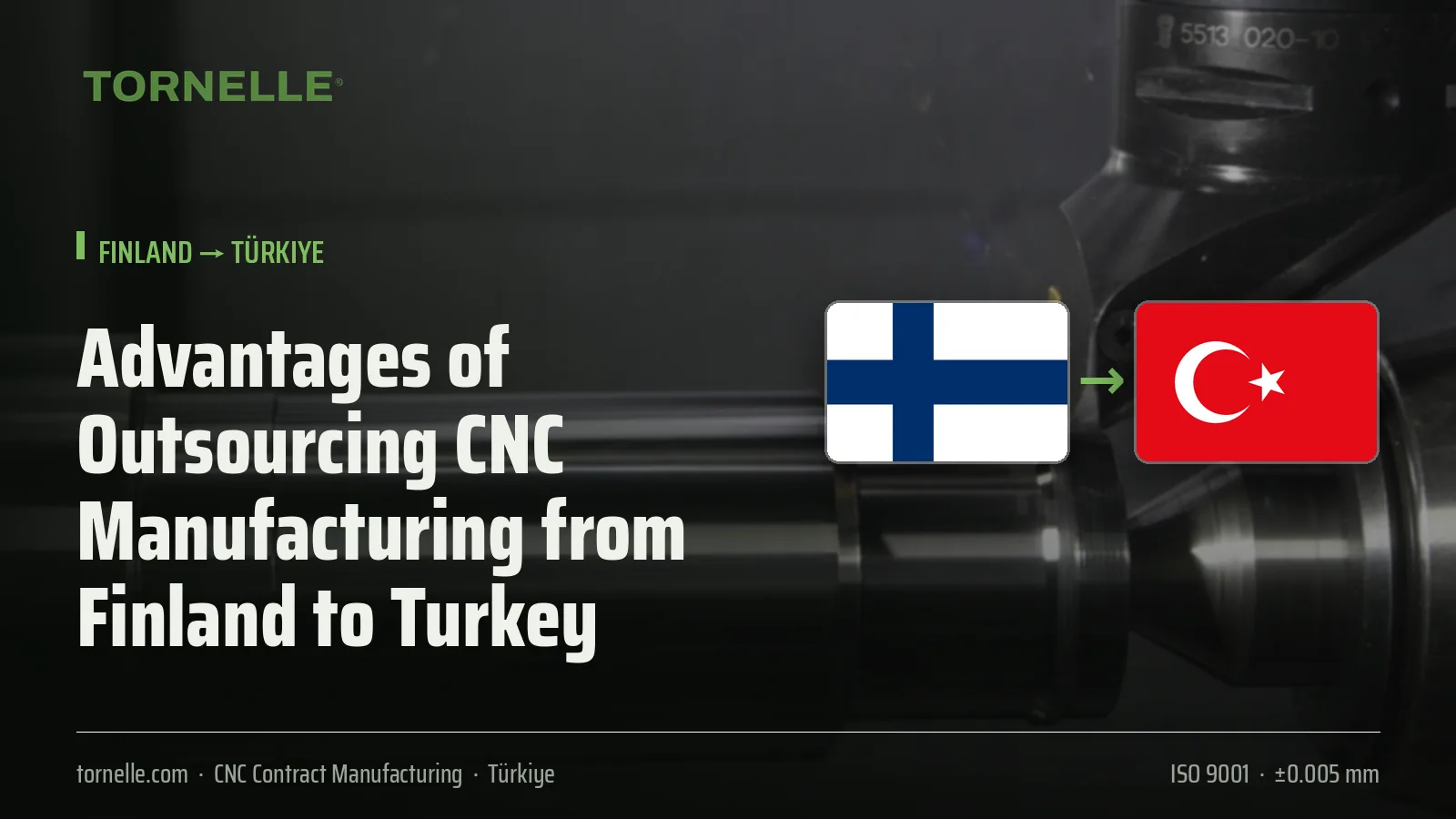
Finland has one of Europe’s most concentrated machinery and engineering industries relative to its population: forestry and mining machinery, marine engines and icebreakers, elevator and escalator systems, paper machines, electronics, and defense. A common feature of these sectors is their need for CNC parts that are not produced in high volumes but have high technical requirements. In the face of high local labor costs, CNC contract manufacturing in Turkey is becoming an increasingly rational option for Finnish companies. Here’s why.
1. EU Customs Union: Duty-Free and Quota-Free Entry
Finland is an EU member; thanks to the Customs Union between Turkey and the EU, industrial products manufactured in Turkey enter Finland duty-free with an A.TR movement certificate. There is no rule of origin; it is sufficient for the part to be in “free circulation” in Turkey. The buyer pays only the import VAT (25.5% in Finland), which is a deductible expense for VAT-registered companies. The customs duties, anti-dumping risks, and complex origin documentation encountered in sourcing from the Far East do not apply here.
2. Cost: 35–50% Savings on Labor-Intensive Parts
CNC machine hourly rates in Finland are similar to those in Germany, and in some regions, even higher. In Turkey, hourly rates for 3-axis lathes and mills typically range from 28 to 45 €. For labor-intensive items such as multi-operation housings, hydraulic blocks, gear shafts, and small precision parts, total savings—including shipping—reach 35–50%. Savings are lower for simple, raw-material-intensive parts; you can find a detailed item-by-item cost comparison in our article.
3. Industry Experience: Heavy Machinery and Maritime
The types of parts demanded by the financial sector align with the areas where the Turkish machining industry excels:
- Forestry and mining machinery: Alloy steel shafts, bushings, hydraulic cylinder components, gear housings.
- Marine: Stainless steel and bronze parts, pump and valve components, engine auxiliary systems.
- Elevators and automation: Aluminum profile machining, guide elements, sensor housings, mass-produced turned parts.
- Electronics and telecommunications: Aluminum heat sink housings, connector sockets, brass Swiss-type turned parts.
For steels requiring low-temperature toughness in cold-climate applications, requests for material certificates and impact tests are common; these documents are readily provided when requested during the quotation phase.
4. Logistics: 7–10 Business Days, Predictable
Road transport from Istanbul to Helsinki or Tampere typically takes 7–10 business days via the Central Europe–Baltic route or the Germany–ferry connection. Air freight is available for urgent shipments in 2–3 days, and ocean container options are available for high-volume, scheduled shipments. Compared to 35–50 days of ocean freight from China, Turkey significantly reduces inventory levels and the risk of rework. For details, see our guide to CNC part logistics to Europe.
5. Time Zone and Communication Culture
Finland and Turkey are in the same time zone (EET/EEST); since Finland is one hour ahead of Western Europe, this creates a workday that fully aligns with Turkey’s. The direct, written, and technical communication style Finnish engineers are accustomed to aligns well with the English-language technical communication used by export-oriented Turkish workshops. STEP files, ISO 2768 general tolerances, and CMM reports serve as a common language.
6. Flexible Lot Sizes
Finnish machine manufacturers typically work with batches ranging from 20 to 1,000 units, involving frequent revisions and a wide range of materials. This structure is unsuitable for Far Eastern suppliers that require high minimum order quantities (MOQ); Turkish contract manufacturing workshops, however, provide services ranging from prototyping to mass production all under one roof. At Tornelle, prototyping and mass production are carried out by the same team using the same measurement infrastructure.
7. Euro-Based Pricing and Exchange Rate Risk
Finland is part of the Eurozone, and Turkish exporters provide quotes in euros; therefore, no exchange rate risk arises for the buyer. In long-term agreements, price updates indexed to raw material costs are a transparent and common practice.
Points to Note
- Confirm that an A.TR certificate accompanies every shipment; if the certificate is missing, third-country duties will apply.
- For low-temperature applications, include a request for a material certificate and, if necessary, an impact test in the order.
- Include a sample and measurement report step in the initial order; define your quality assurance expectations in the quality agreement.
- Specify the delivery terms (DAP Helsinki, FCA Istanbul, etc.) and packaging requirements during the quotation phase.
Frequently Asked Questions
Is there a customs duty on the import of CNC parts from Turkey to Finland?
No. Industrial products are exempt from customs duties with an A.TR certificate; only deductible import VAT is payable.
What is the delivery time?
Production takes 2–5 weeks, and road transport takes 7–10 business days. In urgent cases, air freight takes 2–3 days.
Can production be carried out according to Finnish standards (SFS)?
Most SFS standards are compatible with EN/ISO; simply provide the standard referenced in the image during the quotation phase.
Are small batches and prototypes accepted?
Yes. Batches ranging from 1 to several thousand units are the core business model of Turkish contract manufacturing workshops.
Conclusion
For Finnish companies, Turkey offers duty-free entry through the Customs Union, 35–50% savings on labor-intensive parts, the same time zone, and flexible batch sizes. Submit your technical drawings and annual quantity estimates via our quote form; you’ll receive an itemized quote within 24 hours.