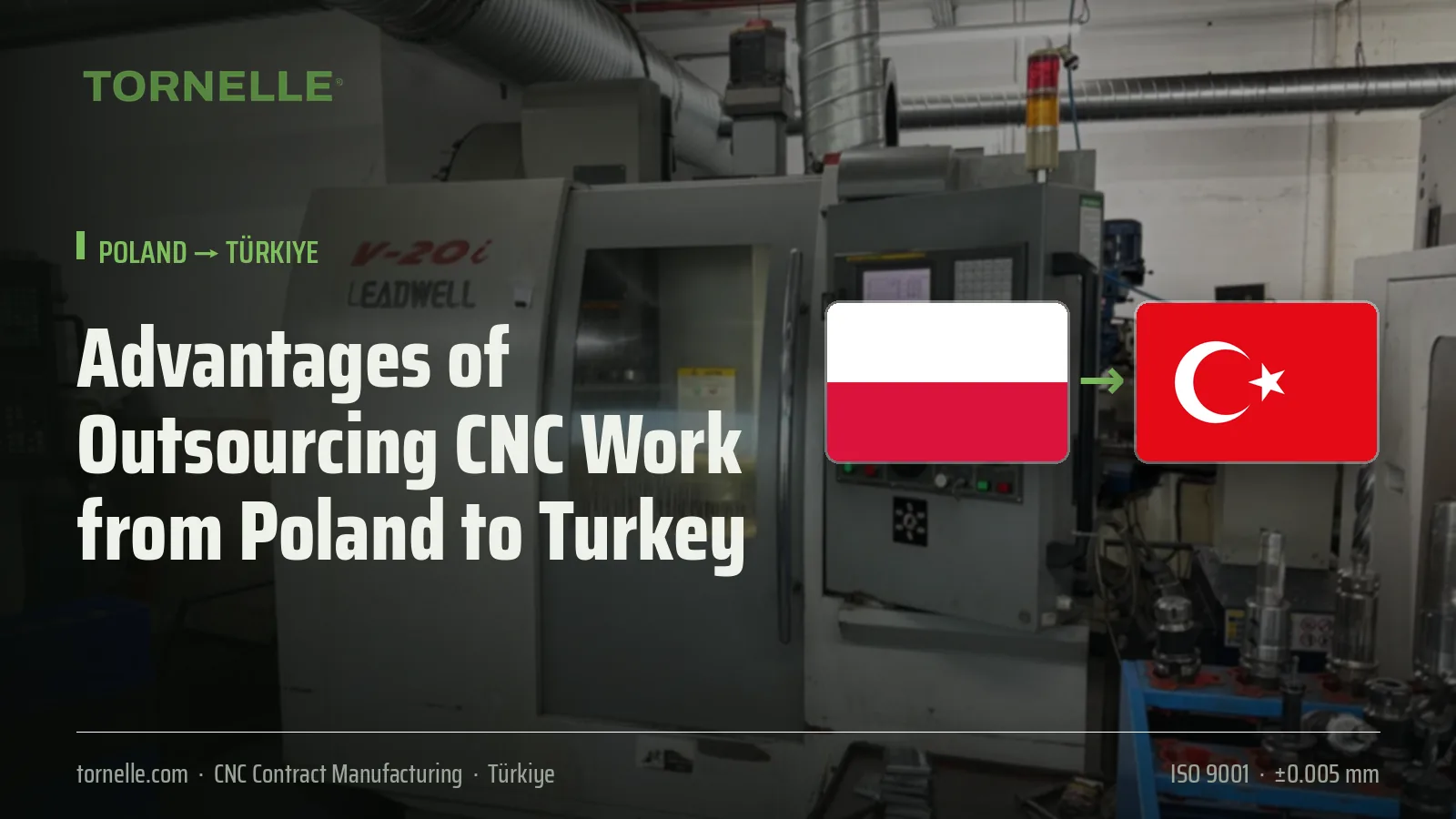
Poland has become Europe’s manufacturing hub in sectors such as automotive, home appliances, furniture accessories, agricultural machinery, and rail systems. This growth has created a side effect: CNC workshops in Poland are at full capacity, finding skilled operators is difficult, and labor costs have risen rapidly in recent years. For Polish manufacturers, the question is no longer “should we outsource work abroad?” but rather “where should we source additional capacity?” This article examines the concrete advantages that CNC contract manufacturing in Turkey offers to Polish buyers. You can access our analysis comparing Turkey and Poland as sourcing countries here.
1. Complementary Supply to Address Capacity Bottlenecks
Due to high domestic demand in Poland, lead times at local workshops have lengthened; many manufacturers prefer to reserve their own machines for high-value-added work and outsource standard turned and milled parts. Turkey’s extensive machining base (Istanbul, Bursa, Konya, Izmir, Ankara) can meet this volume in a short time. At Tornelle, capacity allocated for mass production is planned based on call-off orders.
2. Cost: The Labor Cost Gap Is Widening Again
For a long time, Poland was Europe’s low-cost manufacturing hub; however, the minimum wage has nearly doubled over the past five years, and rising energy prices have driven up machine-hour rates. While hourly rates for 3-axis turning and milling in Turkey typically remain in the €28–45 range, they have approached the €35–55 level in Poland. For labor-intensive parts, savings of 15–30%—including shipping—are realistic; while the difference may not be as significant as that seen in Germany or Scandinavia, it becomes meaningful when combined with advantages in capacity and flexibility. For a line-by-line cost comparison approach, please refer to our article on cost comparisons.
3. Customs Union and A.TR
Poland is an EU member; industrial products from Turkey enter duty-free and quota-free with an A.TR movement certificate. Import VAT (23%) is a deductible expense. The complexity of origin, customs duties, and sanctions checks encountered in sourcing from Ukraine, Belarus, or Asia does not exist here.
4. Logistics: 3–5 Business Days by Road
Road freight between Istanbul and Warsaw, Istanbul and Katowice, or Istanbul and Poznań typically takes 3–5 business days via the Bulgaria–Romania–Hungary–Slovakia route. Due to heavy TIR traffic between Turkey and Poland, there are frequent departures and competitive freight rates for less-than-truckload (LTL) shipments. For urgent shipments, air freight takes 1–2 days. You can find details on routes and transit times in our logistics guide.
5. Sector Alignment: Automotive, Home Appliances, Agricultural Machinery
Poland’s main industrial sectors align perfectly with Turkey’s areas of strength:
- Automotive: Turkey is one of Europe’s major automotive manufacturers; it has a well-established supporting industry for turned shafts, bushings, fasteners, and aluminum bodies.
- Home Appliances: Both countries are major European centers for home appliance production; brass and free-cutting steel Swiss-type turned parts, as well as aluminum fasteners, are in high demand.
- Agricultural machinery and rail systems: Alloy steel shafts, gear housings, and hydraulic components.
6. The Advantage of Swiss-Type Machining for Small-Batch Parts
For high-volume parts in the Ø1–32 mm range, Swiss-type automatic turning technology is the key factor. In Turkey, this machine fleet is particularly concentrated in the Istanbul region, and hourly rates are low. In our article on mass production with Swiss-type automatic turning, we explain the cost mechanism.
7. Communication and Time Zone
There is a 1-hour time difference between Turkey and Poland; technical communication in English is standard. The PN-EN standards used by Polish engineers are identical to EN/ISO standards; no additional conversions are required for drawings.
Points to Consider
- Compare quotes under the same Incoterms conditions (e.g., DAP Warsaw); the freight share can be a deciding factor for low-value parts.
- Include in the contract that the A.TR certificate must accompany the shipment.
- Include a sample + measurement report step in the first order; define your quality assurance expectations in writing.
- Draw a clear line between work performed in-house and work outsourced; retaining critical know-how in-house is a common and sensible strategy.
Frequently Asked Questions
Isn’t Poland already a low-cost manufacturing country?
It used to be; however, rapid wage increases and capacity constraints have narrowed that gap. Turkey is now a complementary contract manufacturing source even for Poland itself.
What is the delivery time from Turkey to Poland?
3–5 business days by road; the typical total lead time, including production, is 3–6 weeks.
Are customs duties payable?
No. Industrial products are duty-free with an A.TR certificate; only deductible import VAT is paid.
Are technical drawings in Polish accepted?
Yes. Since the dimensions and symbols in the drawings are ISO-based, language is not a barrier; including an English summary of the notes will speed up the process.
Conclusion
For Polish manufacturers, Turkey offers a duty-free and flexible contract manufacturing solution just 3–5 days away, providing relief from full production capacities and rising labor costs. Submit the technical drawings of your standard turned and milled parts via our quote form; you’ll receive a competitive quote within 24 hours.