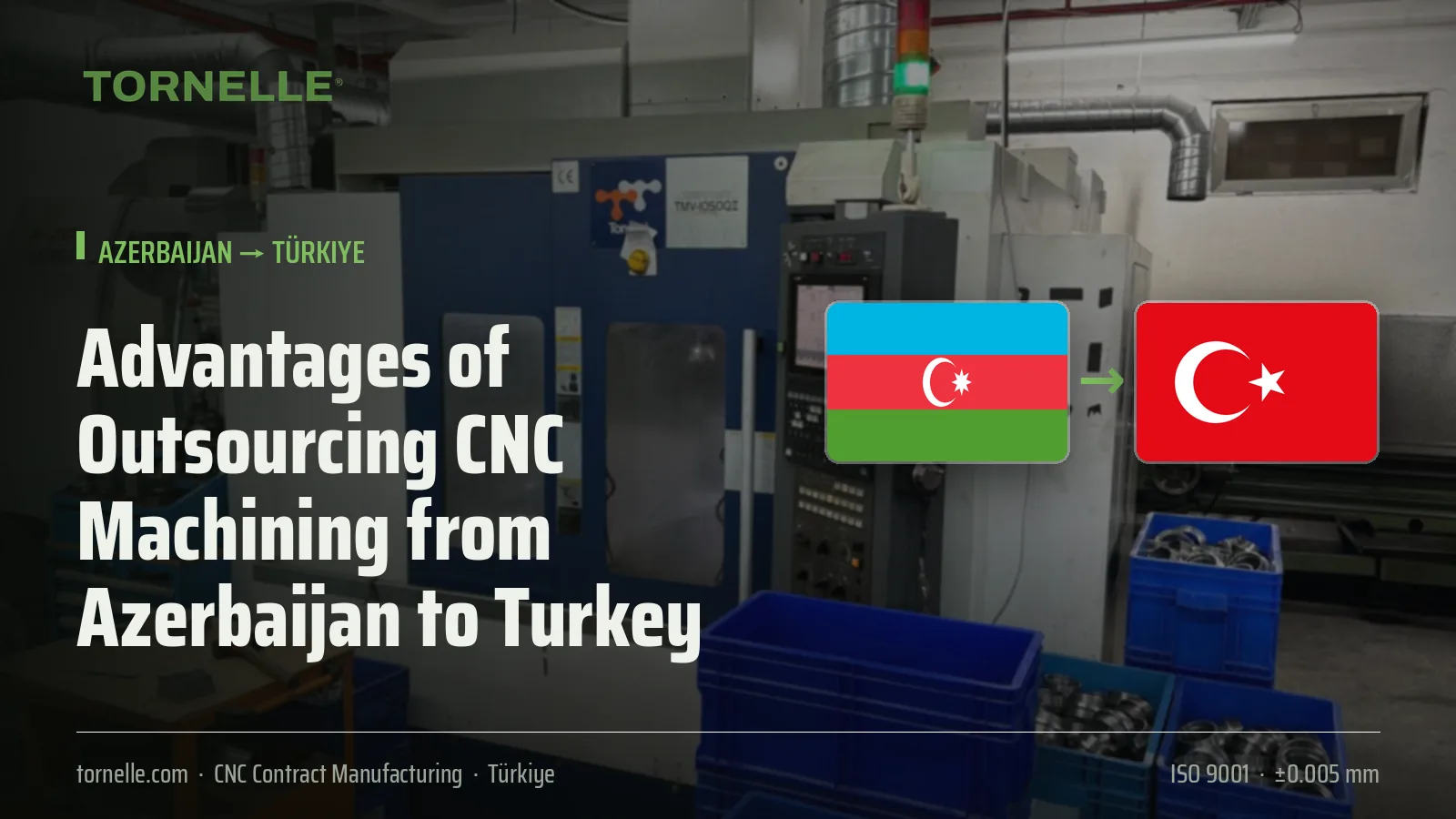
With Caspian oil and gas production, the petrochemical plants at Sangachal and Sumgait, a growing agriculture and food industry, construction and infrastructure investment and a defence industry, Azerbaijan has a constant demand for technical spare parts and equipment components. Because local machining capacity is limited, these parts are mostly imported. Beyond the "one nation, two states" relationship, Turkey is Azerbaijan's nearest industrial supply base thanks to concrete logistical and technical advantages. In this article we look at the advantages of CNC contract manufacturing in Turkey for Azerbaijani buyers.
1. Shared Language: Zero Communication Barrier
Azerbaijani and Turkish are mutually intelligible; drawing notes, quotes, contracts and day-to-day communication run without a translator. The language- and culture-related misunderstandings experienced with European or Chinese suppliers do not exist here. The time difference is 1 hour; a question sent in the morning is answered the same morning. This is a decisive advantage, especially for urgent spare parts and reverse-engineering projects.
2. Logistics: 4–6 Days via Georgia
Road transport between Istanbul and Baku via Georgia (Sarp border crossing) typically takes 4–6 working days; there is heavy truck traffic and regular groupage services between Turkey and Azerbaijan. The Baku–Tbilisi–Kars railway offers an alternative for container loads. With direct Istanbul–Baku flights, air freight takes 1–2 days. Compared with sourcing from Europe, Turkey is both closer and faster.
3. Cost: European Quality, Regional Price
Azerbaijani companies source technical parts from Europe at high prices and with long lead times, or from Russia or China with uncertainty about quality and documentation. In Turkey, 3-axis turning and milling hourly rates are in the €28–45 band, 30–50% below Western Europe, while the quality standard is the same as in the European supply chain. For the calculation approach see our cost comparison article.
4. Customs and Taxes
The Turkey–Azerbaijan Preferential Trade Agreement entered into force in 2021; however, its scope is limited to a small number of product groups, and most CNC-machined industrial parts are not covered. Azerbaijan's standard import tariff applies to these parts; for machine parts and components the rate is mostly 5%, and for some items it may be 0% or 15%. 18% VAT applies on import and is recoverable for registered businesses. Confirm the HS code and the tariff rate with your customs broker at the quotation stage. These conditions are the same as for sourcing from Europe, so they do not change Turkey's price advantage.
5. Sector Fit
- Oil and gas and petrochemicals: valve and pump components, flanges, fittings, instrumentation housings; 316L, duplex, alloy steel. EN 10204 3.1 certificates and NACE-compliant material supply are possible.
- Agriculture and food industry: agricultural machinery spare parts, stainless food-equipment components.
- Construction and infrastructure (reconstruction projects): equipment spares, steel structure connection parts, fast supply.
- Defence: Turkey–Azerbaijan defence cooperation is strong; export-control and end-user declaration requirements apply.
- Energy and water infrastructure: turbine auxiliary equipment, pump shafts, hydraulic components.
6. Standards and Reverse Engineering
In Azerbaijani industry, older GOST-standard equipment coexists with newer European and American (EN/ISO, ASME/API) standard equipment. Turkish workshops are used to working in this mixed environment; the EN equivalents of GOST material grades (for example 12Х18Н10Т ↔ 1.4541, 40Х ↔ 41Cr4) are known. For parts of older equipment without drawings, reverse engineering is done by measuring and modelling from a sample part; the shared language makes this process much easier. For the process see our how we work page.
7. Commercial Convenience
Established banking and payment channels exist between Turkish and Azerbaijani companies; pricing in USD, euros or Turkish lira is possible. Commercial documents (invoice, certificate of origin, packing list) are prepared in Turkish/English. The widespread presence of Turkish companies in Azerbaijan makes on-site support and technical visits easy when needed.
Points to Consider
- Confirm the HS code, the tariff rate and the scope of the Preferential Trade Agreement with your customs broker.
- For GOST-standard parts, clarify the material equivalent and tolerances on the drawing or in the order.
- Define the delivery term (FCA Istanbul or DAP Baku); our Incoterms guide will help.
- Plan a sample and inspection-report step for the first order; define your quality assurance expectations in writing.
Frequently Asked Questions
Is there customs duty on importing CNC parts from Turkey into Azerbaijan?
The Preferential Trade Agreement covers a limited range of products; for most CNC parts the standard tariff (typically 5%) and 18% VAT apply. Confirm according to the HS code.
What is the lead time?
Production 2–5 weeks (shorter for urgent parts); road freight 4–6 working days, air freight 1–2 days.
Can older parts without drawings be produced?
Yes; reverse engineering is done by measuring and modelling from a sample part, the model is submitted for your approval and then produced.
In which currency are prices quoted?
USD, euros or Turkish lira; on request the AZN equivalent is added for reference.
Conclusion
For Azerbaijani companies, Turkey is the most natural source for technical CNC parts, with a shared language, 4–6-day road freight, command of GOST and EN standards and prices below Europe. Send your technical drawings or sample photographs via our quote form; you will receive an itemised quote within 24 hours.