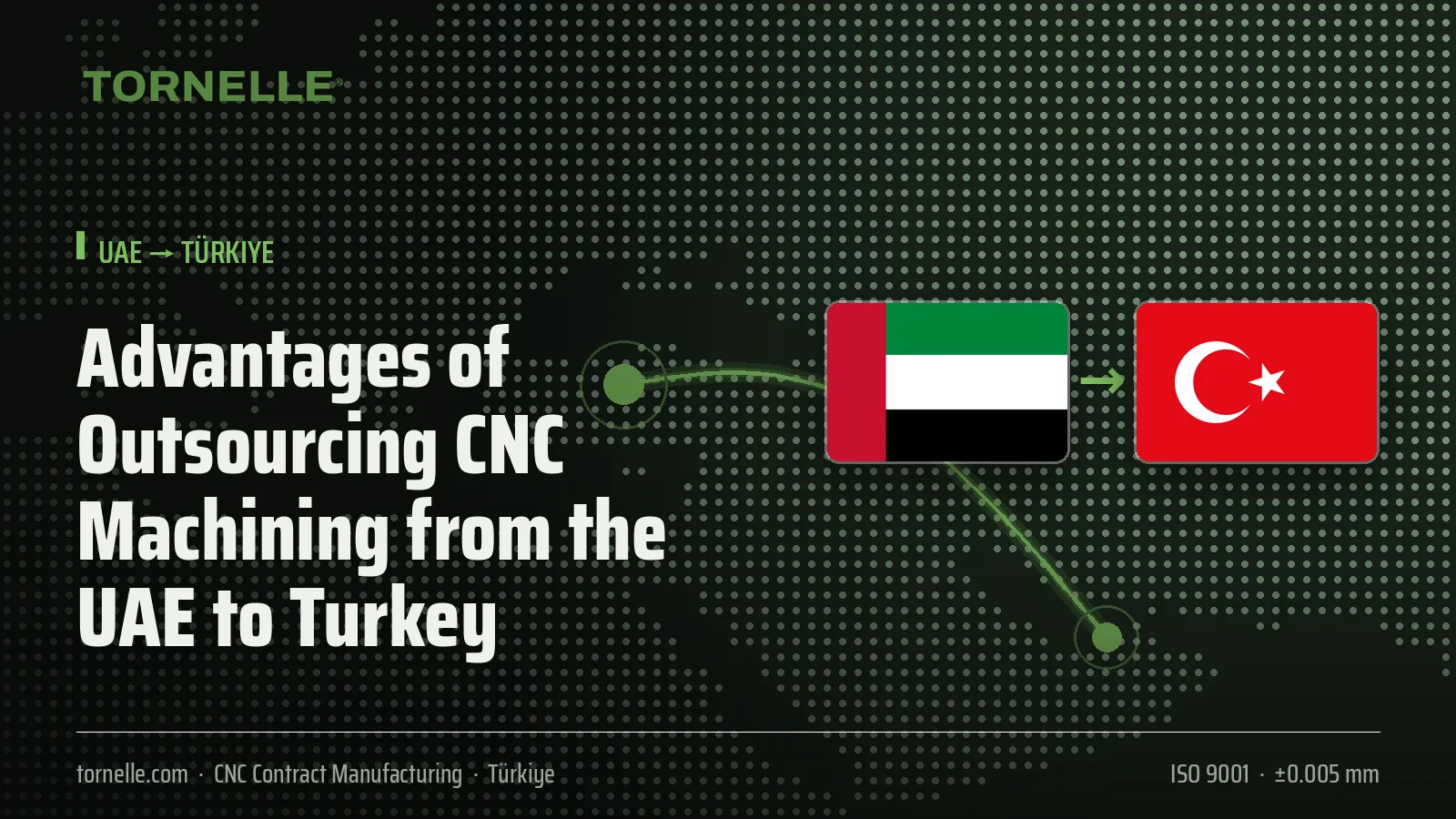
Besides being the Gulf's trade and logistics hub, the United Arab Emirates has a rapidly growing industrial base in oil and gas equipment, shipbuilding and repair, aviation MRO, aluminium production and the defence industry. These sectors demand certified, traceable, tight-tolerance CNC parts in materials such as stainless and alloy steel, duplex, Inconel and aluminium. Local machining capacity, however, lags behind demand and is expensive. In this article we look at the advantages of CNC contract manufacturing in Turkey for UAE buyers.
1. Turkey–UAE CEPA: Customs Advantage
The Comprehensive Economic Partnership Agreement (CEPA) between Turkey and the UAE entered into force on 1 September 2023. The agreement removes or gradually phases out customs duties on most industrial products traded between the two countries. The UAE's standard import duty is 5% (GCC common tariff); for parts of Turkish origin under CEPA, a reduced or zero rate applies with a certificate of origin. We recommend confirming the CEPA tariff schedule for your product's HS code with your customs broker. Imports into free zones (JAFZA, KIZAD, etc.) are exempt from customs duty in any case. 5% VAT applies on import and is recoverable for registered businesses.
2. Logistics: 4-Hour Flight, 2–3-Day Freight
There are dozens of direct flights a day between Istanbul and Dubai and between Istanbul and Abu Dhabi; air freight takes 2–3 days door to door. Thanks to the cargo capacity of Turkish Airlines and Emirates, urgent batches can even be delivered the next day. For high-volume planned shipments, sea freight from Mersin or Istanbul to Jebel Ali takes 10–15 days. Compared with sourcing from Europe or the Far East, Turkey is one of the shortest-lead-time industrial sourcing options for the UAE.
3. Cost: European Quality, Competitive Price
UAE companies mostly source CNC parts from Europe (high price, long lead time) or from Asia (low price, quality and lead-time risk). Turkey sits between the two: European-standard quality and certification, machine hourly rates 30–50% below Europe (3-axis turning/milling €28–45), and lead times far below Asia. For our line-by-line calculation approach see our cost comparison article.
4. Sector Fit
- Oil and gas and petrochemicals: valve and pump components, flanges, fittings, instrument housings; stainless steel (316L), duplex, alloy steel. EN 10204 3.1 material certificates and NACE MR0175-compliant material requirements are common; our certificate guide explains what to expect.
- Marine and ship repair: bronze, stainless steel and aluminium parts, fast repair supply.
- Aviation MRO: tooling, fixture and equipment parts; flight-critical parts require special approvals.
- Defence: growing cooperation between Turkey's defence industry and the UAE; export controls and end-user declarations apply on both sides.
- Construction and infrastructure equipment: heavy turned parts, pins, bushings, hydraulic components.
5. Standards and Communication
UAE industry uses a mix of ASME/API (oil and gas), EN/ISO (European-sourced equipment) and BS standards; inch and metric drawings coexist. Export-oriented Turkish workshops work with both systems. The time difference is only 1 hour; technical communication in English is standard, and support for commercial communication in Arabic is also widely available in Turkey. Cultural and commercial proximity is one of the reasons for the rapid growth of Turkey–UAE trade in recent years.
6. Flexible Batches and Fast Repair Supply
In the oil and gas and marine sectors, demand is mostly for low-volume, urgent, technical parts: 5 valve bodies for a plant on shutdown, 20 bushings for a vessel under maintenance. Turkish contract manufacturers work flexibly from prototype to series; rapid production from a STEP file or a sample part plus 2–3-day air freight provides a critical advantage in these scenarios. For process details see our how we work page.
Points to Consider
- Make sure the CEPA certificate of origin accompanies the shipment and clarify the tariff rate for the HS code at the quotation stage.
- For oil and gas parts, state the material specification (ASTM/EN grade, NACE requirement) clearly on the drawing.
- Define the delivery term (FCA Istanbul or DAP Dubai) and the transport mode; our Incoterms guide will help.
- Plan a sample and inspection report step for the first order.
Frequently Asked Questions
Is there customs duty on importing CNC parts from Turkey into the UAE?
The standard rate is 5%; for products of Turkish origin under the Turkey–UAE CEPA, a reduced or zero rate applies depending on the HS code. Imports into free zones are duty-exempt.
What is the lead time?
Production 2–5 weeks (shorter for urgent parts); air freight 2–3 days, sea freight 10–15 days.
Are oil and gas certificates provided?
EN 10204 3.1 material certificates, inspection reports and NACE-compliant material supply are possible; product certifications such as the API monogram are the responsibility of the equipment manufacturer.
In which currency are prices quoted?
USD or euros; on request the AED equivalent is added for reference.
Conclusion
For UAE companies, Turkey is the nearest industrial sourcing base, with the customs advantage of CEPA, 2–3-day air freight, European-standard certification and competitive prices. Send your technical drawings and quantities via our quote form; you will receive an itemised, USD-based quote within 24 hours.