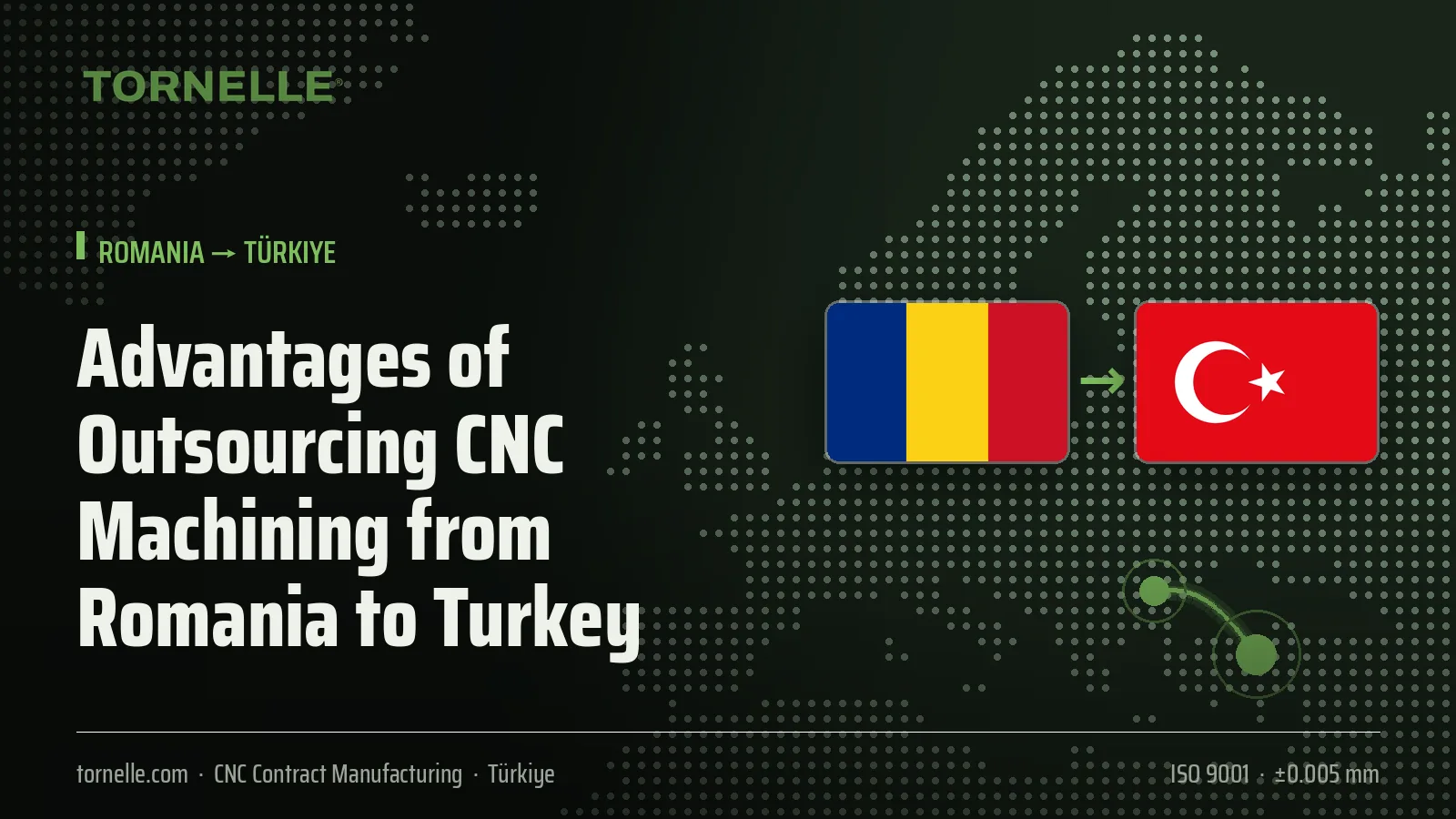
Over the past twenty years Romania has become a production base for Western European OEMs: Dacia in Mioveni, Ford Otosan in Craiova, Airbus Helicopters in Brașov, hundreds of automotive and electronics suppliers around Timișoara and Cluj. This growth is straining local CNC subcontracting capacity; wages are rising at double-digit annual rates, skilled operators are increasingly hard to find and sub-suppliers cannot free up capacity for new projects. In this article we look at the advantages that CNC contract manufacturing in Turkey offers Romanian manufacturers.
1. Geographical Proximity: 2–3 Days by Road
Istanbul and Bucharest are about 650 km apart; road transport via Bulgaria takes 2–3 working days door to door. This is Turkey's fastest delivery route into the EU; a part coming to Romania from a supplier in Western Europe takes a similar time. Weekly groupage services provide regular access to the industrial regions of Bucharest, Constanța, Craiova and Transylvania. In urgent cases, air freight with direct Istanbul–Bucharest flights takes 1–2 days.
2. Customs Union and A.TR: Zero Customs Duty
Thanks to the Customs Union between Turkey and the EU, CNC-machined industrial parts enter Romania without customs duty under the A.TR movement certificate. Romanian VAT (21%) applies on import and is recoverable for VAT-registered businesses; there is no net cost effect. Customs clearance is handled routinely by the forwarder. For details see our A.TR guide.
3. Cost: A Realistic Comparison
Romania is still a low-cost country within the EU; Turkey's price advantage is therefore narrower than against Germany or France. In Romania, 3-axis turning and milling hourly rates are typically €30–45, in Turkey €28–45. On a per-part basis, Turkey's advantage generally stays in the 10–25% range and becomes more pronounced on labour-intensive parts with long cycle times. For the Romanian buyer the real gain is less the price than capacity and delivery reliability: getting parts from Turkey in 3–5 weeks at a time when local workshops are quoting 8–12 weeks means not stopping the production line. For the calculation approach see our cost comparison article.
4. Sector Fit
- Automotive: the Dacia/Renault and Ford Otosan supply chains; turned and milled steel/aluminium parts, PPAP and IATF requirements. Ford Otosan's Turkish origin means a habit of working with Turkish suppliers.
- Aerospace: the cluster around Brașov and Bacău; tooling, fixture and equipment parts, special approvals for flight-worthy parts.
- Oil and gas: equipment manufacturers in the Ploiești region; stainless and alloy steel parts, 3.1 certificate.
- Agricultural machinery and rail: heavy turned parts, shafts, bushings, fasteners.
- Electronics and household appliances: aluminium housings, connector parts, series turned parts.
5. Same Standards, Close Time Zone
Romanian industry works with EN/ISO and DIN standards, the same as Turkey. There is no time difference in summer and only 1 hour in winter. Technical communication in English is standard; because of the density of Turkish investment in Romania, Turkish-speaking commercial counterparts are also common.
6. Flexible Series and Swiss-Type Capacity
OEM suppliers in Romania frequently look for capacity for medium-volume (500–10,000 pieces) turned parts. Turkey's Swiss-type turning capacity and its flexible structure from prototype to series enable fast ramp-up in this segment. First article approval and the PPAP file are prepared in the format expected by the quality team in Romania.
Points to Consider
- Knowing that the price advantage is narrower than against Western Europe, include capacity and delivery reliability in the total cost.
- Make sure the A.TR certificate accompanies the shipment and clarify the delivery term (FCA or DAP) at the quotation stage.
- For automotive parts, state the PPAP level and special characteristics in the RFQ.
- Allow a 1-day delay margin at the Bulgarian border crossings during busy periods.
Frequently Asked Questions
Is there customs duty on importing CNC parts from Turkey into Romania?
No; industrial products within the Customs Union enter duty-free under the A.TR certificate. Only recoverable Romanian VAT (21%) applies.
What is the lead time?
Production 3–5 weeks (1–2 weeks for prototypes); road freight 2–3 working days.
How much cheaper is Turkey than a local workshop in Romania?
10–25% depending on the part; more on labour-intensive, long-cycle parts. The main advantage is usually capacity and delivery reliability.
In which currency are prices quoted?
Euros; on request the RON equivalent is added for reference.
Conclusion
For Romanian manufacturers, Turkey is the nearest external source of supply, with 2–3-day road freight, duty-free supply under A.TR, the same standards and flexible series production against capacity bottlenecks. Send your technical drawings and quantities via our quote form; you will receive an itemised, euro-based quote within 24 hours.