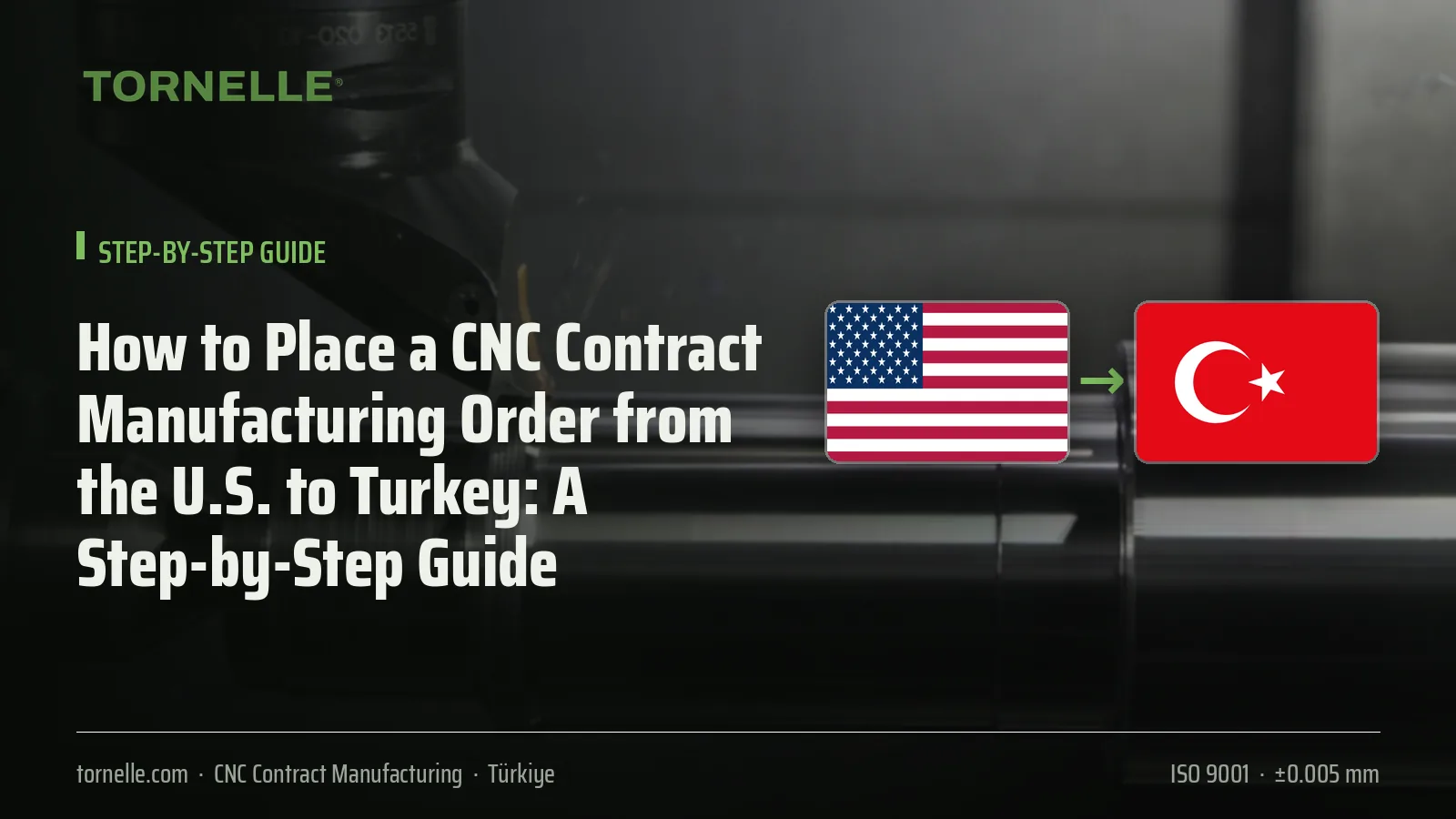
After seeing the advantages of outsourcing CNC work from the U.S. to Turkey, this guide explains step by step how to carry out the process in practice, following the workflow American procurement teams are accustomed to: RFQ, quote, PO, first article, production, shipment.
Step 1: Prepare the Technical Documentation
- Technical drawing (PDF): Inches or metric—both are accepted. ASME Y14.5 geometric tolerances, critical dimensions, surface roughness (µin or µm Ra), thread specifications (UNC/UNF/NPT/metric), and edge chamfer notes.
- 3D model (STEP): AP214/AP242; for pricing and CAM.
- Material: ASTM/AISI/UNS designation and condition (4140 HT 28–32 HRC, 6061-T6, 316L, 7075-T651); MTR required.
- Surface and heat treatment: Anodizing (MIL-A-8625 Type II/III), passivation (ASTM A967), zinc plating, hardening.
- Quantity and scheduling: Order quantity, annual estimate (EAU), first delivery date.
- Quality requirements: Dimensional report scope, FAI (AS9102), PPAP, CoC.
Detailed checklist: RFQ preparation guide.
Step 2: Export Control (ITAR / EAR)
Before sharing technical data, determine whether the part falls under ITAR (defense products) or EAR (dual-use products). The vast majority of commercial parts fall under EAR99 and can be freely shared. The transfer of technical data subject to ITAR abroad requires a license; in this case, consult with your supplier and export compliance advisor in advance. Turkey is a NATO ally, and defense industry cooperation is well-established; however, procedures must be followed.
Step 3: Proposal and Evaluation
Turkish suppliers will provide a USD-based quote within 1–3 business days in response to a complete RFQ. The quote should include quantity tiers, installation/programming costs, the scope of reports and certifications, delivery time, Incoterms, and DFM recommendations. Compare offers based on total cost: unit price + shipping + customs duties (if applicable) + customs brokerage fees + the cost of capital associated with the payment terms.
Step 4: Commercial Terms and Order
Incoterms
FCA Istanbul: Your own freight forwarder arranges air or sea freight; entry into the U.S. and customs clearance are your responsibility. DAP: The supplier delivers to your doorstep; import duties and customs procedures are your responsibility. DDP is rarely used.
Payment
30–50% advance payment on the first order, with the balance due prior to shipment (wire transfer); for ongoing relationships, Net 30–60. USD-based pricing is standard. Credit cards and letters of credit are rarely used.
Contracts
NDA prior to technical data; for serial supply, a quality agreement and supply contract (including governing law and arbitration clause).
Step 5: Initial Sample and Approval
Receive a pre-production sample or pilot batch, accompanied by a dimensional report (balloon drawing + measurement table or CMM report), MTR, and, if required, a coating certificate. AS9102 FAI is required for aerospace, PPAP for automotive, and validation documents for medical applications. Verify the sample using your own equipment. Quality system: quality assurance manual.
Step 6: HTS Classification and Customs
For imports into the U.S.:
- You must be the Importer of Record or appoint a customs broker; shipments exceeding 2,500 USD require a formal entry and a customs bond.
- HTS Code: The importer is responsible for classifying the part. Common codes: 7326.90 (steel), 7616.99 (aluminum), 8487.90 (machine parts), 8483 (mills), 8481.90 (valve parts). The tax rate is 0–5% for most codes.
- Section 232: Codes listed in the steel and aluminum products list may be subject to additional duties; confirm with your customs broker on a product-by-product basis.
- Country of origin marking: The “Made in Turkey” marking must appear on the part or packaging.
- Documents: Commercial invoice (HTS code, country of origin, Incoterms, value), packing list, AWB or bill of lading, MTR if required.
Customs clearance is typically completed within 1–2 days; the forwarder or express courier provides an integrated customs brokerage service.
Step 7: Shipping
- Express courier (DHL, UPS, FedEx): 2–4 days for samples and small shipments, with integrated customs clearance.
- Air freight (forwarder): 3–5 days for shipments over 50 kg; direct flights from Istanbul to all major U.S. hubs.
- Sea freight: LCL/FCL for high volumes; 3–4 weeks to the East Coast, 5–6 weeks to the West Coast.
Details: Logistics guide (Europe-focused; air freight and ocean freight options for the U.S. are listed above).
Step 8: Serial Delivery
- Blanket PO + release: Fixed annual quantity, with monthly or quarterly call-offs; unit price decreases.
- Safety stock: 4–8 weeks’ worth of inventory held by the supplier or at a 3PL warehouse in the U.S.; replenished via air freight.
- Consolidated shipments: Combine multiple part numbers to reduce air freight costs.
Common Mistakes
- Sending technical data without performing ITAR/EAR checks;
- Failing to confirm the HTS code and Section 232 coverage in advance;
- Sending shipments requiring formal entry without a customs bond;
- Setting tolerances too narrow (which increases costs);
- Skipping the sample phase and placing a production order directly;
- Failing to indicate the country of origin on the packaging.
Frequently Asked Questions
Is it sufficient to send drawings in inches?
Yes. Turkish suppliers serving the U.S. market routinely work with inch-based drawings, ASME Y14.5, and UNC/UNF/NPT threads; measurement reports can also be prepared in inches.
How much is the customs duty?
Most processed metal parts have an MFN rate of 0–5%; the additional Section 301 tariffs applied to China do not apply to Turkey. Section 232 coverage must be checked on a product-by-product basis.
How long does the first order take?
1–2 weeks production for samples + 2–4 days express courier; 3–6 weeks production for production runs + 3–5 days air freight.
How do I make payment?
USD wire transfer is standard; advance payment for the first order, Net 30–60 for ongoing business.
Conclusion
Outsourcing CNC work from the U.S. to Turkey—with the right technical files, export controls, HTS confirmation, and an experienced freight forwarder—becomes just as routine as sourcing from Mexico or China—without the added customs duties or intellectual property risks. Send us your technical drawings and receive a USD-based quote within 24 hours.