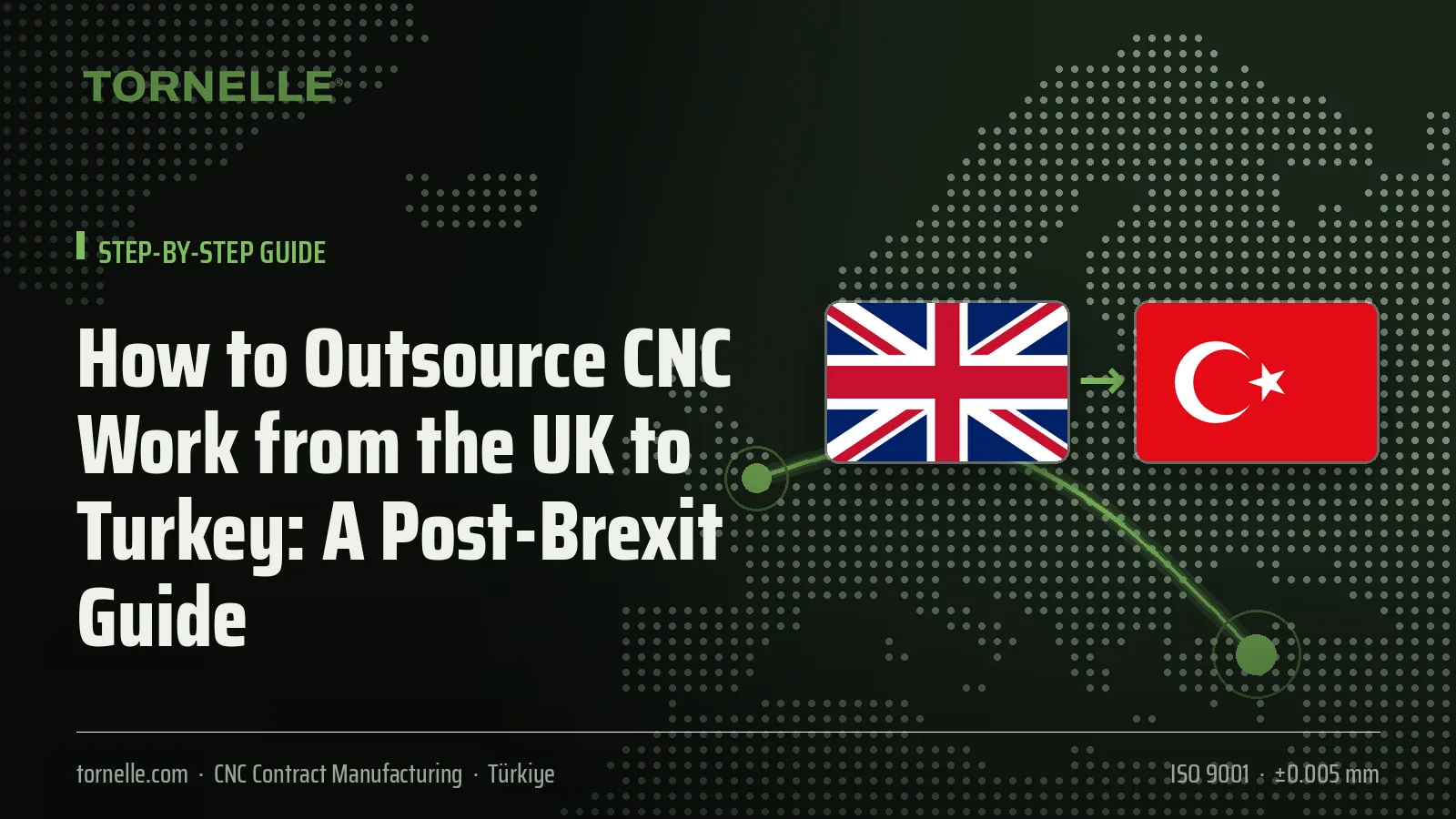
Now that you’ve seen the advantages of outsourcing CNC work from the UK to Turkey, it’s time to move on to the practical steps. This guide outlines the process a procurement or engineering team in the UK should follow when working with a CNC supplier in Turkey—from the initial order through to serial delivery—including post-Brexit customs and VAT procedures.
Step 1: Prepare the Documentation
- Technical drawing (PDF): Must comply with BS 8888 or ISO standards; general tolerances (ISO 2768-m/f), critical dimensions, surface roughness (Ra), and threads (metric, BSP, UNF) must be clearly specified. Drawings in inch units are accepted.
- 3D model (STEP): For programming and quick pricing.
- Material: BS EN or ASTM designation (e.g., 316L / 1.4404, EN24T / 817M40, 6082-T6). Specify the certificate type (EN 10204 3.1) if required.
- Surface and heat treatment: Anodizing, passivation, zinc plating, hardening.
- Quantity and schedule: Annual forecast and first delivery date.
See our RFQ preparation guide for a complete request for quotation.
Step 2: Get Quotes and Compare Them Based on TCO
Export-oriented Turkish suppliers typically provide quotes within 1–3 business days. When evaluating a quote, look beyond the unit price to the total cost of ownership: shipping, insurance, customs brokerage (typically a flat fee per shipment), payment terms, and inventory costs. Shipping costs for Turkish suppliers may seem higher than those from the Far East, but the elimination of customs duties and a 5–7-day delivery window—which reduces inventory requirements—more than offset this difference.
Step 3: Define the Commercial Terms
Incoterms
Practical options for British buyers include FCA Istanbul (your own forwarder handles shipping, and you file the import declaration) or DAP (the supplier delivers to your doorstep, and you are responsible for import VAT). DDP is rarely used because it requires the supplier to be registered for VAT in the United Kingdom.
Payment
A 30–50% advance payment on the first order, with the balance due before shipment; for ongoing relationships, open account terms with 30–60 days’ credit are common. Pricing in GBP or EUR is possible; you may request a 6–12-month price lock to mitigate exchange rate risk.
Contracts
Sign an NDA before sharing technical data. For serial supply, a quality agreement and a framework agreement (call-off agreement) are recommended.
Step 4: Sample and Approval
Request a sample or pilot batch before mass production. Required accompanying documents: measurement report (CMM for critical dimensions), 3.1 material certificate, and, if necessary, a coating certificate. If you’re in the automotive or aerospace supply chain, request the PPAP or FAIR (AS9102) format; Turkish suppliers are familiar with these formats. We’ve covered all the quality steps in our quality assurance guide.
Step 5: Customs and VAT — Post-Brexit Practices
Imports from Turkey to the United Kingdom are exempt from customs duties on industrial products under the UK–Turkey Free Trade Agreement. Requirements:
- EORI number (starting with GB) — you, as the importer, must have this.
- Commercial invoice — HS/commodity code (e.g., 7326 for processed steel parts, 7616 for aluminum parts, and the relevant 84xx code for machine parts), Incoterms, and value.
- Declaration of origin — on the invoice or in a separate document, issued by the Turkish exporter; serves as the basis for the preferential tariff.
- Packing list and transport document (CMR or AWB).
- Import declaration — submitted via the CDS by your carrier or customs broker.
For VAT, you can declare and offset the import VAT on the same declaration using “postponed VAT accounting” without making a cash payment. Customs clearance is typically completed on the same day.
Step 6: Serial Delivery
- Call-off orders: Annual quantities are fixed, and deliveries are made via monthly calls; this improves unit pricing and raw material planning.
- Safety stock: 2–4 weeks’ inventory held by the supplier; since road transport takes 5–7 days, the total lead time is reduced.
- Consolidated shipments: Combine multiple part numbers into a single shipment to reduce shipping and customs costs.
We’ve compared logistics options in our logistics guide.
Common Mistakes
- Initiating a shipment without an EORI number — causes delays at customs;
- Forgetting the declaration of origin — results in the loss of duty-free entry; while corrections can be made later, it takes time;
- Failing to specify the commodity code;
- Setting tolerances too narrowly;
- Failing to document acceptance criteria.
Frequently Asked Questions
Is an exporter number required for the declaration of origin?
For shipments exceeding 6,000 EUR, a Turkish exporter must have approved exporter status or the relevant number; export-oriented suppliers have this infrastructure in place. For low-value shipments, a simple declaration of origin is sufficient.
Do I need to pay import VAT in advance?
No. With “postponed VAT accounting,” you declare the VAT and offset it on the same return; there is no cash outflow.
Do Turkish suppliers quote prices in GBP?
Most suppliers work in EUR or USD; pricing in GBP is also possible. For long-term contracts, an exchange rate band or periodic updates are agreed upon.
How long does it take to deliver the first order?
For samples: 1–2 weeks production + 2–7 days shipping; for production runs: 3–6 weeks production + 5–7 days ground shipping.
Conclusion
In the post-Brexit era, sourcing from Turkey offers the same customs procedures as sourcing from the EU, but with lower costs and greater capacity. With the proper documentation and a certificate of origin, the process becomes routine after a few shipments. Send us your technical drawings and receive a quote within 24 hours.