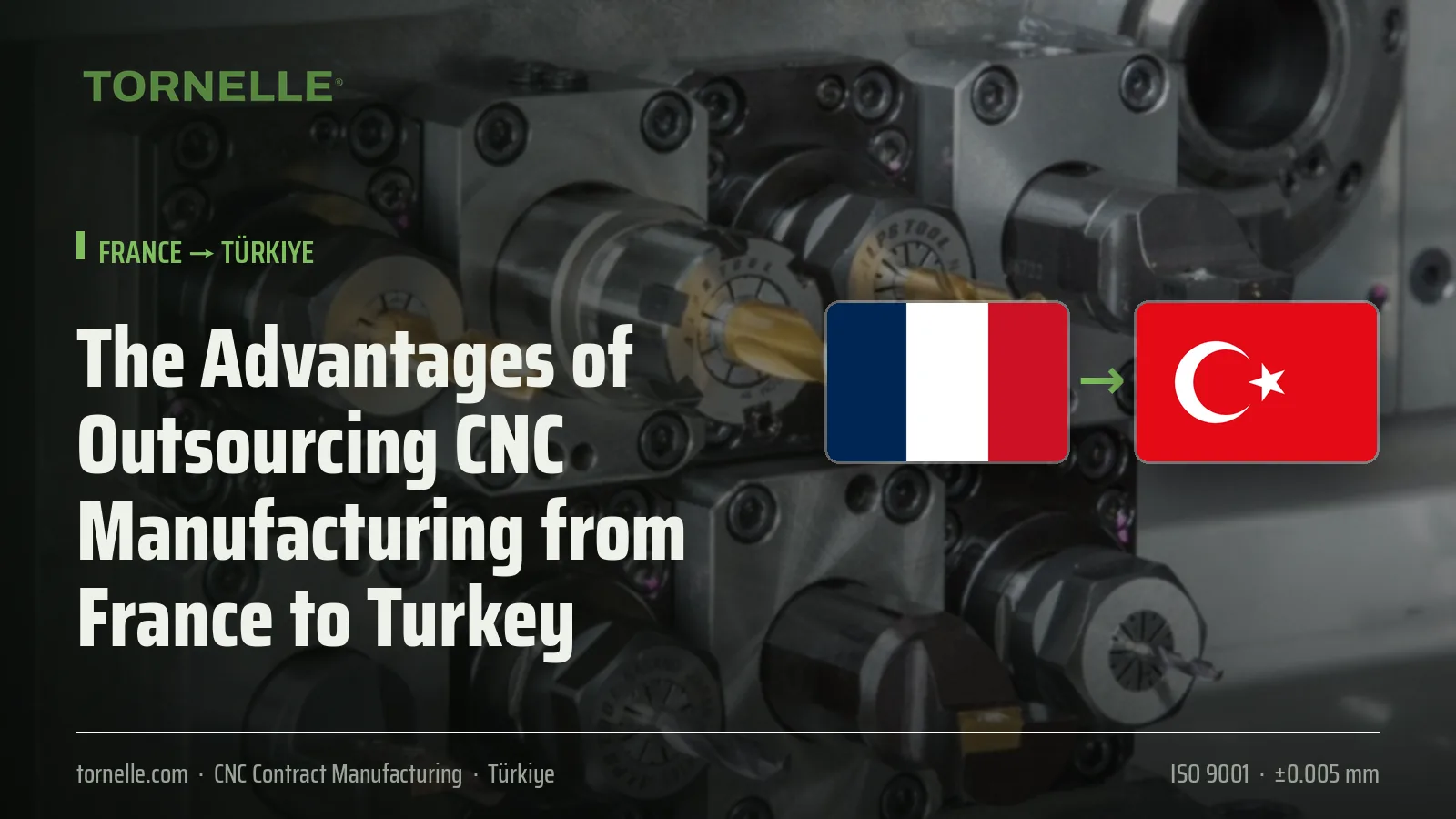
In recent years, the manufacturing industry in France has been caught between two pressures: on one hand, the goal of reindustrialization and bringing supply chains closer to Europe; on the other, high labor costs and competitive pressures. Sourcing from the Far East conflicts with these two goals; local sourcing, however, is not cost-effective for every part. This is precisely where Turkey stands out—at Europe’s doorstep—as a duty-free and competitive CNC contract manufacturing hub.
1. Customs Union: Zero Customs Duties
Thanks to the EU–Turkey Customs Union, CNC parts manufactured in Turkey enter France duty-free with an A.TR movement certificate. French importers are only required to declare import VAT (TVA à l’importation); since 2022, this VAT has been offset directly on the VAT return (autoliquidation) without being paid at customs. The customs duties and anti-dumping risks associated with imports from Asia do not apply to Turkish supplies. For details, see our article on the Customs Union and A.TR.
2. By Road: 4–6 Business Days
The distance from Istanbul to Lyon is approximately 2,700 km, and from Istanbul to Paris is approximately 2,900 km. With regular road transport routes, shipments reach your factory in France within 4–6 business days; for urgent shipments, air freight via direct flights from Istanbul to Paris, Lyon, Marseille, or Toulouse takes 1–2 days. This significantly reduces inventory levels and working capital tied up compared to sourcing from Asia, which involves a 6–8-week wait via sea freight.
3. Compliance with NF EN / ISO Standards
French technical drawings are based on European standards: NF EN ISO 2768 for general tolerances, NF EN ISO 1101 for geometric tolerances, and NF EN 10204 for material certificates. These standards are standard practice for Turkish CNC suppliers who have been serving the German and European markets for decades. Since French material designations (e.g., X5CrNi18-10, 42CrMo4, EN AW-2017A) correspond to the European numbering system, materials can be sourced directly. Technical communication is conducted in English; standard terms in French technical drawings (“tolérances générales,” “arêtes cassées,” “état de surface”) are easily understood.
4. Cost Advantage
In France, the hourly cost of CNC machining, along with social security contributions and energy prices, ranks among the highest in Europe. In Turkey, labor and overhead costs are significantly lower, while raw material prices are tied to the global market. As a result, French buyers typically see a total cost advantage of 30–45%—especially for labor-intensive parts, such as those requiring multiple operations, tight tolerances, and small-to-medium production runs. We illustrated the calculation logic in our Germany–Turkey cost comparison; the results for France are very similar.
5. Sectoral Alignment: Aerospace, Automotive, Energy
The Turkish machining sector has experience that aligns with sectors where France is strong:
- Aviation: Turkey is an established player in the Airbus supply chain; it has an AS9100-certified supplier ecosystem. It has extensive experience with milled aluminum and titanium parts.
- Automotive: French OEMs and Tier-1 suppliers have factories in Turkey; local suppliers are familiar with IATF 16949 standards and the PPAP process.
- Energy and nuclear industry: Certified materials and traceability practices are well-established for turned parts made of stainless and alloy steels.
- Railway: Turkish suppliers are familiar with EN 15085 and railway quality requirements.
6. Capacity and Flexibility
Long lead times for small and medium-volume runs, which are common in France, are rarely seen in Turkey. Capacity in CNC turning, 3–5-axis CNC milling, and sliding automatic lathes provides flexibility from prototypes to high-volume production runs. Surface treatment, heat treatment, and assembly can all be managed under one roof.
7. Time Zone and Access
Turkey is only 1 hour ahead of France (1 hour during daylight saving time). The flight from Paris to Istanbul takes approximately 3.5 hours; a supplier visit can be completed in a single day. Virtual factory tours and digital inspections are also common practices.
Practical Notes for French Buyers
- Technical drawings may remain in French; summarizing critical dimensions and acceptance criteria on a separate English-language page speeds up the process.
- Request a measurement report and an EN 10204 3.1 certificate with the first order.
- Select FCA Istanbul or DAP factory as the Incoterms.
- Share your annual forecast and secure price and capacity guarantees through a framework agreement (contrat cadre).
Frequently Asked Questions
Are there customs duties on imports from Turkey?
No. Industrial products arriving with an A.TR movement certificate are exempt from duties under the Customs Union; only the import VAT is offset via autoliquidation on the customs declaration.
Are technical drawings in French accepted?
Yes. Since the standard notation is based on European norms, it is directly readable; technical communication is conducted in English.
Is Turkey suitable for aerospace parts?
Yes. Turkey is well-established in the Airbus and Boeing supply chains; there are AS9100-certified suppliers and expertise in titanium and aluminum machining.
How does the process work?
We’ve outlined the steps in our article titled “How to Outsource CNC Machining from France to Turkey.”
Conclusion
Outsourcing CNC machining work from France to Turkey meets the goal of sourcing close to Europe while simultaneously ensuring cost competitiveness. Duty-free trade, delivery in less than a week, compliance with NF EN/ISO standards, and industry expertise are all offered in a single package. Send us your technical drawings and receive a quote within 24 hours.