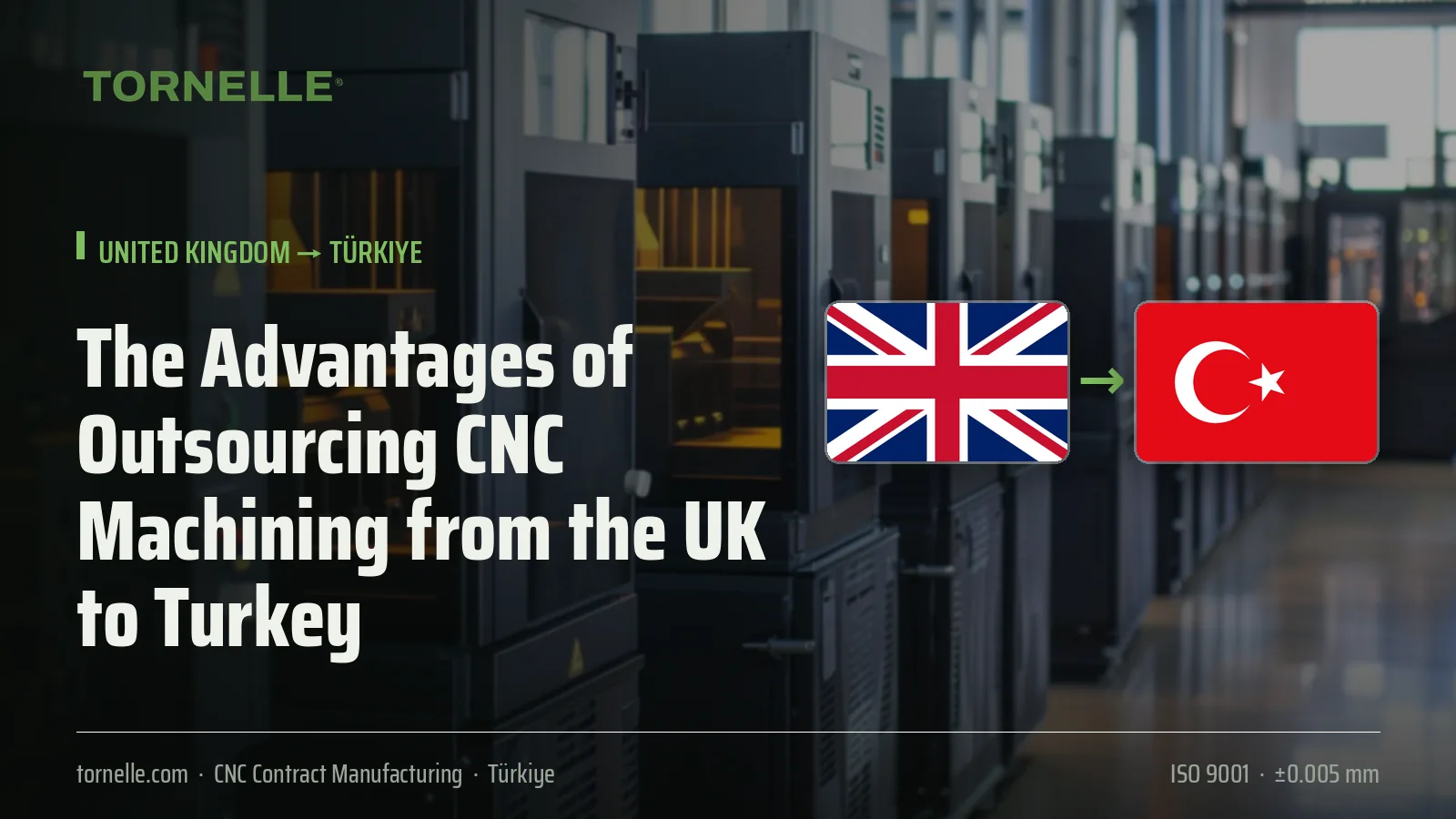
Brexit has forced UK manufacturers to rethink their supply chains. What was once a seamless flow of EU supplies now involves customs declarations, rules of origin, and occasional delays. In this environment, Turkey has emerged as an unexpectedly strong alternative for UK companies: The Free Trade Agreement (UK–Turkey FTA) between the United Kingdom and Turkey, in effect since January 1, 2021, maintains duty-free trade in industrial goods, while Turkey’s cost and capacity advantages are offered from a much closer distance compared to the Far East.
1. UK–Turkey Free Trade Agreement
Duty-free trade, previously facilitated through the Turkey–EU Customs Union prior to Brexit, has been preserved under the bilateral FTA signed with the United Kingdom. CNC parts of Turkish origin enter the United Kingdom duty-free with a statement of origin. The British importer only declares import VAT and can offset it using deferred VAT accounting without affecting cash flow. The customs duties applied to imports from the Far East do not apply to Turkish supplies.
2. Less Bureaucracy Compared to EU Suppliers
Interestingly, following Brexit, sourcing from Turkey has reached the same documentation level as sourcing from the EU: both are declared as third-country imports. Turkish exporters have, in fact, regarded the United Kingdom for the past 25 years not as a market requiring “non-EU” documentation, but as one operating under customs procedures; consequently, they are experienced in handling commercial invoices, packing lists, declarations of origin, and EORI processes. The result: You will not encounter more friction in Turkey than you would with an EU supplier.
3. Delivery Times: 5–7 Business Days by Road, 2 Days by Air Freight
Road freight from Istanbul to the United Kingdom, including the Channel crossing, typically takes 5–7 business days. For urgent parts, air freight via direct flights from Istanbul to London, Manchester, or Birmingham takes 1–2 days. Instead of waiting 6–8 weeks for sea freight from China, you’ll receive parts at your factory in about a week—which reduces your inventory and working capital needs.
4. Familiarity with BS, ISO, and the Inch Measurement System
Turkish suppliers serving the UK market directly apply BS EN standards (largely compatible with the EU), ISO 2768 tolerances, and ISO 1101 geometric tolerances. For UK companies that still use inch-based technical drawings or BSP/BSPT/UNF threads, these thread types and measurement conversions are routine. English-language technical communication is standard practice among export-oriented Turkish companies.
5. Significant Cost Advantage
Rising energy and labor costs in the United Kingdom, a decline in precision machining capacity, and difficulties in finding qualified operators have driven up local CNC hourly rates. In Turkey, labor and overhead costs are significantly lower; raw material prices, however, are global. For this reason, British buyers typically see a 30–40% total cost advantage, particularly for labor-intensive parts—those with multiple operations and tight tolerances. We illustrated this cost structure in our Germany–Turkey comparison; the ratios are similar for the UK.
6. Capacity: From Prototypes to High Volumes
The problem frequently faced by British engineering firms—“local workshops are full, 8-week wait”—is rarely seen in Turkey. An extensive fleet of CNC lathes, CNC mills, and sliding automatic machines offers flexibility ranging from prototypes to annual production runs of 100,000 units. Surface treatment, heat treatment, and assembly can all be managed through the same supplier.
7. Time Zone and Transportation
Turkey is 2 hours ahead of the United Kingdom (2 hours during daylight saving time); business days overlap almost completely. The flight time from London to Istanbul is approximately 4 hours, and there are dozens of direct flights daily. A one-day visit for supplier audits is both practical and cost-effective.
Which UK Sectors Are Suitable?
- Automotive and motorsports supply chain (the Midlands “Motorsport Valley”);
- Aviation supply industry and MRO;
- Oil and gas, offshore, and valve manufacturers (Aberdeen region)—stainless and duplex steel turned parts;
- Medical device and laboratory equipment manufacturers;
- Industrial automation, pump, and hydraulic system manufacturers;
- Manufacturers of scientific instruments and optical-mechanical components.
Frequently Asked Questions
Are imports from Turkey subject to customs duties after Brexit?
Under the UK–Turkey Free Trade Agreement, industrial products originating in Turkey are exempt from customs duties upon presentation of a certificate of origin. Only import VAT is declared.
I have technical drawings in inches—will this be a problem?
No. Turkish suppliers focused on exports routinely work with inch measurements and BSP/UNF/UNC threads; if necessary, drawings are confirmed along with metric conversions.
What is the lead time?
Production takes 1–2 weeks for prototypes and 3–6 weeks for mass production; ground shipping to the United Kingdom takes 5–7 business days, and air freight takes 1–2 days.
How does the process of outsourcing CNC machining from the UK to Turkey work?
We’ve outlined the steps in our article titled “How to Outsource CNC Machining from the UK to Turkey.”
Conclusion
In the post-Brexit environment, Turkey is one of the few sourcing options that combines duty-free trade, short lead times, English-language communication, and competitive costs for British manufacturers. Send us your technical drawings to see what benefits manufacturing your parts in Turkey can offer you, and receive a quote within 24 hours.