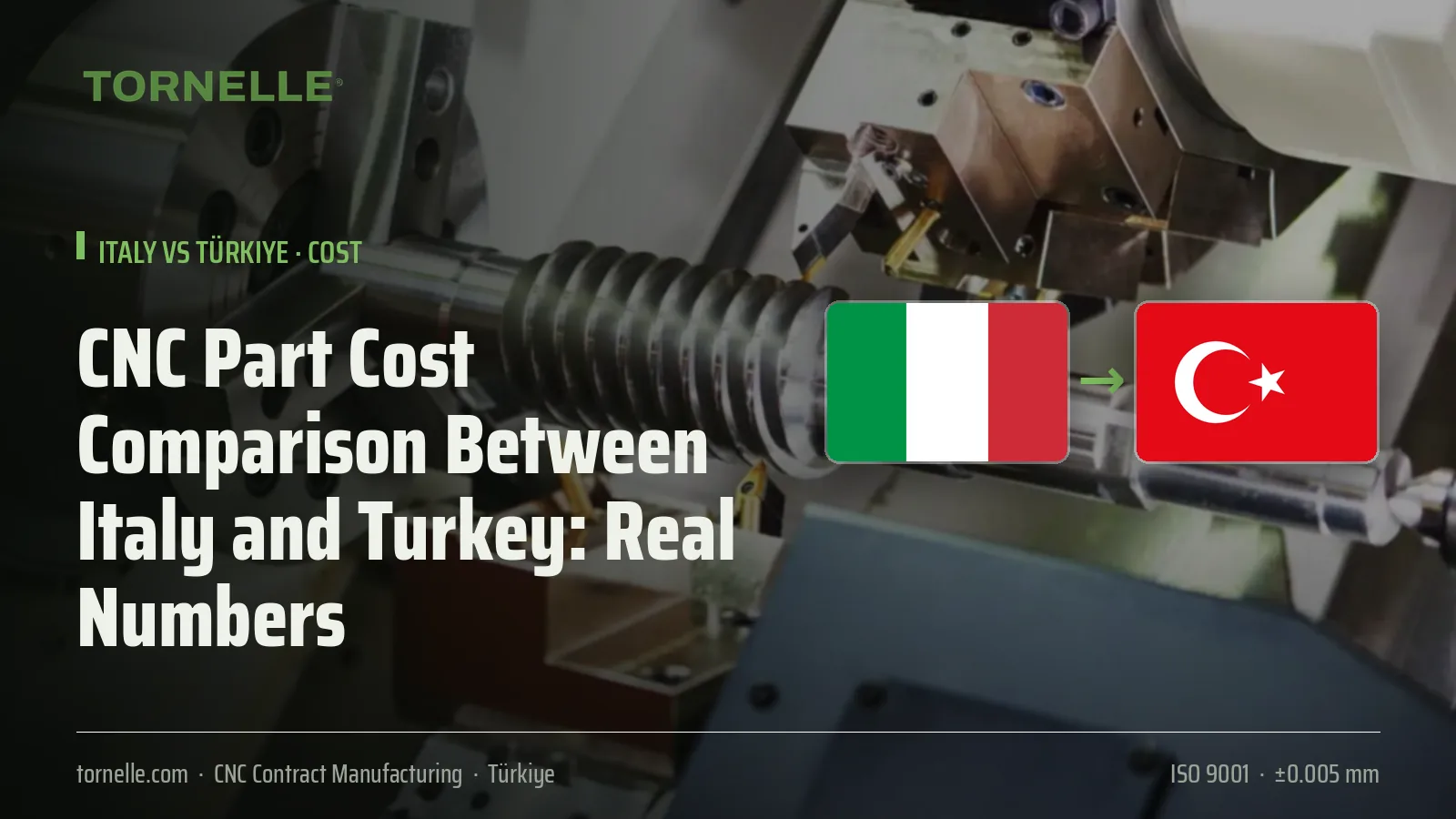
The Italy–Turkey comparison differs from the Germany or Netherlands comparison: CNC hourly rates in Italy are below those of Northern Europe, and the turned-parts clusters in northern Italy (Brescia, Lecco, Lumezzane) operate with high productivity. On the other hand, Italy has the highest industrial electricity prices in Europe and finding skilled operators has become difficult. This article adds numbers to our Italy advantages and process articles. The figures are typical values reflecting 2025–2026 market conditions; they vary by supplier and part.
Line-by-Line Comparison
| Item | Italy (North) | Turkey | Difference |
|---|---|---|---|
| CNC turning hourly rate (3-axis) | €50–68 | €28–40 | ≈ 40% lower |
| CNC milling hourly rate (3-axis) | €55–75 | €30–45 | ≈ 42% lower |
| 5-axis milling hourly rate | €80–110 | €45–65 | ≈ 42% lower |
| Swiss-type / multi-spindle automatic hourly rate | €45–62 | €25–38 | ≈ 40% lower |
| Programming / set-up (hour) | €60–75 | €30–45 | ≈ 45% lower |
| Raw material (steel, aluminium, brass) | Market (strong local brass and steel production in Italy) | Market (±5%) | Similar |
| Industrial electricity (kWh) | €0.20–0.30 (highest in the EU) | €0.10–0.14 | ≈ 55% lower |
| Coating / heat treatment | Market | 15–30% lower | Medium |
| Freight to Italy (share of part value) | 0.5–1% (domestic) | 2–3% (Ro-Ro Trieste 3–4 days; road 4–6 days) | Higher for Turkey |
| Customs duty | — | 0% (A.TR) | None |
| Customs clearance (per shipment) | — | €40–80 | Fixed, small |
| Import IVA (22%) | Domestic IVA | Paid at customs, deducted in the return (deferral possible with AEO/plafond) | Small cash-flow effect |
At 40–45%, the hourly-rate gap between Italy and Turkey is narrower than the 50–55% for Germany; but in energy-intensive processes (heat treatment, long machining times) the gap widens.
Example 1: Turned-and-Milled Steel Hydraulic Valve Body
C45E, Ø60×85 mm, turning + 4-axis milling (6 ports, 3 cartridge cavities, intersecting bores), deburring, phosphate coating; ISO 2768-m, special tolerances on cartridge cavities; 100% pressure test; quantity 800.
| Italy | Turkey | |
|---|---|---|
| Raw material | €2.90 | €3.00 |
| Turning + milling (19 min) | €19.50 | €11.60 |
| Deburring + washing | €1.60 | €0.90 |
| Phosphate coating | €0.70 | €0.55 |
| Pressure test | €0.90 | €0.55 |
| Set-up/programming | €0.90 | €0.45 |
| Quality/report | €0.80 | €0.60 |
| Overhead + margin | €6.00 | €3.60 |
| Ex-works price | €33.30 | €21.25 |
| Freight + customs clearance | €0.25 | €0.65 |
| Delivered cost | €33.55 | €21.90 |
Saving: ≈ 35%. A typical part of the Emilia-Romagna hydraulics industry; labour- and energy-intensive. The requirements are explained in our hydraulic components article.
Example 2: Brass Multi-Spindle Automatic Part
CW617N, Ø14×20 mm, hexagon, M10 thread, bore; nickel plating; quantity 50,000.
| Italy | Turkey | |
|---|---|---|
| Raw material | €0.36 | €0.37 |
| Automatic lathe (28 s) | €0.42 | €0.24 |
| Nickel plating (bulk) | €0.09 | €0.07 |
| Set-up/programming | €0.01 | €0.01 |
| Quality (SPC) | €0.02 | €0.02 |
| Overhead + margin | €0.16 | €0.10 |
| Ex-works price | €1.06 | €0.81 |
| Freight + customs clearance | €0.01 | €0.02 |
| Delivered cost | €1.07 | €0.83 |
Saving: ≈ 22%. This is Italy's strongest area: the Brescia–Lumezzane brass cluster is very efficient with local brass production and a large multi-spindle fleet; the raw material share reaches 35%. Turkey keeps the gap but it remains narrow; the main argument is capacity and lead time. Details are in our brass series parts article.
Italy-Specific Factors
- Energy: Italy's industrial electricity is markedly above the EU average; it feeds directly into machine-hour and heat-treatment costs and preserves the gap with Turkey.
- Logistics proximity: The Istanbul/Çeşme–Trieste Ro-Ro line reaches Italy in 2–3 days; door to door to northern Italy in 3–5 days. This makes Italy the Western European country logistically closest to Turkey; the freight share is lower than for Germany. Details are in our logistics guide.
- IVA: Import IVA is in principle paid at customs and deducted in the return; habitual exporters can import without payment using the plafond (IVA exemption ceiling). The cash-flow effect is manageable for most companies.
- Payment culture: 60–90 day terms are common in Italy; Turkish suppliers work with advance + balance before shipment on first orders, then 30–60 days; the expected terms should be reflected in the quotation.
- Lead time: 8–12 weeks of waiting is common in northern Italian shops; 3–6 weeks in Turkey.
Total Cost of Ownership
Because logistics are short, the safety-stock effect is small (0.2–0.4% of part value); customs clearance is fixed per shipment; quality risk is equivalent with the right system. Total savings on labour-intensive parts are typically 25–40%; on brass and automatic-lathe parts 15–25%. The method is described in our TCO article.
Where the Saving Remains Low
- Brass and free-cutting steel multi-spindle automatic parts (Italy is very efficient; gap 15–25%);
- Large, simple parts where the raw material share exceeds 60%;
- Very low-quantity (1–5) prototypes;
- Parts requiring daily JIT delivery.
Frequently Asked Questions
How much cheaper are CNC parts from Turkey for Italy?
Typically 25–40% delivered for labour-intensive milled and turned-milled parts; 15–25% for brass automatic-lathe parts; 10–15% for material-heavy simple parts.
How do customs duty and IVA work?
Customs duty is zero under A.TR; import IVA is paid at customs and deducted in the return, or deferred with the plafond. Details are in our A.TR guide.
How long does shipping take?
3–5 days to northern Italy by Ro-Ro via Trieste, 4–6 days by road; samples by courier in 1–2 days.
Can I get numbers for my own part?
Yes. Send your technical drawing with the information in our RFQ guide; you will receive a comparable quote within 24 hours.
Conclusion
The CNC part cost gap between Italy and Turkey is narrower than for Germany, but at 25–40% it is meaningful for labour- and especially energy-intensive parts; 3–5 day Ro-Ro logistics and zero duty under A.TR carry this gap to the buyer. The real added value is a 3–6 week lead time against the shrinking capacity in northern Italy. To see the real numbers for your own parts, send us your technical drawings.