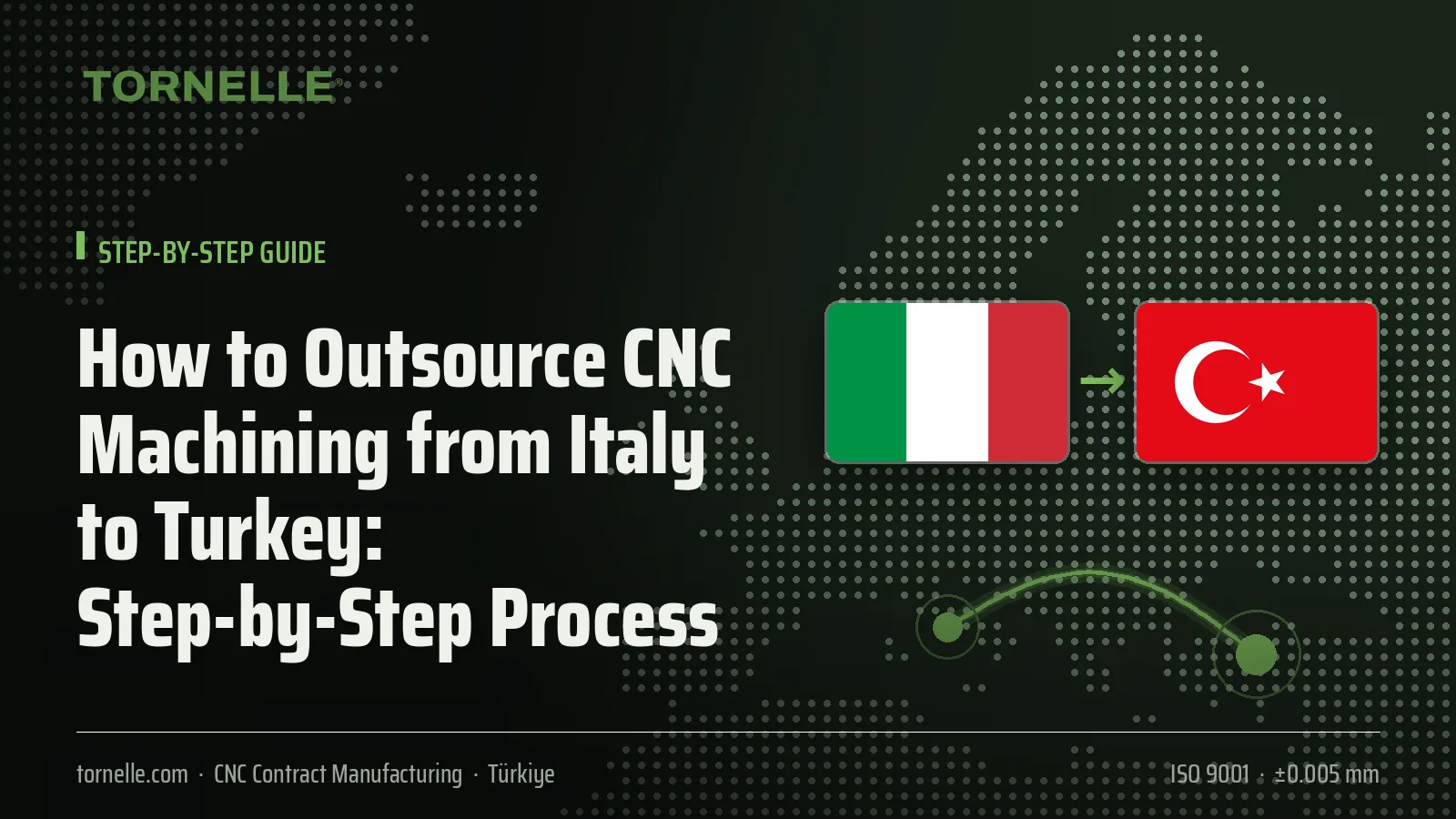
You already know the advantages Turkey offers Italian companies: a 25–40% cost advantage, the Customs Union, 4–6-day logistics and a similar machine-building culture. This article explains step by step how Italian companies, from a packaging-machine builder in Emilia-Romagna to a valve manufacturer in Brescia, place the first order in practice.
Step 1: Prepare the Technical Documents
Italian drawings are prepared to UNI/EN/ISO standards and are read without difficulty in Turkey; drawing notes remaining in Italian is usually not a problem, but an English equivalent of critical notes prevents errors. The ideal package:
- STEP (AP214) 3D model + PDF technical drawing; revision numbers must match.
- Material with its EN grade (e.g. 1.4404, 39NiCrMo3 → EN 39NiCrMo3 / 1.6510, EN AW-6082, CW614N); a trade name alone is not sufficient.
- General tolerance standard (UNI EN 22768 / ISO 2768-mK) in the title block.
- Surface roughness, heat treatment, coating and edge-break notes.
- Annual quantity, batch size, first-order quantity and target delivery date.
- Documentation expectations: inspection report, EN 10204 3.1 certificate, PPAP/FAI if required.
For details see our file format guide.
Step 2: Request and Compare Quotes
Send the RFQ to 2–3 Turkish suppliers and compare item by item: unit price (quantity tiers), set-up/programming, material certificate, inspection report, packaging, delivery term and lead time. Instead of the "tutto compreso" (all-inclusive) price you are used to from Italian suppliers, Turkish quotes are mostly itemised; equalise the scope when comparing. Suppliers who send DFM and tolerance recommendations with the quote are a sign of process discipline. For the method see our RFQ guide.
Step 3: Clarify the Commercial Terms
Incoterms
Two practical options: FCA Istanbul (your own forwarder collects in Turkey; economical for high-volume buyers) or DAP (the Turkish supplier delivers to your door and you only deal with the import declaration and VAT; simple for first orders). Avoid EXW: responsibility for the export declaration passes to you. Details are in our Incoterms guide.
Payment
In Italy 60–90-day terms and Ri.Ba. are common; on export sales Turkish suppliers generally work with a partial advance payment (30–50%) + balance before shipment on first orders, and 30–60 days open account in a regular relationship. Euro-based SWIFT transfer is standard; Ri.Ba. is not used. State your payment-term expectation clearly in the RFQ; volume and continuity extend the terms.
Contract and confidentiality
An English NDA and quality agreement are sufficient; if you want an Italian text, a bilingual version can be prepared. The governing law and place of dispute resolution should be specified. Turkish intellectual-property legislation is aligned with the EU.
Step 4: Sample and First Article Approval
On the first order, request 1–5 sample pieces and a full inspection report based on a ballooned drawing; Italian quality teams call this "campionatura" and "rapporto dimensionale". Verify the report with your own measurement; series production starts after approval. For automotive suppliers a PPAP/VDA 2 file, for general machinery an FAI is sufficient. For the process see our FAI guide.
Step 5: Logistics, Customs and Import
There are two main routes between Turkey and Italy:
- Road (via the Balkans): 4–6 working days door to door from Istanbul to Milan, Brescia, Bologna; weekly groupage services.
- Ro-Ro (Çeşme/Pendik–Trieste): loaded trucks cross the Adriatic by ferry (about 2.5–3 days), same-day distribution from Trieste to Northern Italy; 4–6 days in total. It bypasses the Balkan border crossings and the transit time is more predictable.
- Air freight: Istanbul–Milan/Rome/Bologna 1–2 days.
Customs: parts enter duty-free under the A.TR movement certificate. On import, 22% Italian VAT applies; it is paid at customs and deducted in the VAT return. For companies importing frequently, a VAT warehouse (deposito IVA) or habitual-exporter status (esportatore abituale, "plafond") can defer VAT payment at customs; plan this with your tax adviser. The customs broker (spedizioniere doganale) files the import declaration with your EORI number. Our A.TR guide has the document details.
Step 6: Series Deliveries and Continuous Improvement
In series production, monthly or quarterly call-off orders (ordine aperto) and batch-based deliveries are common. Turkish suppliers adapt to the flexible call-off pattern Italian buyers are used to; after 2–3 batches, price, packaging and delivery timing settle. For the annual price update a material-indexed rule (especially for brass and stainless steel) should be defined. An inspection report and 3.1 certificate accompany every batch.
Common Mistakes
- Sending Italian drawing notes without translation and having a critical note missed.
- Specifying the material only by trade name (for example "Avional", "Anticorodal"); the EN grade must be added.
- Assuming 90-day terms on the first order; terms extend with the relationship.
- Choosing a forwarder without comparing road and Ro-Ro; depending on the load one may be clearly advantageous.
- Comparing the full scope with a "tutto compreso" quote; a price comparison without equalising the items is misleading.
Frequently Asked Questions
Can I send technical drawings in Italian?
Yes; dimensions and symbols are international. Adding an English equivalent of critical notes reduces the risk of error.
How much time should I plan for the first order?
Quote 1–2 days, sample 1–3 weeks, series 3–5 weeks after approval, freight 4–6 days: the first series batch is typically in your hands in 6–10 weeks.
How does the process work in case of a complaint?
Notification with photos and measurement evidence, an 8D or similar root-cause report, re-production or credit note. This process should be defined in writing in the quality agreement.
Do I need to visit the supplier in Turkey?
Not mandatory; but Istanbul can be visited in a day with a 2.5–3-hour direct flight from Milan and Rome. A visit before the first series or once a year strengthens the relationship.
Conclusion
Outsourcing CNC machining from Italy to Turkey is a predictable process consisting of the right file package, an itemised quote comparison, sample approval and duty-free import under A.TR. Send your technical drawings and quantity information via our quote form; you will receive an itemised, euro-based quote within 24 hours. For the process steps see our how we work page.