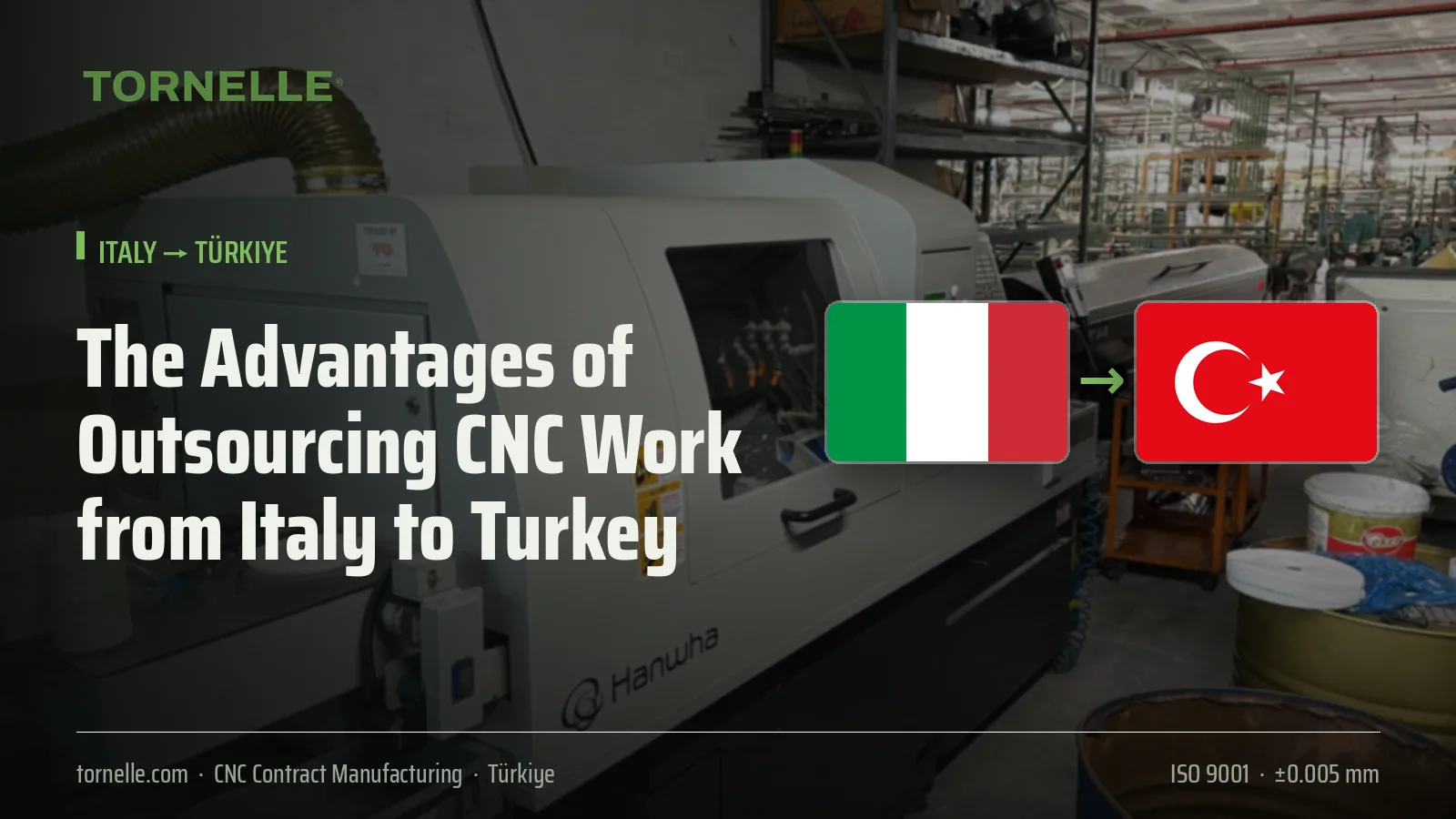
Italy is Europe’s second-strongest country in machinery manufacturing after Germany, specializing in packaging machinery, machine tools, hydraulics and pneumatics, agricultural machinery, the automotive supply industry, and design-oriented industrial products. Thousands of SMEs in Northern Italy—the heart of these sectors—have traditionally sourced turned and milled parts from local workshops. However, generational change, rising costs, and capacity constraints are driving Italian manufacturers to seek new sources. Turkey is the closest major alternative for Italy, both geographically and commercially.
1. Customs Union: Zero Customs Duty
Thanks to the EU–Turkey Customs Union, CNC parts manufactured in Turkey enter Italy duty-free (dazio) with an A.TR movement certificate. Italian importers only declare import VAT (IVA all’importazione); regular importers can offset this VAT. There are no customs duties or anti-dumping risks associated with sourcing from Asia. Details: Customs Union and A.TR Guide.
2. Geographical Proximity: 3–5 Business Days
The distance from Istanbul to Milan is approximately 1,900 km, and from Istanbul to Bologna is approximately 1,800 km. Shipments reach Northern Italy in 3–5 business days via regular road routes through the Balkans and Slovenia or via the Çeşme–Trieste Ro-Ro connection. Air freight from Istanbul to Milan/Bologna/Venice takes 1 day. Italy is one of the European markets that can be supplied most quickly from Turkey.
3. UNI EN ISO Standards and a Shared Engineering Culture
Italian technical drawings are based on UNI EN ISO standards (ISO 2768, ISO 1101, EN 10204)—a standard practice for Turkish suppliers. Italian material designations (e.g., AISI 304/316L, 39NiCrMo3, C40, Al 6082 / Anticorodal) align seamlessly with their European equivalents. Turkish and Italian machining cultures are quite similar: SME scale, flexibility, quick decision-making, and a practical engineering approach. Technical communication is conducted in English.
4. Cost Advantage
In Northern Italy, CNC machining costs have reached levels comparable to those in Germany; however, energy prices are among the highest in Europe. In Turkey, labor and overhead costs are significantly lower, and raw material prices are on a global level. Italian buyers typically see a total cost advantage of 25–40%—especially for labor-intensive, multi-operation parts. Low shipping costs (due to proximity) help maintain this advantage. Sample calculation: cost comparison.
5. Sectoral Alignment
- Packaging and food machinery (Emilia-Romagna “Packaging Valley”): Stainless steel turned/milled parts, shafts, cams, hygienic design.
- Hydraulics and pneumatics (Lombardy, Emilia): Valve bodies, pistons, fasteners — CNC lathe and sliding automatic machine parts.
- Machine tools and automation: Aluminum and steel housing parts, 5-axis milling.
- Automotive and motorcycle (Piedmont, Emilia): Precision aluminum and steel parts, PPAP experience.
- Agricultural machinery and fittings: Brass and steel turned parts.
6. Capacity and Flexibility
The capacity constraints faced by Italian SMEs in small-to-medium production runs are rarely encountered in Turkey. Flexible capacity—from prototypes to high-volume production runs—is offered under one roof, along with surface treatment and heat treatment. The CNC milling and turning fleet is scaled to meet European demands.
7. Time Zone and Transportation
Turkey is 1 hour ahead of Italy. The flight from Milan to Istanbul takes approximately 3 hours; there are also direct flights from Rome, Bologna, Venice, and Turin. A supplier visit can be completed in a single day.
Practical Notes for Italian Buyers
- Technical drawings in Italian are accepted; summarizing critical dimensions and acceptance criteria in English speeds up the process.
- Request a measurement report and an EN 10204 3.1 certificate with the first order.
- Select FCA Istanbul or DAP factory as the Incoterms; compare Ro-Ro and road transport options.
- Secure price guarantees through a “contratto quadro” (framework agreement) by sharing annual forecasts.
Frequently Asked Questions
Are customs duties paid on imports from Turkey?
No. Industrial products arriving with an A.TR certificate are exempt from customs duties under the Customs Union; only import VAT (IVA all’importazione) is declared.
Are AISI-standard materials available in Turkey?
Yes. AISI 304/316L (1.4301/1.4404), 39NiCrMo3 (≈1.6511), C40/C45, and 6082 aluminum are commonly stocked materials.
What is the lead time?
Production takes 1–2 weeks for prototypes and 3–6 weeks for mass production; shipping to Northern Italy takes 3–5 business days, and air freight takes 1 day.
How does the process of placing an order in Turkey work?
We’ve outlined the general steps in our comprehensive guide and our RFQ guide.
Conclusion
Outsourcing CNC machining from Italy to Turkey means duty-free, fast, and competitive sourcing from the closest non-European production hub. A shared engineering culture and industry alignment streamline the process. Send us your technical drawings and receive a quote within 24 hours.