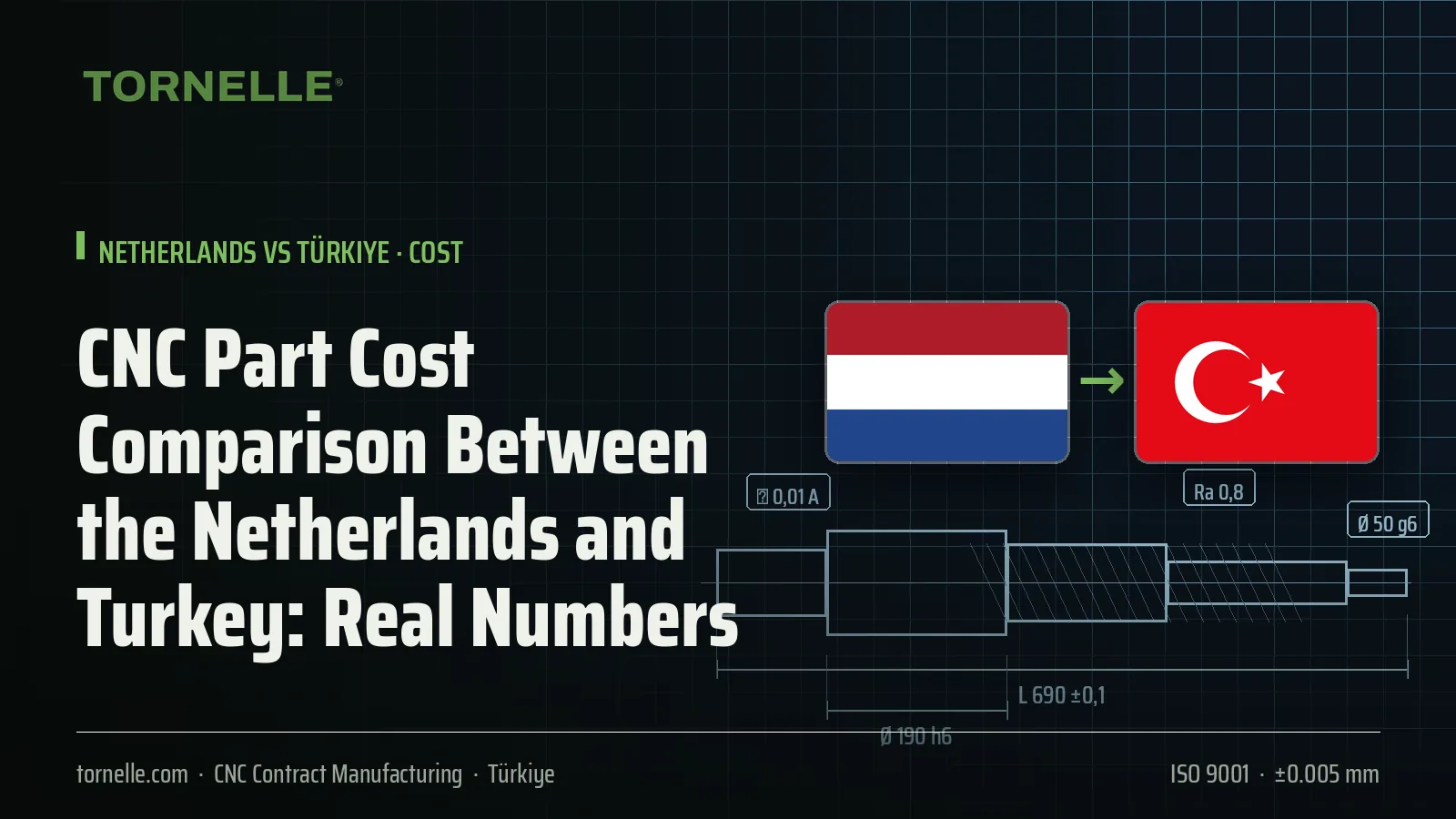
For Dutch buyers, the sourcing equation has two characteristics: demand for precision parts is high (the Eindhoven high-tech cluster, Twente, Rotterdam maritime), while domestic CNC capacity is tight and expensive. This article is the Netherlands version of our Germany comparison and adds numbers to our Netherlands advantages article. The figures are typical values reflecting 2025–2026 market conditions; they vary by supplier and part.
Line-by-Line Comparison
| Item | Netherlands | Turkey | Difference |
|---|---|---|---|
| CNC turning hourly rate (3-axis) | €65–85 | €28–40 | ≈ 50–55% lower |
| CNC milling hourly rate (3-axis) | €70–95 | €30–45 | ≈ 50–55% lower |
| 5-axis milling hourly rate | €95–135 | €45–65 | ≈ 50% lower |
| Swiss-type turning hourly rate | €60–80 | €25–38 | ≈ 55% lower |
| Programming / set-up (hour) | €75–95 | €30–45 | ≈ 55% lower |
| Raw material (steel, aluminium, stainless) | Market | Market (±5%) | Similar |
| Industrial electricity (kWh) | €0.15–0.22 | €0.10–0.14 | ≈ 35% lower |
| Coating / heat treatment | Market | 20–35% lower | Medium |
| Freight to the Netherlands (share of part value) | 0.5–1% (domestic) | 2–4% (road 5–6 days; sea 12–16 days) | Higher for Turkey |
| Customs duty | — | 0% (A.TR) | None |
| Customs clearance (per shipment) | — | €40–80 | Fixed, small |
| Import BTW (21%) | Domestic BTW | Offset in the return with an Article 23 licence; no cash effect | Neutral |
Dutch hourly rates are in the same band as Germany's; lead times are long due to the shortage of skilled operators. The difference to Turkey is typically 50–55%.
Example 1: Precision-Milled Aluminium Housing (High-Tech Equipment)
EN AW-6082 T6, 200×120×45 mm, 3-axis milling in 4 set-ups, 24 holes, 8 threads, ±0.02 position tolerances, flatness 0.02; black anodising; inspection report (CMM); quantity 100.
| Netherlands | Turkey | |
|---|---|---|
| Raw material | €11.50 | €11.90 |
| Machine + labour (55 min) | €76.00 | €34.50 |
| Set-up/programming (per piece) | €7.50 | €3.40 |
| Anodising | €4.80 | €3.30 |
| Quality/CMM report | €4.50 | €3.20 |
| Overhead + margin | €19.00 | €10.00 |
| Ex-works price | €123.30 | €66.30 |
| Freight + customs clearance | €0.80 | €2.40 |
| Delivered cost | €124.10 | €68.70 |
Saving: ≈ 45%. A low-quantity precision housing with long machining time; a typical part of the Dutch high-tech supply chain. For tight-tolerance capability, see our tolerance article.
Example 2: Turned Stainless Steel Food Machinery Part
1.4404, Ø30×60 mm, turning + milling (2 flat faces, 4 holes), Ra 0.8 on all surfaces, electropolishing; 3.1 certificate; quantity 1,000.
| Netherlands | Turkey | |
|---|---|---|
| Raw material | €2.60 | €2.70 |
| Turning + milling (7 min) | €9.00 | €4.10 |
| Electropolishing | €1.40 | €0.95 |
| Set-up/programming | €0.45 | €0.20 |
| Quality/report/3.1 | €0.50 | €0.35 |
| Overhead + margin | €3.50 | €1.80 |
| Ex-works price | €17.45 | €10.10 |
| Freight + customs clearance | €0.10 | €0.35 |
| Delivered cost | €17.55 | €10.45 |
Saving: ≈ 40%. Although the stainless raw material share is high, the machining time is significant; material details are in our stainless steel guide.
Logistics: Road or Sea?
There are two realistic options for the Netherlands: road (5–6 working days, weekly groupage) and Istanbul–Rotterdam container (12–16 days port to port, 40–60% lower unit cost for heavy and bulky loads). For regular volumes above 2 tonnes per month, sea freight plus domestic distribution from Rotterdam reduces the freight share to 1–2%. Air freight or courier for samples takes 1–3 days. Details are in our logistics guide.
Total Cost of Ownership: The Hidden Items
- Inventory and capital: 1–2 weeks of additional safety stock by road, 3–4 weeks by sea; 0.3–1% of part value.
- Customs management: €40–80 per shipment; with an Article 23 licence there is no BTW cash outflow (without the licence it is paid at customs and reclaimed in the return).
- Capacity and lead time: 8–14 weeks of waiting is common in the Netherlands; 3–6 weeks in Turkey.
- Quality risk: Equivalent with the right quality system; 1–2 weeks for corrective action in case of a complaint.
Result: for labour-intensive parts, the total cost of ownership saving is typically 35–45%; the method is described in our TCO article.
Where the Saving Remains Low
- Large, simple parts where the raw material share exceeds 60%;
- Very low-quantity (1–5) prototypes, where set-up and freight dominate;
- Parts requiring daily JIT delivery;
- Semiconductor parts requiring clean-room assembly and sub-micron tolerances (specialist supplier domain).
Frequently Asked Questions
How much cheaper are CNC parts from Turkey for the Netherlands?
Typically 35–45% for labour-intensive parts, including freight and customs clearance; 10–20% for material-heavy simple parts.
How do customs duty and BTW work?
Customs duty is zero under A.TR; companies with an Article 23 licence do not pay import BTW at customs but declare it in the VAT return and deduct it in the same return. Details are in our A.TR guide.
When does sea freight make sense?
For regular volumes above 2 tonnes or 3–4 pallets per month; the lead time rises to 3–4 weeks and the freight cost halves.
Can I get numbers for my own part?
Yes. Send your technical drawing with the information in our RFQ guide; you will receive a comparable quote within 24 hours.
Conclusion
The CNC part cost difference between the Netherlands and Turkey comes from machine hours and labour; because customs duty is zero under A.TR and BTW is neutral under Article 23, the saving reaches the buyer, and sea freight via Rotterdam reduces the freight share further at regular volumes. A total saving of 35–45% on labour-intensive parts is a realistic expectation. To see the real numbers for your own parts, send us your technical drawings.