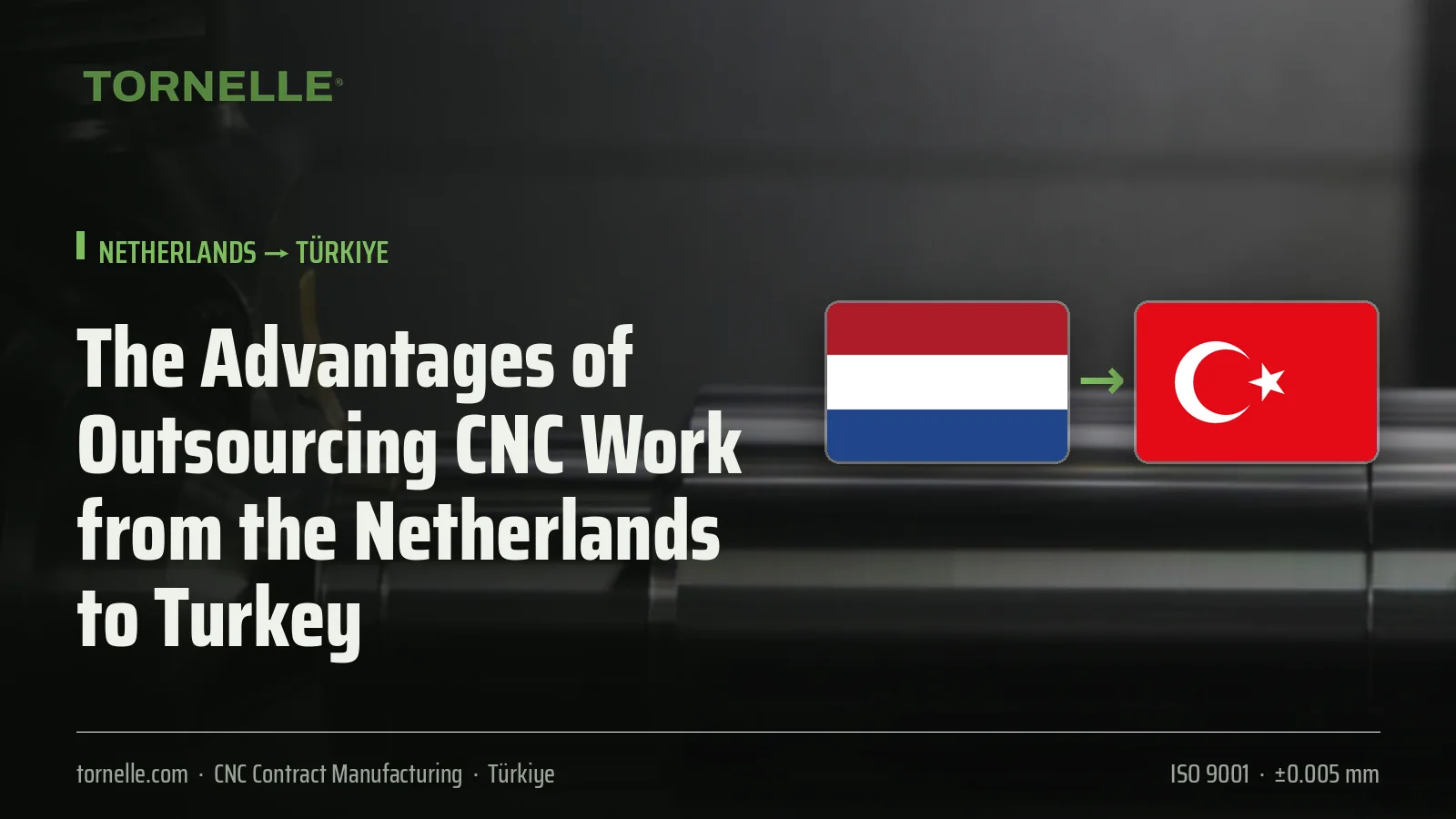
The Netherlands boasts one of Europe’s most concentrated high-tech manufacturing clusters relative to its population: the semiconductor equipment and precision mechanical ecosystem around Eindhoven, the machine manufacturers in the Twente region, and the robust agricultural-food machinery and maritime sectors. A common characteristic of these sectors is their constant need for CNC parts with tight tolerances and high-quality standards. In this environment, where local capacity is limited and expensive, Turkey is increasingly becoming a preferred nearshoring destination for Dutch buyers.
1. Zero Customs Duties Under the Customs Union
Industrial products manufactured in Turkey enter the Netherlands duty-free under the EU–Turkey Customs Union with an A.TR movement certificate. Dutch importers can declare and offset the import VAT on their VAT return without paying it at customs by using the “artikel 23 vergunning” (permit for deferral of import VAT). This is one of the most practical advantages offered by the Netherlands as Europe’s logistics gateway. For details, see our Customs Union guide.
2. Delivery in 4–5 Business Days by Road
The distance between Istanbul and Rotterdam or Istanbul and Eindhoven is approximately 2,700 km. Parts are delivered in 4–5 business days via regular road transport routes through the Balkan corridor. For urgent parts, air cargo via direct flights from Istanbul to Amsterdam takes 1–2 days. Instead of waiting 5–7 weeks for sea freight from Asia to Rotterdam, delivery in less than a week reduces inventory and allows engineering changes to be quickly incorporated into production.
3. Capacity Suitable for High-Precision Requirements
The expectations of the Dutch high-tech supply chain—micron-level tolerances, cleanliness requirements, and comprehensive measurement documentation—are met by export-oriented suppliers in Turkey:
- High-volume parts with ±0.005 mm tolerances in the Ø1–32 mm range using a sliding automatic machine;
- Aluminum and stainless steel housings, as well as optical-mechanical components, produced on 5-axis milling machines;
- CMM measurement reports, surface roughness measurements, and traceable material certificates;
- Clean packaging and corrosion protection standards.
4. Cost Advantage
In the Netherlands, hourly costs for CNC machining are above the European average due to high labor and energy costs; finding qualified CNC operators is becoming increasingly difficult. In Turkey, labor and overhead costs are significantly lower, while raw material prices are global. As a result, Dutch buyers typically see a total cost advantage of 30–45%—especially for labor-intensive, multi-operation, and tight-tolerance parts. For a line-by-line breakdown, please refer to our Germany–Turkey cost comparison; the ratios are similar for the Netherlands.
5. Standards and Communication
The Dutch industry uses NEN-EN-ISO standards; these are identical to the ISO 2768, ISO 1101, and EN 10204 standards used throughout Europe and are standard practice for Turkish suppliers. Technical communication is conducted in English—the language preferred by Dutch engineers as well. Dutch notes in technical drawings (“algemene toleranties,” “scherpe kanten breken”) do not pose a problem, as they are standard terms.
6. Industry Compliance
- High-tech and semiconductor equipment: Precision parts made of aluminum, stainless steel, and engineering plastics (POM, PEEK);
- Agricultural and food machinery: Turned and milled stainless steel parts, hygienic design;
- Marine and offshore: Duplex and super duplex stainless steel, bronze parts;
- Water technologies and pumps: Valve bodies, shafts, flanges;
- Automation and robotics: Brackets, shafts, gear housings;
7. Time Zone and Transportation
Turkey is 1 hour ahead of the Netherlands; business days overlap almost completely. The flight from Amsterdam to Istanbul takes approximately 3.5 hours, and there are numerous direct flights daily. Supplier audits can be conducted in a single-day visit.
Practical Notes for Dutch Buyers
- If you do not have an Article 23 permit, consult with your customs broker to evaluate the application; it offers a cash advantage on import VAT.
- Request a measurement report and a 3.1 certificate with your first order.
- Select FCA Istanbul or DAP factory as the Incoterms.
- Share your annual forecast to secure price and capacity guarantees through a raamovereenkomst (framework agreement).
Frequently Asked Questions
Is customs duty paid on imports from Turkey?
No. Industrial products imported with an A.TR certificate are exempt from duties under the Customs Union; import VAT is offset on the customs declaration under Article 23 authorization.
Are tolerances at the micron level possible?
Yes. Tolerances of ±0.005 mm or less are achieved through a combination of sliding automatic machines and precision grinding, and are documented with a CMM report.
What is the delivery time?
1–2 weeks for prototypes, 3–6 weeks for mass production; 4–5 business days by road to the Netherlands, 1–2 days by air freight.
How does the process begin?
We’ve outlined the steps in our article titled “How to Outsource CNC Machining from the Netherlands to Turkey.”
Conclusion
For the Netherlands’ high-tech and machinery industries, Turkey offers a combination of duty-free trade, delivery in less than a week, precision machining capabilities, and competitive pricing. Send us your technical drawings and receive a quote within 24 hours.