Blog
Technical insights, industry news and engineering tips from the world of CNC machining.
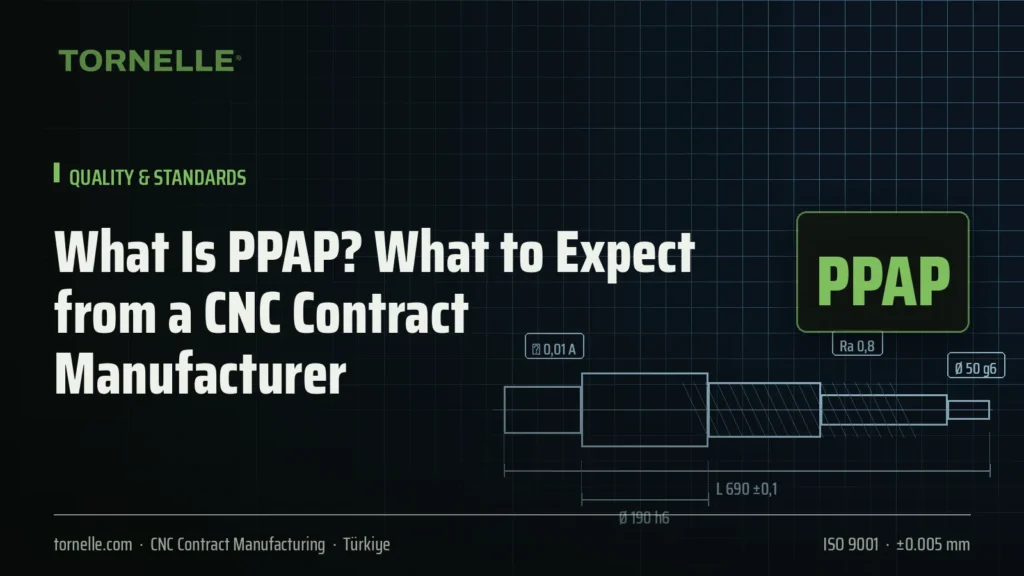
What Is PPAP? What to Expect from a CNC Contract Manufacturer
In the automotive supply chain, a CNC part's transition to series production depends on approval of the PPAP (Production Part Approval Process) file. This article explains the 18 elements of PPAP, the 5 submission levels, which documents the machining subcontractor prepares, Cpk/Ppk expectations and the difference from VDA 2 (PPF) used in Germany, from the perspective of a buyer and a quality engineer.
Quality Read more
How to Outsource CNC Machining from Switzerland to Turkey: Step-by-Step Process
As a Swiss medical, machinery or precision-mechanics manufacturer, placing your first CNC subcontracting order in Turkey is easier than you might think. This guide walks through the process step by step, from preparing technical documents and the RFQ to evaluating quotes, from sample approval to the EFTA Free Trade Agreement and Swiss customs procedures, from VAT (MWST) to Incoterms and payment terms.
Switzerland Read more
Nearshoring vs Offshoring: Total Cost of Ownership for CNC Parts
A CNC part quote from the Far East may look 20% cheaper on unit price; but once freight, customs duty, 8 weeks of in-transit stock, safety stock, quality risk, revision cycles and travel costs are added, the picture changes. This article adapts the total cost of ownership (TCO) model to CNC parts, shows how each item is calculated and compares nearshore sourcing from Turkey with offshore sourcing from Asia using a concrete example.
Cost Read more
How to Outsource CNC Machining from Italy to Turkey: Step-by-Step Process
As an Italian machine builder or supplier, placing your first CNC subcontracting order in Turkey is easier than you might think. This guide walks through the process step by step, from preparing technical documents and the RFQ to evaluating quotes, from sample approval to duty-free import under A.TR, from the Çeşme–Trieste Ro-Ro and road-freight options to Italian payment habits.
Italy Read more
What Does Surface Roughness (Ra, Rz) Mean in CNC Manufacturing?
The surface roughness symbol on technical drawings is the second line after tolerance that affects cost the most, and one of the most misunderstood. This article explains the difference between Ra and Rz, the old N grades and Rmax, which Ra value is routine in CNC turning and milling, the cost gap between Ra 0.8 and Ra 0.4, how measurement is carried out and how to specify the surface requirement correctly on the drawing.
Quality Read more
CNC Contract Manufacturing in Turkey for EU Companies: An Overview
Turkey is one of the European Union's largest industrial suppliers and the only major non-EU manufacturing country with duty-free access to the EU market thanks to the Customs Union. This overview summarises, in a single article, the commercial framework, cost structure, quality and standards alignment, logistics times, differences between countries and how to start a first order for manufacturers in the EU's 27 member states; it serves as an introduction to our country guides.
EU Read more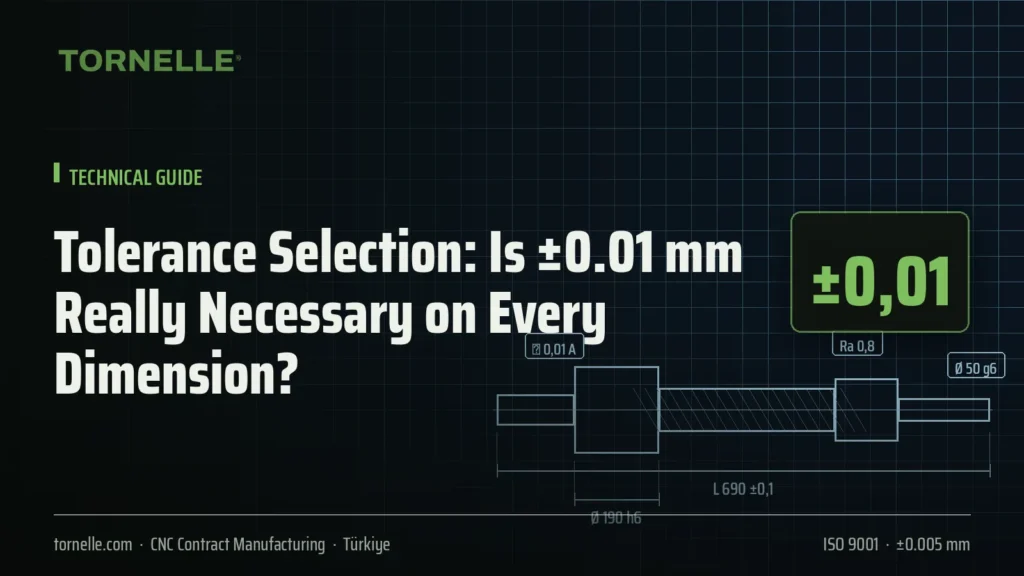
Tolerance Selection: Is ±0.01 mm Really Necessary on Every Dimension?
The most expensive line on a technical drawing is often the tolerance line: writing ±0.01 mm instead of ±0.1 mm can double the price of a part without changing its function. This article explains why cost rises exponentially as tolerances tighten, which machine and measuring infrastructure the different tolerance bands require, how to determine the functional tolerance and what realistic tolerance values are for turned and milled parts.
Technical Read more
Advantages of Outsourcing CNC Machining from Hungary to Turkey
With the Audi, Mercedes-Benz, BMW and Suzuki plants, rapidly built battery factories and a strong electronics and medical industry, Hungary is one of Central Europe's dense manufacturing hubs; but a labour shortage and the limits of local subcontracting capacity are forcing suppliers to look for new sources. With 3–4-day road freight, duty-free supply under A.TR, the same standards and flexible series capacity, Turkey is a strong alternative for Hungarian manufacturers.
Hungary Read more
Brass Turned Parts: CuZn39Pb3 (MS58 / CW614N) and Swiss-Type Turning
Fittings, couplings, valve parts, connectors and sensor housings: a large share of the world's turned parts is made from CuZn39Pb3 (MS58 / CW614N) brass. This article explains the properties of free-machining brass, why it machines so efficiently on Swiss-type lathes, lead restrictions (RoHS, drinking water) and lead-free alternatives, plating options and the factors that determine the price when sourcing brass turned parts from Turkey.
Material Read more